2025年第二季度英国酒店仪表板
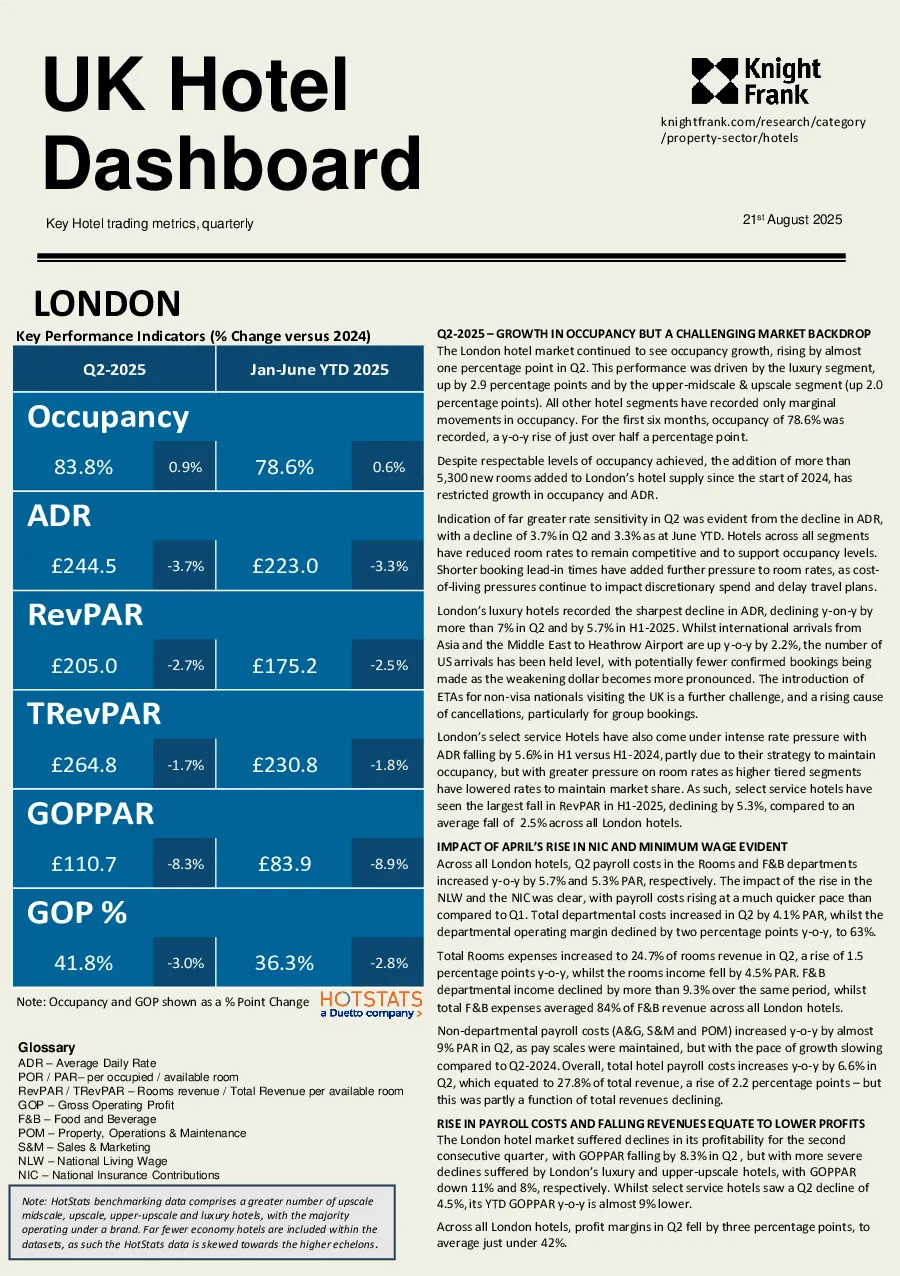
21stAugust2025 Key Hotel trading metrics, quarterly LONDON The London hotel market continued to see occupancy growth, rising by almostone percentage point in Q2. This performance was driven by the luxury segment,up by 2.9 percentage points and by the upper-midscale & upscale segment (up 2.0percentage points). All other hotel segments have recorded only marginalmovements in occupancy. For the first six months, occupancy of 78.6% wasrecorded, a y-o-y rise of just over half a percentage point. Despite respectable levels of occupancy achieved, the addition of more than5,300 new rooms added to London’s hotel supply since the start of 2024, hasrestrictedgrowthinoccupancyandADR. Indication of far greater rate sensitivity in Q2 was evident from the decline in ADR,with a decline of 3.7% in Q2 and 3.3% as at June YTD. Hotels across all segmentshave reduced room rates to remain competitive and to supportoccupancylevels.Shorter booking lead-in times have added further pressure to room rates, as cost-of-living pressures continue to impact discretionary spend and delay travel plans. London’s luxury hotels recorded the sharpest decline in ADR, declining y-on-y bymore than 7% in Q2 and by 5.7% in H1-2025. Whilst international arrivals fromAsia and the Middle East to Heathrow Airport are up y-o-y by 2.2%, the number ofUS arrivals has been held level, with potentially fewer confirmed bookings beingmade as the weakening dollar becomes more pronounced. The introduction ofETAs for non-visa nationals visiting the UK is a further challenge, and a rising causeof cancellations, particularly for group bookings. London’s select service Hotels have also come under intense rate pressure withADR falling by 5.6% in H1 versus H1-2024, partly due to their strategy to maintainoccupancy, but with greater pressure on room rates as higher tiered segmentshave lowered rates to maintain market share. As such, select service hotels haveseen the largest fall in RevPAR in H1-2025, declining by 5.3%, compared to anaverage fall of 2.5% across all London hotels. IMPACT OF APRIL’S RISE IN NIC AND MINIMUM WAGE EVIDENT Across all London hotels, Q2 payroll costs in the Rooms and F&B departmentsincreased y-o-y by 5.7% and 5.3% PAR, respectively. The impact of the rise in theNLW and the NIC was clear, with payroll costs rising at a much quicker pace thancompared to Q1. Total departmental costs increased in Q2 by 4.1% PAR, whilst thedepartmental operating margin declined by two percentage points y-o-y, to 63%. Total Rooms expenses increased to 24.7% of rooms revenue in Q2, a rise of 1.5percentage points y-o-y, whilst the rooms income fell by 4.5% PAR. F&Bdepartmental income declined by more than 9.3% over the same period, whilsttotal F&B expenses averaged 84% of F&B revenue across all London hotels. Non-departmental payroll costs (A&G, S&M and POM) increased y-o-y by almost9% PAR in Q2, as pay scales were maintained, but with the pace of growth slowingcompared to Q2-2024. Overall, total hotel payroll costs increases y-o-y by 6.6% inQ2, which equated to 27.8% of total revenue, a rise of 2.2 percentage points–butthis was partly a function of total revenues declining. GlossaryADR–Average Daily Rate POR / PAR–per occupied / available roomRevPAR / TRevPAR–Rooms revenue / Total Revenue per available roomGOP–Gross Operating ProfitF&B–Food and BeveragePOM–Property, Operations & MaintenanceS&M–Sales & MarketingNLW–National Living WageNIC–National Insurance Contributions RISE IN PAYROLL COSTS AND FALLING REVENUES EQUATE TO LOWER PROFITS The London hotel market suffered declines in its profitability for the secondconsecutive quarter, with GOPPAR falling by 8.3% in Q2 , but with more severedeclines suffered by London’s luxury and upper-upscale hotels, with GOPPARdown 11% and 8%, respectively. Whilst select service hotels saw a Q2 decline of4.5%, its YTD GOPPAR y-o-y is almost 9% lower. Note:HotStatsbenchmarking data comprises a greater number of upscalemidscale, upscale, upper-upscale and luxury hotels, with the majorityoperating under a brand. Far fewer economy hotels are included within thedatasets, as such theHotStatsdata is skewed towards the higher echelons. Across all London hotels, profit margins in Q2 fell by three percentage points, toaverage just under 42%. London–Hotel KPIs Departmental Metrics LONDON Regional UK knightfrank.com/research/category/property-sector/hotels MIXED MESSAGES Whilst the headline number for Regional UK shows y-o-y occupancy flat, acrossmost segments there was a downward turn. Regional upscale and upper-upscalehotels suffered the biggest declines, with occupancy down by more than twoand 3 percentage points, respectively. Yet, with continued inflationary pressuresand the recent hikes in staff costs, a rate-driven strategy has led to modestgrowth in their ADR, which helped counter the fall in occupancy. Meanwhile, Regional UK’s top 12 city centres recorded a surprise uplift in Q2occupancy, rising by 1.5 percentage