AI智能总结
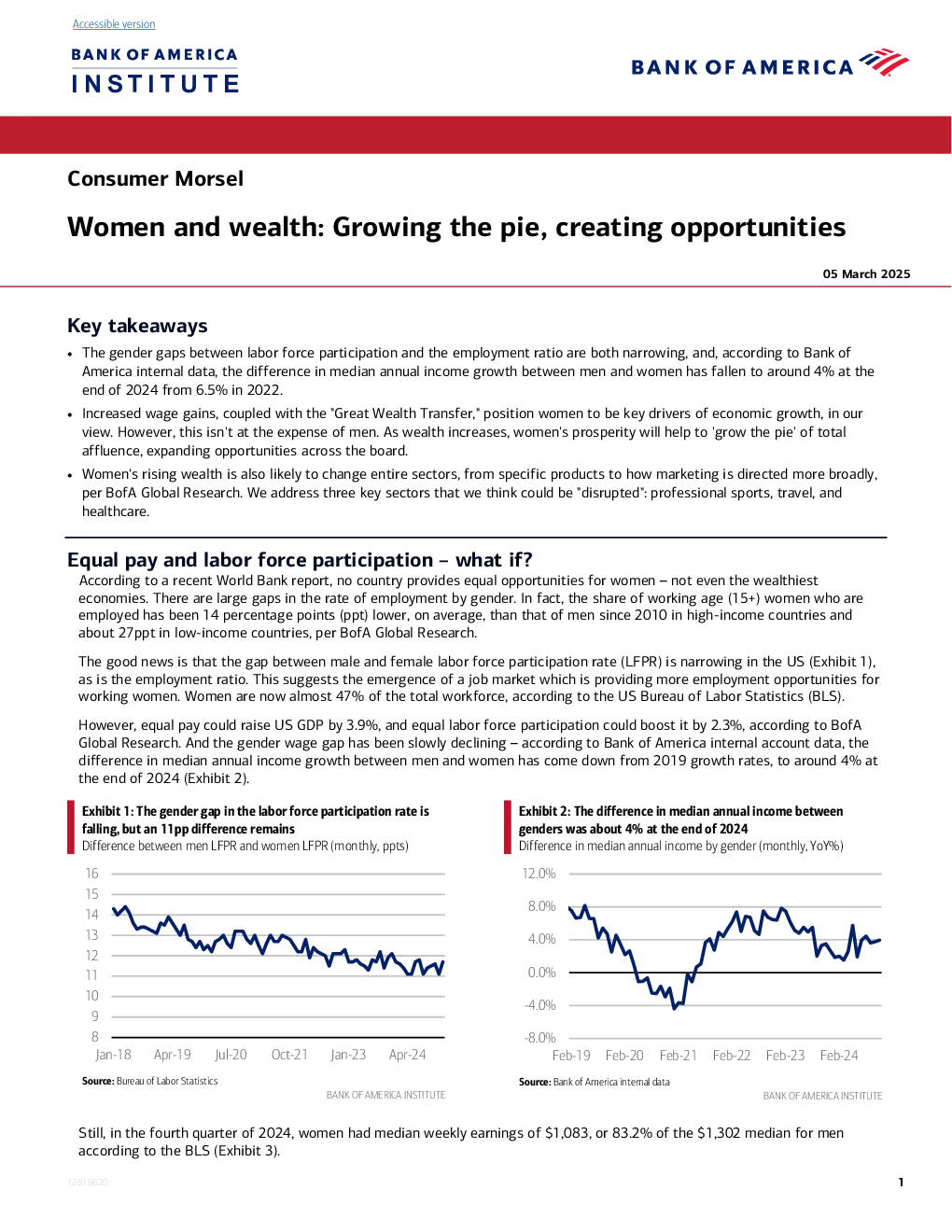
Women and wealth: Growing the pie, creating opportunities 05 March 2025 Key takeaways •The gender gaps between labor force participation and the employment ratio are both narrowing, and, according to Bank ofAmerica internal data, the difference in median annual income growth between men and women has fallen to around 4% at theend of 2024 from 6.5% in 2022. •Increased wage gains, coupled with the "Great Wealth Transfer," position women to be key drivers of economic growth, in ourview. However, this isn't at the expense of men. As wealth increases, women's prosperity will help to 'grow the pie' of totalaffluence, expanding opportunities across the board. •Women's rising wealth is also likely to change entire sectors, from specific products to how marketing is directed more broadly,per BofA Global Research. We address three key sectors that we think could be "disrupted": professional sports, travel, andhealthcare. Equal pay and labor force participation – what if?According to a recent World Bank report, no country provides equal opportunities for women–not even the wealthiest economies.There are large gaps in the rate of employment by gender. In fact, the share of working age (15+) women who areemployed has been 14 percentage points (ppt) lower, on average, than that of men since 2010 in high-income countries andabout 27ppt in low-income countries, per BofA Global Research. The good news is that the gap between male and female labor force participation rate (LFPR) is narrowing in the US (Exhibit 1),as is the employment ratio. This suggests the emergence of a job market which is providing more employment opportunities forworking women. Women are now almost 47% of the total workforce, according to the US Bureau of Labor Statistics (BLS). However, equal pay could raise US GDP by 3.9%, and equal labor force participation could boost it by 2.3%, according to BofAGlobal Research. And the gender wage gap has been slowly declining–according to Bank of America internal account data, thedifference in median annual income growth between men and women has come down from 2019 growth rates, to around 4% atthe end of 2024 (Exhibit 2). Exhibit1:The gender gap in the labor force participation rate isfalling, but an 11pp difference remainsDifference between men LFPR and women LFPR (monthly, ppts) Exhibit2:The difference in median annual income betweengenders was about 4% at the end of 2024Difference in median annual income by gender (monthly, YoY%) Still, in the fourth quarter of 2024, women had median weekly earnings of $1,083, or 83.2% of the $1,302 median for menaccording to the BLS (Exhibit 3). The gender gap in pay increases as women get older. In fact, women 16 to 24 years old earned 90.6% as much as men in thesame age group, but that gap is approximately 81% for those who are 35 to 54 years old, often when some are reaching thepeak earning years of their careers. The gap is 76% for those aged 55 to 64 years old. Exhibit3:Among women and men, weekly earnings were highest for workers ages 35 to 44 years old, but there’s a 20 percentage pointgender pay gapMedian usual weekly earnings of full-time wage and salary workers by age and sex (current dollars, fourth quarter 2024, not seasonally adjusted) Estimating the economic impact under three scenariosRecently, BofA Global Research illustrated the economic impact of labor market equality on the European Union (EU), United Kingdom (UK) and US economies–three high-income countries–under three scenarios (Exhibit 4). •Scenario #1:How much could we gain from closing the employment gap? If working-age women had the same labor forceparticipation rate as men, assuming workers earned the current average earnings, it could generate an additional $1.1 trillion(tn) (or ~4% of GDP) in labor compensation per year in the US. •Scenario #2:Gender wage gaps contribute directly to higher levels of income inequality and poverty. Closing the genderwage gap could provide an additional $866 billion (bn) in labor compensation per year in the US. •Scenario #3:Finally, closing both the gender employment and wage gaps could generate an additional $2.1tn (~7.5% of GDP)in the US and $1.1tn (~4% of GDP) in the EU and $260bn (6.5% of GDP) in the UK, respectively. This totals $3.5tn, just fromthese three economies. These estimates are a simple illustration of the cost of the employment and wage gap alone. Costs are likely to be greater if weconsider gaps in employment opportunities (education, health, financial inclusion) due to gender biases. One study finds that if more women were in the workforce and in management in Organization for Economic Cooperation andDevelopment (OECD) countries, $7tn could be added to the global economy.1Another study indicates that achieving gender parityin employment and pay could unlock as much as a 20% increase in global GDP per capita.2These estimates show that the cost ofinequality is high. Even without pay parity, wealth is tilting femaleAn estimated $