AI智能总结
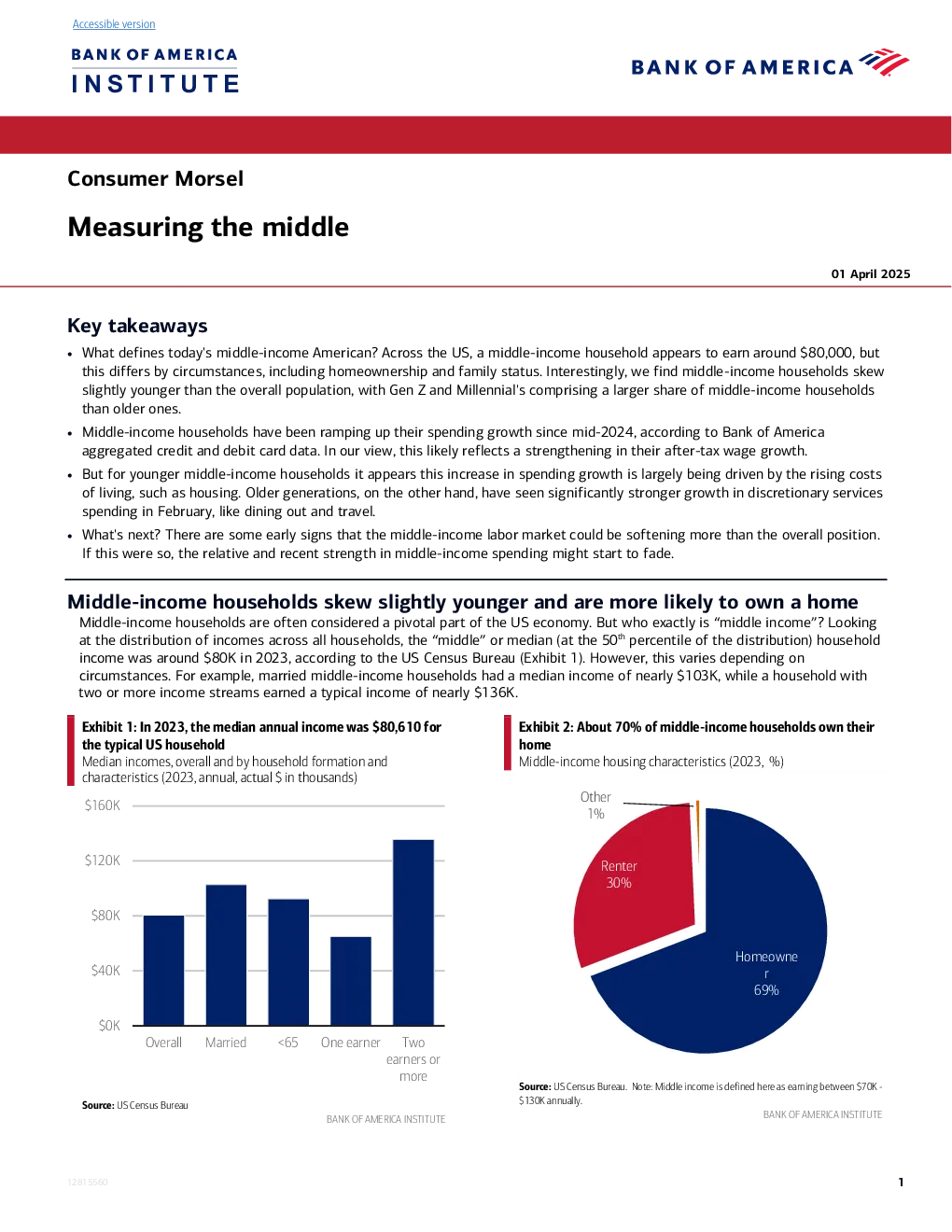
Measuring the middle Key takeaways •What defines today's middle-income American? Across the US, a middle-income household appears to earn around $80,000, butthis differs by circumstances, including homeownership and family status. Interestingly, we find middle-income households skewslightly younger than the overall population, with Gen Z and Millennial's comprising a larger share of middle-income householdsthan older ones. •Middle-income households have been ramping up their spending growth since mid-2024, according to Bank of Americaaggregated credit and debit card data. In our view, this likely reflects a strengthening in their after-tax wage growth. •But for younger middle-income households it appears this increase in spending growth is largely being driven by the rising costsof living, such as housing. Older generations, on the other hand, have seen significantly stronger growth in discretionary servicesspending in February, like dining out and travel. •What's next? There are some early signs that the middle-income labor market could be softening more than the overall position.If this were so, the relative and recent strength in middle-income spending might start to fade. Middle-income households skew slightly younger and are more likely to own a homeMiddle-income households are often considered a pivotal part of the US economy. But who exactly is“middle income”? Looking at the distribution of incomes across all households, the“middle”or median (at the 50thpercentile of the distribution) householdincome was around $80K in 2023, according to the US Census Bureau (Exhibit 1). However, this varies depending oncircumstances. For example, married middle-income households had a median income of nearly $103K, while a household withtwo or more income streams earned a typical income of nearly $136K. Exhibit2:About70% of middle-income households own theirhomeMiddle-income housing characteristics (2023,%) Exhibit1:In 2023, the median annual income was $80,610 forthe typical US householdMedian incomes, overall and by household formation and characteristics (2023, annual, actual $ in thousands) When we dive deeper and use roughly this range of incomes, we find that about 70% of middle-income households arehomeowners, while 30% rent (Exhibit 2). Additionally, middle-income households tend to skew slightly younger–nearly 40% arebetween 25 and 44 years old (Exhibit 3). But looking in 10-year increments, we can see that people aged 25 to 34 years old onlymake up a slightly larger share of middle-income households than most other age groups. Share of middle-income households by age (2023, %) Middle-income households continued their forward spending momentum in FebruaryAccording to data from the Bureau of Labor Statistics (BLS), the middle 40% of households by income contributed about 34% of total annual spending in 2023 (Exhibit 4). Using Bank of America aggregated credit and debit card data, we find that the middle-income tercile’s spending growth per household is not as high as it was two years ago but has accelerated the most of anyincome cohort since mid-2024, and was up nearly 2% year-over-year (YoY) this February (Exhibit 5). Exhibit4: The middle 40% of US households by income decilecontributed 34% to annual spending in 2023Contribution share to annual consumer expenditures by income Exhibit5:Spending growth for middle-and higher-incomehouseholds was stronger in February, up around 2% YoY, whileit has lagged slightly for lower-income households, up nearly1.3% YoYTotal credit and debit card spending per household, by household decile (2023, %) income terciles (3-month moving average, YoY%, seasonally adjusted(SA)) The labor market supports middle-income households’ spending gainsIn our view, the acceleration in middle-income spending growth seen since the middle of 2024 is likely due to an improvement in their wage growth. Bank of America internal data on after-tax average wage growth shows that it was up a little over 3% YoY inFebruary–an important trend over the past year for the middle-income cohort. Meanwhile, after-tax wage growth has continuedto ease for those with lower incomes (Exhibit 6). However, while there has been a recovery in middle-income household wage growth since the middle of 2024, the cumulativeincrease in middle-income wage levels since the pandemic has not kept up with rising prices (Exhibit 7). This is in contrast withlower-income households, whose average wage growth has kept up with, and even surpassed, the rate of inflation. Exhibit7: Unlike lower-income households, middle-incomewage growth has not kept up with inflation, despite havingincreased 19.5% compared to 2019After-tax wage and salary growth by household income terciles, Exhibit6: Average wage growth was up 3.1% YoY for middle-income householdsAfter-tax wage and salary growth by household income terciles, based on Bank of America aggregated consumer deposit data(February 2025, 3-month moving average, YoY%, S