AI智能总结
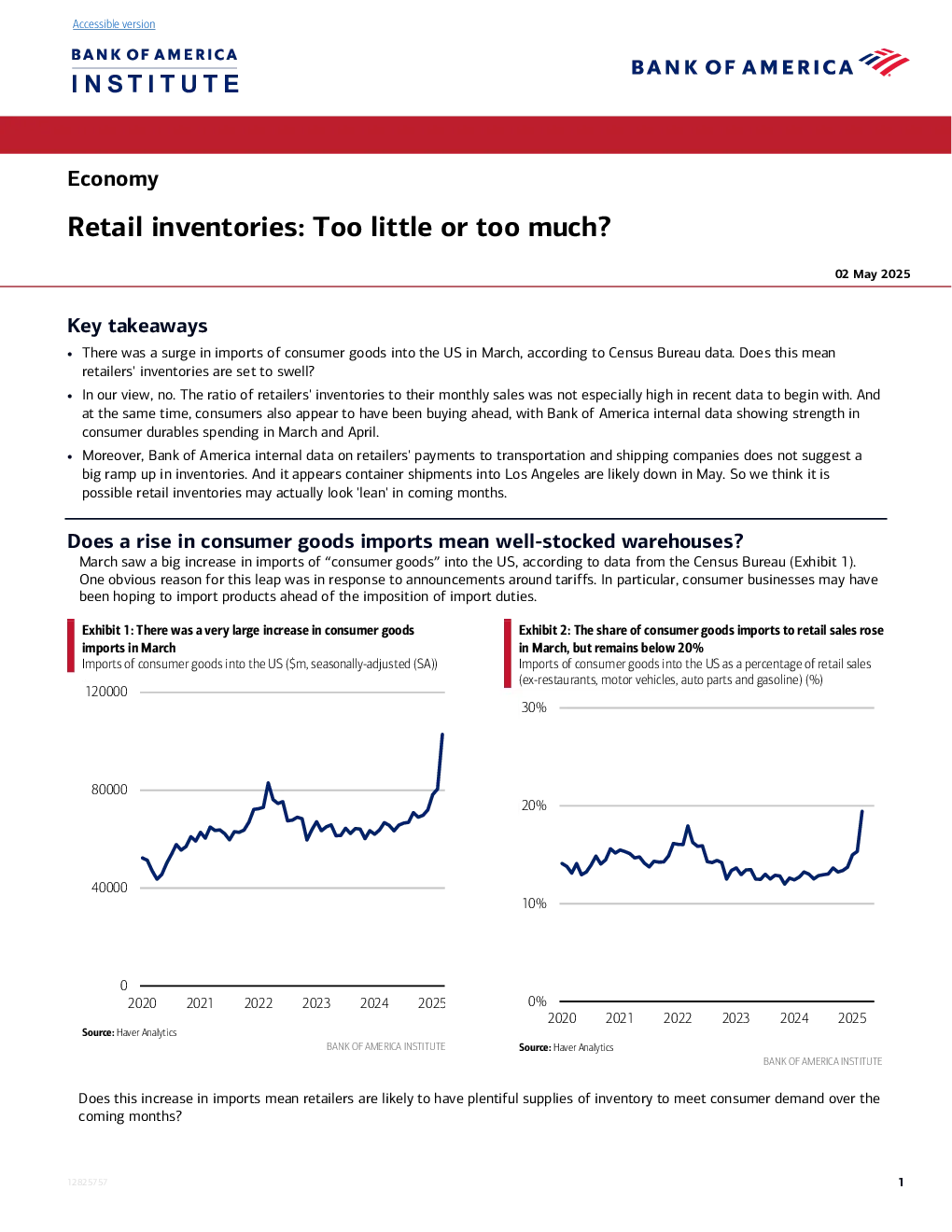
Retail inventories: Too little or too much? 02 May 2025 Key takeaways •There was a surge in imports of consumer goods into the US in March, according to Census Bureau data. Does this meanretailers' inventories are set to swell? •In our view, no. The ratio of retailers' inventories to their monthly sales was not especially high in recent data to begin with. Andat the same time, consumers also appear to have been buying ahead, with Bank of America internal data showing strength inconsumer durables spending in March and April. •Moreover, Bank of America internal data on retailers' payments to transportation and shipping companies does not suggest abig ramp up in inventories. And it appears container shipments into Los Angeles are likely down in May. So we think it ispossible retail inventories may actually look 'lean' in coming months. Does a rise in consumer goods imports mean well-stocked warehouses?March saw a big increase in imports of“consumer goods”into the US, according to data from the Census Bureau (Exhibit 1). One obvious reason for this leap was in response to announcements around tariffs. In particular, consumer businesses may havebeen hoping to import products ahead of the imposition of import duties. Exhibit2:The share of consumer goodsimports to retail salesrosein March, but remains below 20%Imports of consumer goods into the US as a percentage of retail sales Exhibit1:There was a very largeincreasein consumer goodsimports in MarchImports of consumer goods into the US ($m, seasonally-adjusted (SA)) (ex-restaurants, motor vehicles, auto parts and gasoline) (%) Does this increase in imports mean retailers are likely to have plentiful supplies of inventory to meet consumer demand over thecoming months? We would be a little skeptical. For one, consumer goods imports usually account for around 15% or so of monthly retail sales(Exhibit 2). And, while the rise in this share is significant, it remains modest overall–below 20%. So, imports alone won’t meetconsumer demand in coming months. Moreover, when we look at the level of retailers’inventories relative to their monthly sales, it was lower in March 2025 than itwas on average during 2015-2019, according to data from the Census Bureau (Exhibit 3). Even if the surge in imports takes awhile to find its way into retail inventories, the increase might not do much more than take the retail inventory/sales ratio backto around pre-Covid averages. Exhibit3:Relative to theperiod 2015-2019, retailinventories looked fairly lean headinginto the uncertainty caused by tariffsRetail inventory to sales ratio (monthly, seasonally-adjusted (SA)). Dotted lines are 2015-2019 averages. Many retailers work with relatively thin inventoriesDoes any of this matter? Well, the amount of inventory retailers hold relative to their sales will be a determinant of how well they can weather any demand or supply disruptions. In fact,Exhibit 4shows that as of March 2025, many retailers only haveone- or two-months’worth of sales in inventory. This means unforeseen demand or supply disruptions can quickly impact whatgoods retailers can supply and/or the price they will charge. Exhibit4:Manycategories of retailerhaveonlytwomonths orless of inventoriesRetail inventory to sales ratio for selected retail stores inMarch2025 (red diamond=average for 2015-2019 period) Supplies may tighten in the coming monthsIn the current economic environment, this relatively lean supply is important because, as discussed in theApril Consumer Checkpointand ourApril consumer spending update, the tariff announcements not only appear to have encouraged retailers andwholesalers to“buy ahead”but also some consumers, too–particularly consumer durables (which we proxy as spending onelectronics, furnishings, building materials and auto parts) and vehicles. Therefore, despite the rise in consumer goods imports, retailers could actually find themselves rather light on inventories in thecoming months, particularly if the surge in imports is only temporary. To gauge this, we look at Bank of America internal data onretailers’payments to shipping and transportation companies as a proxy for their inventory orders (see methodology), given theyneed to pay for their deliveries. Exhibit 5shows that after a period of strengthening, the year-over-year (YoY) growth in these shipping and transportationpayments has actually slackened in recent months, which suggests to us that there is not likely to be a significant rise in retailinventories in the pipeline. Exhibit5:Retail transportation payment growth hasdecreased% YoY change in retail inventories and Bank of America retail sector Exhibit6:It appears inbound containersinboundto the Port of LosAngeles will drop well back in MayPort of LosAngelesinbound containers (% YoY), April-May 2025 payments to transportation and shipping companies (three-monthmoving average, % YoY) Moreover, BofA Global Research has highlighted that the number of inbound container ships