AI智能总结
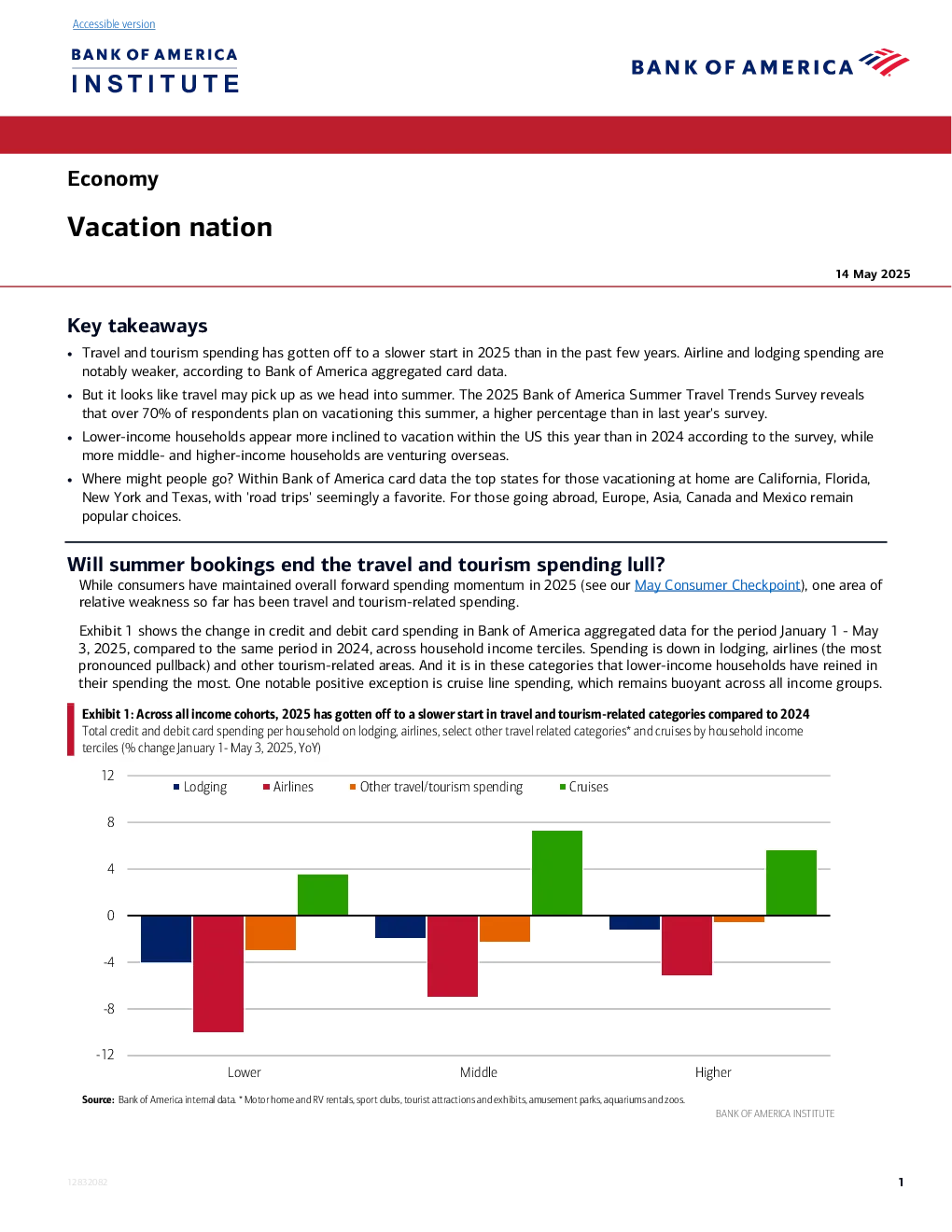
Vacation nation Key takeaways •Travel and tourism spending has gotten off to a slower start in 2025 than in the past few years. Airline and lodging spending arenotably weaker, according to Bank of America aggregated card data. •But it looks like travel may pick up as we head into summer. The 2025 Bank of America Summer Travel Trends Survey revealsthat over 70% of respondents plan on vacationing this summer, a higher percentage than in last year's survey. •Lower-income households appear more inclined to vacation within the US this year than in 2024 according to the survey, whilemore middle- and higher-income households are venturing overseas. •Where might people go? Within Bank of America card data the top states for those vacationing at home are California, Florida,New York and Texas, with 'road trips' seemingly a favorite. For those going abroad, Europe, Asia, Canada and Mexico remainpopular choices. Will summer bookings end the travel and tourism spending lull?While consumers have maintained overall forward spending momentum in 2025 (see ourMay Consumer Checkpoint), one area of relative weakness so far has been travel and tourism-related spending. Exhibit 1shows the change in credit and debit card spending in Bank of America aggregated data for the period January 1 - May3, 2025, compared to the same period in 2024, across household income terciles. Spending is down in lodging, airlines (the mostpronounced pullback) and other tourism-related areas. And it is in these categories that lower-income households have reined intheir spending the most. One notable positive exception is cruise line spending, which remains buoyant across all income groups. Exhibit1:Across all income cohorts,2025 has gotten off to a slower start in travel and tourism-related categoriescompared to 2024Total credit and debit card spending per household on lodging, airlines, select other travel related categories* and cruises by household incometerciles (% change January 1- May 3, 2025, YoY) One potential reason for the softening in travel spending is the sharp deterioration in consumer sentiment this year (Exhibit 2).With lower confidence and rising economic uncertainty, it could be that consumers have decided to defer some relatively large,and often highly discretionary, travel spending. Looking by region, it appears that a broad aggregate of travel spending covering cruises, rental cars and trucks, lodging, airlines,theme parks and travel agencies has been weakest in the Northeast–which is also the region that’s seen the largest slide inconsumer sentiment, according to the University of Michigan measure (Exhibit 3). Exhibit3: The Northeast has seen the weakest travel spending andthe largest drop in consumer sentiment in 2025Three-month average YoY change in travel spending in April 2025 (%) and the change in Michigan consumer sentiment from January 2025 toApril 2025 (pts), by region However, other factors, including the weather (a poor start in January and February) and the timing of Easter (relatively late),may also have played a role in weaker spending thus far this year. Additionally, the prices of some travel and tourism-relatedcategories, such as airfare and lodging, have come down in recent months, according to consumer price data from the Bureau ofLabor Statistics (Exhibit 4). Moreover, both 2023 and 2024 were such strong years for travel and tourism as people emergedfrom the pandemic that it was always going to be hard for 2025 to compete. Consumer price indices for select categories (seasonally-adjusted, January 2024=100) Now boarding: 2025 Bank of America Summer Travel OutlookThe obvious question is whether this slower start to 2025 implies weaker prospects for travel spending over the key summer season. Survey results from the new2025 Bank of America Summer Travel Outlook(travel survey) provides useful insights intohow consumers’plans are shaping up. First up, it appears more than 70% of respondents plan on travelling this summer (Exhibit 5), with a rough 50:50 split of thosesaying they’ve already booked their trip versus those who haven’t. And across income cohorts, it seems more people are planningto travel over the summer of 2025 than were in the summer of 2024 (Exhibit 6). Lower-income respondents appear most likely,however, to say they aren’t planning a summer vacation at all. Exhibit5:Over 70% of respondents plan to travel in summer2025… Exhibit6:…though a higher share of lower-income respondentsdon’t plan on going away% responding ‘Yes’ to ‘Are you planning to travel this summer?’ by % responses to ‘Are you planning to travel this summer?’ income Home or away?Digging a little deeper, a key question for where travel spending is heading is whether people are planning to travel within the US or overseas.Exhibit 7shows that a majority of respondents plan to spend time travelling in the US on their vacation. But theproportion of lower-income respondents saying they are planning on doing this has r