流动中:更多的搬家者,更少的购房者
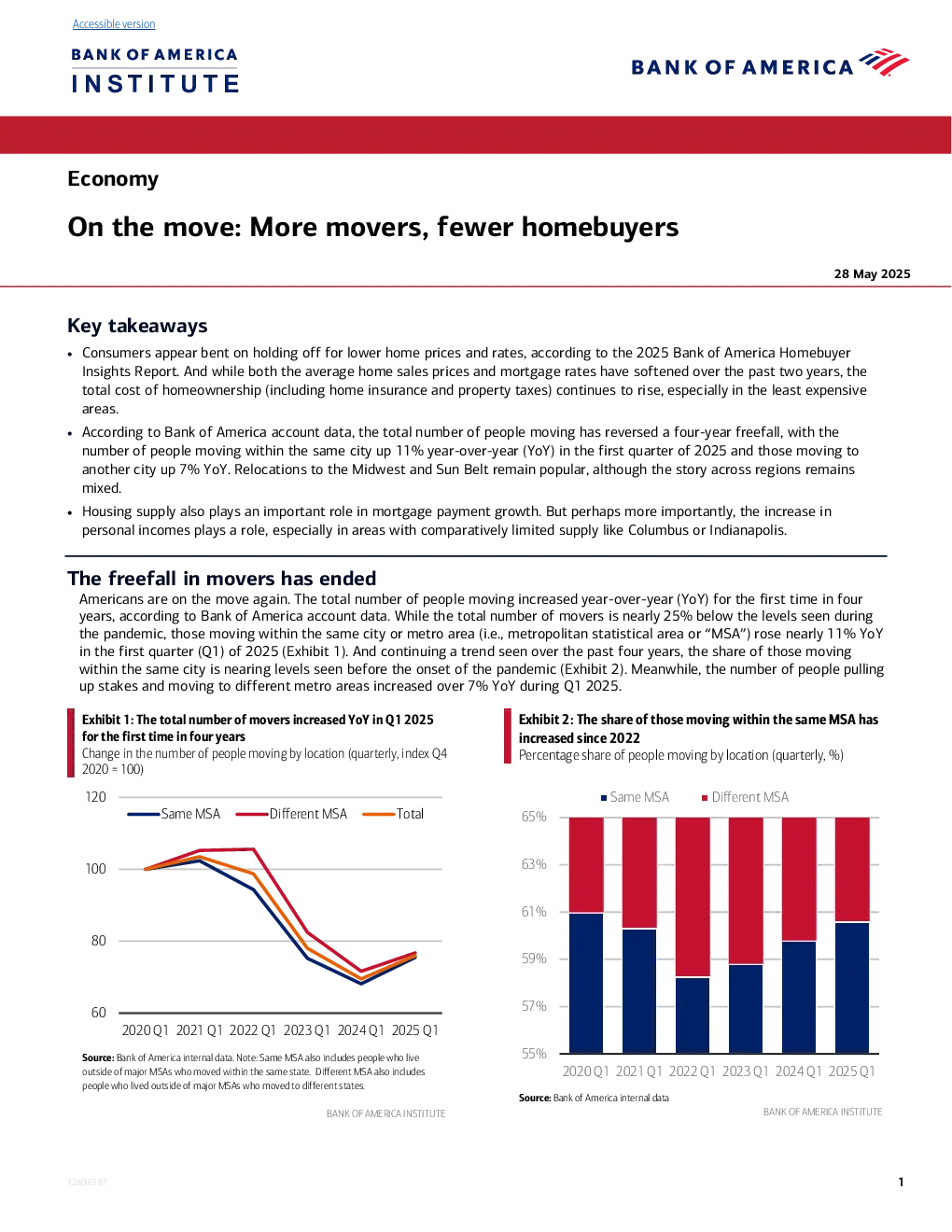
On the move: More movers, fewer homebuyers Key takeaways •Consumers appear bent on holding off for lower home prices and rates, according to the 2025 Bank of America HomebuyerInsights Report. And while both the average home sales prices and mortgage rates have softened over the past two years, thetotal cost of homeownership (including home insurance and property taxes) continues to rise, especially in the least expensiveareas. •According to Bank of America account data, the total number of people moving has reversed a four-year freefall, with thenumber of people moving within the same city up 11% year-over-year (YoY) in the first quarter of 2025 and those moving toanother city up 7% YoY. Relocations to the Midwest and Sun Belt remain popular, although the story across regions remainsmixed. •Housing supply also plays an important role in mortgage payment growth. But perhaps more importantly, the increase inpersonal incomes plays a role, especially in areas with comparatively limited supply like Columbus or Indianapolis. The freefall in movers has endedAmericans are on the move again. The total number of people moving increased year-over-year (YoY) for the first time in four years, according to Bank of America account data. While the total number of movers is nearly 25% below the levels seen duringthe pandemic, those moving within the same city or metro area (i.e., metropolitan statistical area or“MSA”) rose nearly 11% YoYin the first quarter (Q1) of 2025 (Exhibit 1). And continuing a trend seen over the past four years, the share of those movingwithin the same city is nearing levels seen before the onset of the pandemic (Exhibit 2). Meanwhile, the number of people pullingup stakes and moving to different metro areas increased over 7% YoY during Q1 2025. Exhibit1:The total number of movers increased YoY in Q1 2025for the first time in four yearsChange in the number of people moving by location (quarterly, index Q4 Exhibit2:Theshare of those moving within the same MSA hasincreased since 2022Percentage share of people moving by location (quarterly, %) 2020 = 100) Prospective homebuyers are staying on the sidelinesAs we discussed in last quarter’sOn the move (OTM),those moving appear to largely be lower-income and younger consumers looking for cheaper rents. This still seems likely to be the case given that the owner-occupied housing market remains fairlystagnant. Existing home sales declined 7% in April from its recent peak in December 2024, more than offsetting increases innew home sales, according to data from the National Association of Realtors (NAR) and US Census Bureau (Exhibit 3). Furthermore, the2025 Bank of America Homebuyer Insights Report(HBIR) suggests that prospective homebuyers are stillwaiting for home prices and mortgage rates to drop further before purchasing a home. In fact, the percentage of HBIRrespondents who say they are holding off on buying has reached the highest level in three years. Three out of four respondents(75%) expect prices and interest rates to fall and are waiting until then to buy a new home. That compares to 67% in 2024 and62% in 2023 (Exhibit 4). In our view, some of this may be driven by an increase in economic uncertainty due to slowing wagegrowth and tariff-related policies. Exhibit3:While new home sales rose in April from February, it wasoffset by a significant decrease in existing home salesNumber of existing and new home sales (monthly, seasonally adjusted Exhibit4:There’s been a significant increase in prospectivehomebuyers waiting for prices and rates to fall before buyingSurvey respondents who are prospective homebuyers, expect home annualized rate (SAAR)) prices and interest rates to fall, and are waiting for home prices andinterest rates to fall before buying (yearly, %) Some home buying conditions have improved…slightlyDespite the negative trends, nearly 52% of 2025 HBIR respondents think this year is a better time to buy than last year. That compares with 48% in 2024 and 38% in 2023 (Exhibit 5). In our view, this may be due to some softness in the homebuyingmarket. Average sales prices have been largely flat over the past three years and average rates for a 30-year fixed mortgagehave come off their recent peak of 7.6%, although they remain stubbornly high (Exhibit 6). Exhibit6: Average home sales prices andmortgage rates havebeen fairly flat the past two yearsAverage sales price, based on data from the US Census Bureau, Exhibit5:A majority of prospective homebuyers think this year’sbuying conditions are better than the last (monthly, actual $s) and average mortgage rates, based on data fromFreddie Mac (monthly, %) Survey respondents who are prospective homebuyers who believe thehomebuying market is better now than it was a year ago (yearly, %) Somewhat sunny picture in the Sun Belt, but cloudy in the NortheastOne of the most interesting migration trends has been the more nuanced picture in the Sun Belt. Population growth accelerated YoY