网络化政府
 AI智能总结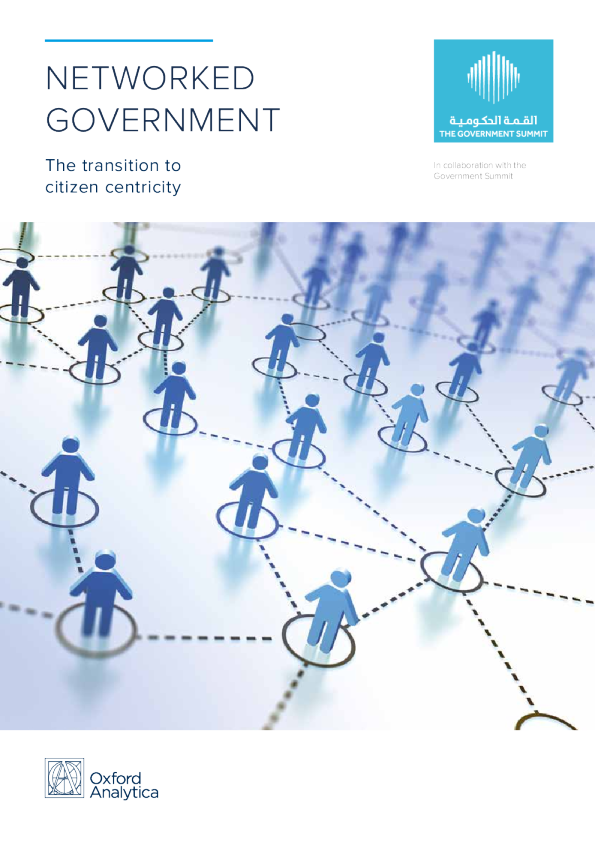
Any reproduction or distribution of this study in whole or in partwithout the written consent of Oxford Analytica Ltd is strictly forbidden.© Oxford Analytica 2015HEAD OFFICE5 Alfred Street, Oxford OX1 4EH United KingdomT +44 1865 261 600www.oxan.comOxford Analyticais a global analysis and advisory firm which draws on aworldwide network of experts to advise its clients on their strategy andperformance. Our insights and judgements on global issues enable our clientsto succeed in complex markets where the nexus of politics and economics,state and business is critical. To learn more about our products and services,visitwww.oxan.comAbout this reportA report in collaboration with the Government SummitFebruary 2015This study is intended for the use and assistance of the Government Summit.It should not be regarded as a substitute for the exercise by the recipients oftheir own judgment. Oxford Analytica Ltd and/or any person connected with itaccepts no liability whatsoever for any direct or consequential loss of any kindarising out of the use of this study or any part of its contents. 2Executive Summary3Organisational4Technological5New terminology7Introduction8Networked government8Citizen-to-government and business-to-government (“vertical networking”)10Current learning and best practices10Access12Participation15Service Delivery16Relationship management16Policy- to citizen-centric management18Transforming government18Traditional government: hierarchical structure18Future government: networked holacracy22Open government data24Global uptake of open data26The future of networked government26Unified data profiles27People participation in policy design29Redesign of digital services to better account for different user needs29Redesign of services for mobile devices30Better search services: needle in a haystack32Challenges32Secure and private integrated personal profiles33Ministerial and technocratic opposition33Security35Policy recommendations35Organisational35Technological36Conclusion 1 Executive SummaryNETWORK GOVERNMENTNetwork governmentis the transition to a more transparent, cooperative andbeneficialrelationship between government,citizens and business as a resultof technological integration and organisational connectivity. By enabling activestakeholder participation and access, it transforms government services by placingusers at the centre of policy design and implementation and service delivery.The growing use of the internet in the 1990s led many governments to recognise itspotential to broaden and deepen their relationship with citizens, businesses and otherkey external stakeholders. Implementing the concept of e-government began with theposting on newly launched government websites of a range of basic information such asthe location and hours of operation of government offices, but quickly grew to include thesharing of information across government departments.The rapid evolution of technology and the internet led governments to realise that thisrepresented the mere first phase of e-government and as technology improved so wouldthe capabilities of governments to interact with and service multiple stakeholders. Assuch, the next phase of e-government, known increasingly asnetworked government,encompasses the complete electronic integration and personalisation of services betweengovernment and other stakeholders. This will enable governments to improve policy designand implementation and place users at the centre of service delivery.The goal of this thought leadership report is to examine the concept of networkedgovernment, identify the characteristics of today’s top performers, and explore thefuture direction and challenges of its successful implementation.Of critical importance to the effectiveness of networked government is the ability to collectand publicly share multiple forms of data across different channels (e.g. email, SMS, websitesites, social media), both through active engagement and unconscious participation, in real-time and at low cost. As such, as networked government evolves, the emphasis on a virtual,non-physical interaction between a government and its stakeholder will serve to furtherunderstand user needs and, ultimately, transform the effective formulation of policies.Traditional government decision-makingHowever,varying degrees of physical access to the internet and disparate citizencapabilities (the “digital divide”) underscore the dangers of elite bias and a fragmented,inequitable delivery of future government services. As such, the successful implementationand operation of networked government solutions depends on: 2Network government decision-making 3―Access.Having access to technology and understanding how to use it.―Participation.Nurturing engaged citizenry and continuous interaction with providers.―Service delivery.Services in the correct format, delivered via the appropriate platforms.While technological innovation will be critical to the development of networked governmentsolut