减少碳排放路线图
 AI智能总结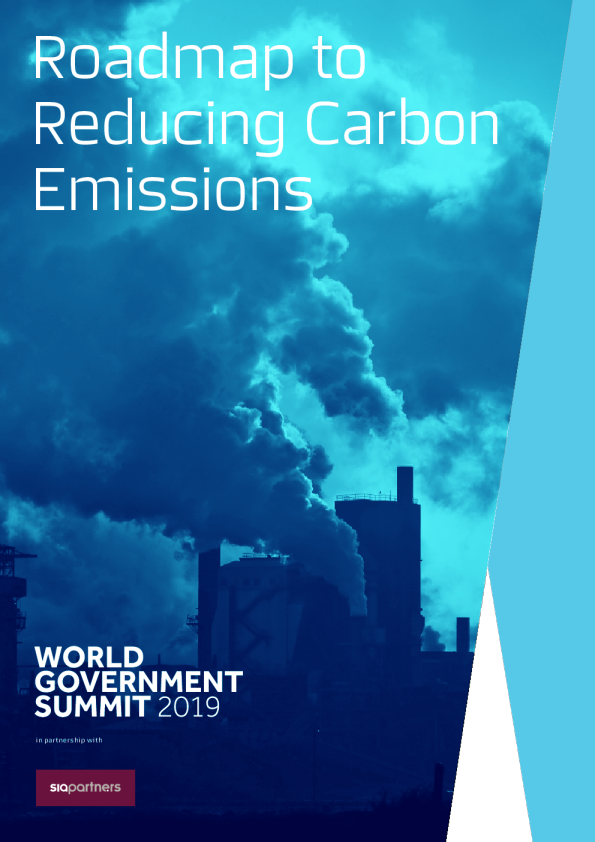
The World Government Summit is a global platform dedicated toshaping the future of governments worldwide. Each year, the Summitsets the agenda for the next generation of governments with a focuson how they can harness innovation and technology to solve universalchallenges facing humanity.The World Government Summit is a knowledge exchange center at theintersection of government, futurism, technology, and innovation. Itfunctions as a thought leadership platform and networking hub forpolicymakers, experts and pioneers in human development.The Summit is a gateway to the future as it functions as the stage foranalysis of future trends, concerns, and opportunities facing humanity.It is also an arena to showcase innovations, best practice, and smartsolutions to inspire creativity to tackle these future challenges.AnsweringTomorrow’sQuestionsToday2 ContentsIntroductionThe signs are already hereMoving to a low carbon economyConclusionRamping up the decabornization speed with the use ofArtificial Intelligence (AI)1- Data to enhance our knowledge2- AI to experiment and explore unknown scenarios3- Towards an Agile data-driven policy making1.1 – Fighting global warming with new weapons: data2.1 - What if Climate Change becomes the next AI challenge?3.1 - Moving towards real data policy making cycles….1.2 – With new solutions come new challenges2.2 - Challenges to reach to full potential of AI3.2 - … requires reinforced cooperation in data sharing1.3 – Data is already contributing to reduce our carbon footprint 0608123218202428 Since the dawn of history, human’s ability to transform energy into heat, lightor motion has always been the main driver for progress and prosperity. Throughinnovation, humans never stopped looking for new ways to extract energy fromnature, and this continuous quest has been always the starting point of a revolutionthat deeply changed society and businesses. In the last two hundred years, we havewitnessed the most miraculous advances in human conditions, and most of the timethose advances can be linked to new ways of producing energy.Despite the fact that energy has always supported human prosperity, the way weare harvesting it is coming with a significant price. In fact, it took us more thanone hundred years after the industrial revolution to notice the consequences ofour actions. When the first computer models of global climate were developed inthe 1960s, many scientists supported the idea that the rise in greenhouse gasesin the atmosphere would result in a warming climate, by the 1980s when globaltemperature began rising sharply, more voices from the media and the public joinedthe scientists to raise the attention of policy makers to the size of the challengeahead.Climate change has become the main challenge that we face as a species in thetwenty first century, the world that our children and all generations to come willlive in depends on our ability to take the right decisions and our capacity to deliveron them. This challenge must be a concern for everyone; citizens, businesses andpolicy-makers alike. The only way to overcome it, is by combining efforts at alllevels, through collaboration and innovation.In its Special Report on Global Warming of 1.5 °C (SR15) released in October 2018,the Intergovernmental Panel on Climate Change (IPCC) states that meeting a 1.5°C target is still possible, but it requires “rapid, far-reaching and unprecedentedchanges in all aspects of society”; Global emissions of carbon dioxide (CO2) wouldneed to fall by about 45% from 2010 levels by 2030, reaching ‘net zero’ around 2050.If history showed that energy played a major role in past industrial revolutions,the one we are witnessing in this 21st century is fundamentally different. Unlikeits predecessors, the 4th Industrial Revolution is fueled by Data. From sensors andconnected objects that collect data to artificial intelligence that transforms raw datainto insightful information, the digital technologies that are at the core of the fourthindustrial revolution extend our abilities to embrace the complexity of the world andfind new ways to tackle problems the scale of climate change. However, achieving thefull potential of digital technologies in fighting climate change requires tremendousand coordinated efforts from governments and businesses.This paper explores the opportunities offered by digital technologies and theextensive use of data to foster the collective efforts to reduce carbon emissions,and shows how data-driven policy making based on digital technologies can set arealistic roadmap to reduce carbon dioxide emissions.Introduction6 World Government Summit 2019 The signsare alreadyhere8 Over the last 800,000 years, the presence of carbondioxide in our atmosphere fluctuated between 180 and280 ppm (parts per million), following glacial periods.This stable trend has been disrupted since the advent ofthe first industrial revolution in the middle of the 19thcentury. The levels of carbon dioxide kept risi