AI智能总结
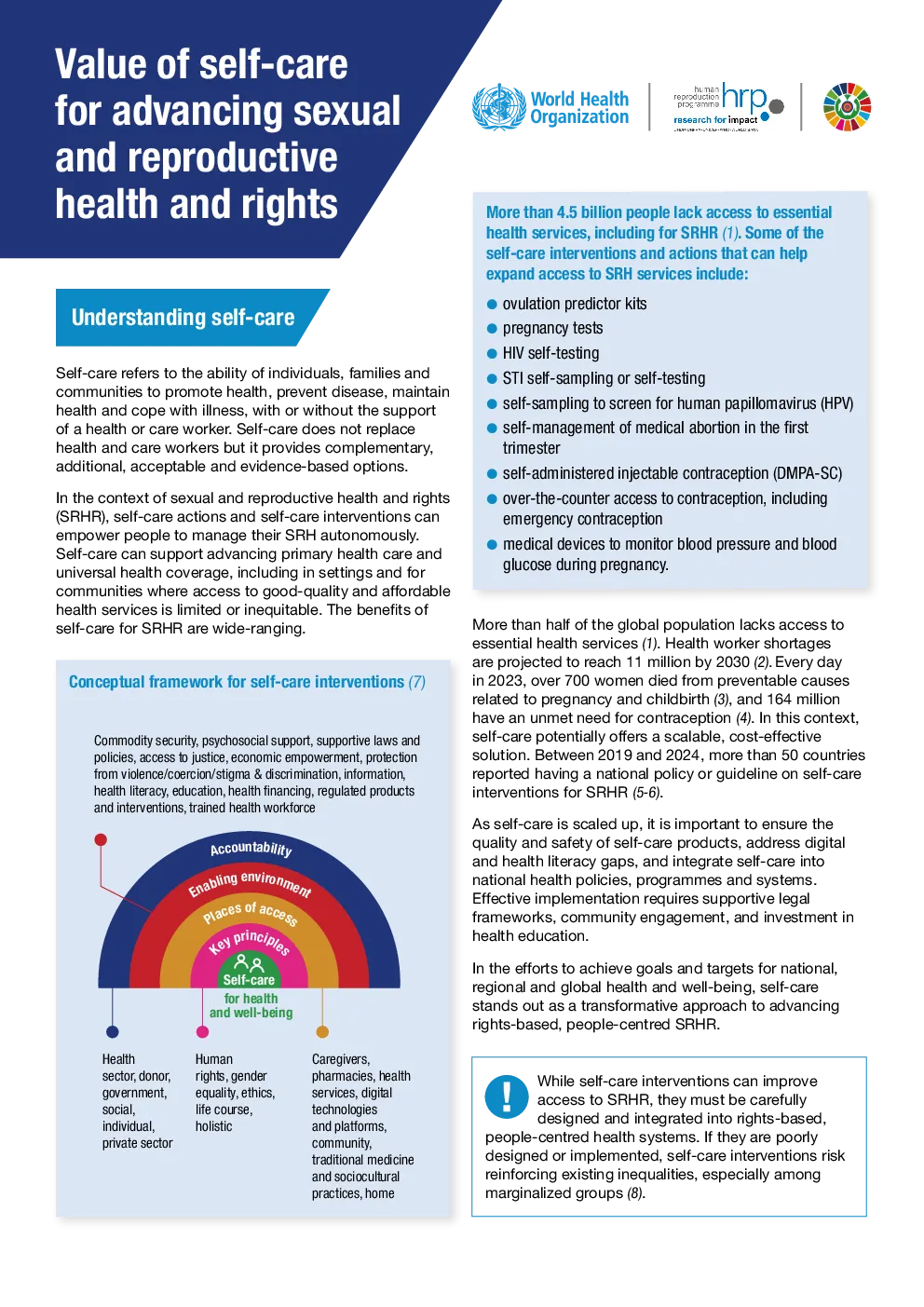
More than 4.5 billion people lack access to essentialhealth services, including for SRHR(1). Some of theself-care interventions and actions that can helpexpand access to SRH services include:ovulation predictor kitspregnancy testsHIV self-testingSTI self-sampling or self-testingself-sampling to screen for human papillomavirus (HPV)self-management of medical abortion in the firsttrimesterself-administered injectable contraception (DMPA-SC)over-the-counter access to contraception, includingemergency contraceptionmedical devices to monitor blood pressure and bloodglucose during pregnancy.More than half of the global population lacks access toessential health services(1). Health worker shortagesare projected to reach 11 million by 2030(2).Every dayin 2023, over 700 women died from preventable causesrelated to pregnancy and childbirth(3), and 164 millionhave an unmet need for contraception(4). In this context,self-care potentially offers a scalable, cost-effectivesolution. Between 2019 and 2024, more than 50 countriesreported having a national policy or guideline on self-careinterventions for SRHR(5-6).As self-care is scaled up, it is important to ensure thequality and safety of self-care products, address digitaland health literacy gaps, and integrate self-care intonational health policies, programmes and systems.Effective implementation requires supportive legalframeworks, community engagement, and investment inhealth education.In the efforts to achieve goals and targets for national,regional and global health and well-being, self-carestands out as a transformative approach to advancingrights-based, people-centred SRHR.While self-care interventions can improveaccess to SRHR, they must be carefullydesigned and integrated into rights-based,people-centred health systems. If they are poorlydesigned or implemented, self-care interventions riskreinforcing existing inequalities, especially amongmarginalized groups(8). ●●●●●●●●● Key and underserved populationsSelf-care interventions are a vital strategy for improving SRHR among underservedpopulations, particularly when they are situated in challenging contexts such ashumanitarian settings, remote areas, or where they are subject to legal or socialexclusion. These populations include people living with HIV, racially minoritizedcommunities, transgender and gender-diverse individuals, people withdisabilities, older adults, young people, people experiencing homelessness, refugees andmigrants, and Indigenous people. The intersection of identity and context often compoundsbarriers to care – such as when isolation from the local population limits access to servicesfor refugees, or when fear of criminalization or deportation deters migrants from disclosingtheir health needs. Similarly, stigma and discrimination – often originating within healthsystems – can deter individuals from seeking care altogether. Self-care can help mitigatethese barriers by offering discreet, accessible and person-centred options that individualscan use independently or with minimal support – such as HIV self-testing and self-managedcontraception(7). In this context, self-care interventions not only offer practical solutions butalso represent a rights-based approach to health that affirms dignity, autonomy and equity.Kenya:Developed a national SRHRself-care guideline, integrated self-careinto policies, training and humanitariansettings, with active DMPA-SC scale-up.Zimbabwe:Implemented self-care via HIVself-testing, DMPA-SC self-injection, oralcontraceptives, and HPV self-sampling, withcommunity health workers playing a key role.India:Providing “Self-care kits”containing condoms, emergencycontraceptive pills and pregnancytests at 150 000 primary carehealth and wellness centres. Men and boysSelf-care interventions are also essential for addressingthe SRH needs of men and boys, who tend to havelimited engagement with “formal” services, suchas HIV testing, STI screening and fertility care(7).Self-care tools – such as HIV self-testing, digitalhealth platforms and over-the-counter access to condoms andSTI treatments – offer discreet, accessible options that canhelp overcome time constraints, stigma and reluctance amongmen and boys to engage with the formal health system. Menalso have an important role to play as partners and fathersin the sphere of self-care. For example, the World HealthOrganization’s (WHO’s) antenatal care recommendationshighlight the value of men supporting their female partner’s self-care to manage anxiety during pregnancy(10).Ghana:Scaledup self-injectionof DMPA-SC forfamily planningafter nationalimplementationresearch andregulatoryapproval.Uruguay:Implemented self-managed medical abortionsupported by professionalcounselling under a national law. Timor-Leste:Included HPV self-sampling in national cervicalcancer screening programmes. Providing contraceptive self-care interventions (condoms and contraceptive pills) to everyhealth outpost for an outreach initiative. Launched a pilotp