您的浏览器禁用了JavaScript(一种计算机语言,用以实现您与网页的交互),请解除该禁用,或者联系我们。 [国际贸易中心]:巴基斯坦园艺与畜牧业气候智慧型技术与实践 - 发现报告

巴基斯坦园艺与畜牧业气候智慧型技术与实践

农林牧渔 2025-06-30 国际贸易中心 测试专用号1普通版
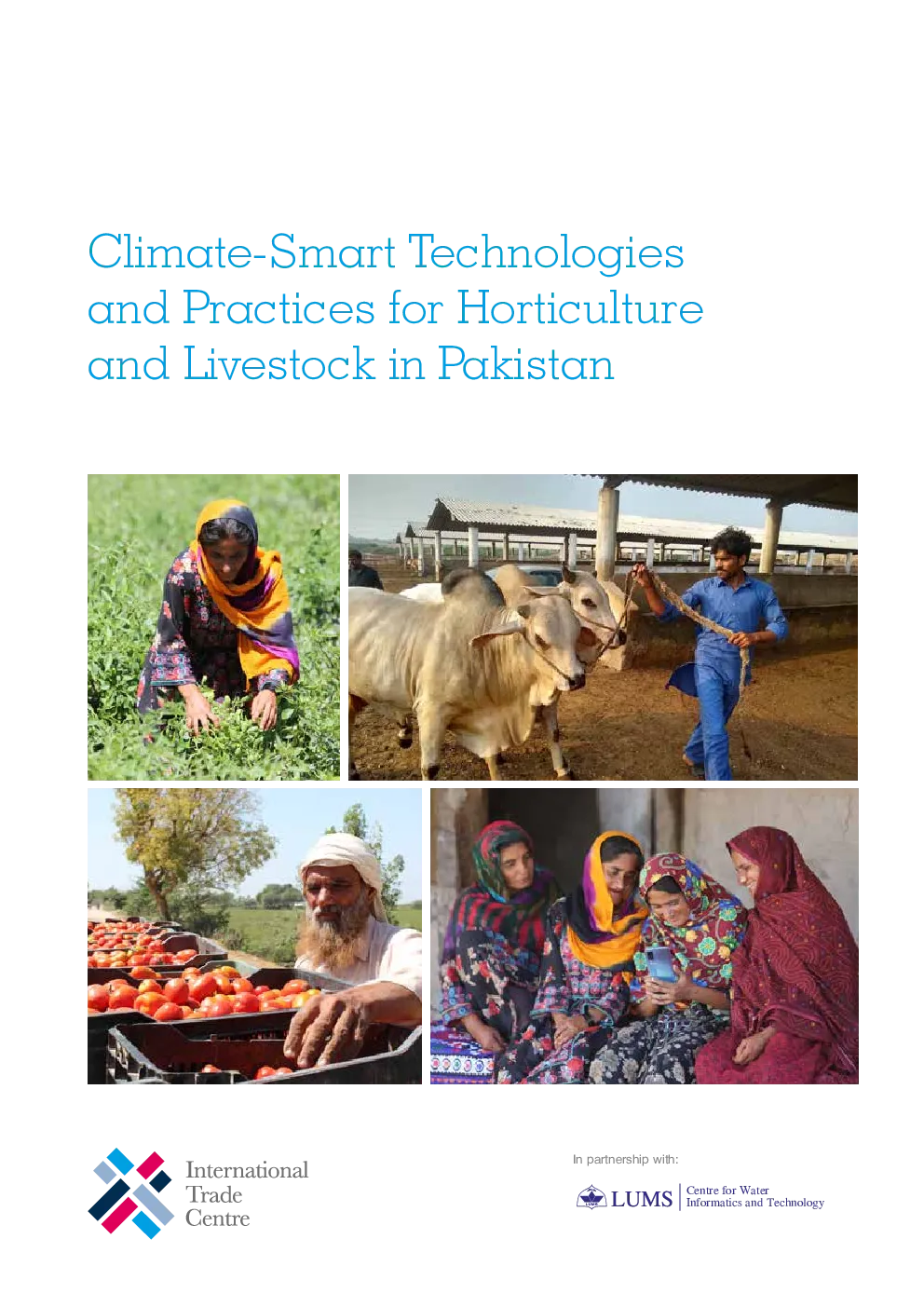
报告封面

Street address:ITC54-56, rue de Montbrillant1202 Geneva, SwitzerlandPostal address:ITCPalais des Nations1211 Geneva 10, SwitzerlandTelephone:+41-22 730 0111Fax:+41-22 733 4439E-mail:itcreg@intracen.orgInternet:http://www.intracen.orgThe International Trade Centre (ITC) is the joint agency ofthe World Trade Organization and the United Nations. Climate-Smart Technologiesand Practices for Horticultureand Livestock in Pakistan About the paperMany climate-smart technologies and practices are available in Pakistan – these are crucial for improving farm productivityand building climate change resilience. This report examines their availability and accessibility in the horticulture andlivestock sectors in Balochistan and Sindh provinces. It finds that uptake among farmers and agribusinesses remainslow due to limited access to information and finance, weak financial incentives for adoption and few support services.Promotion levels and demonstrations are also low.To improve adoption of climate-smart technology and practices, this report recommends developing a rental model to helpfarmers afford technology and creating demonstration sites to train farmers.Publisher:International Trade Centre.Title:Climate-Smart Technologies and Practices for Horticulture and Livestock in PakistanPublication date and place:Geneva, July 2025Page count:76Language:EnglishITC document numberGIVC-25-198.ECitation:International Trade Centre and LUMS (2025).Climate-Smart Technologies and Practices for Horticulture and Livestock in Pakistan. ITC,Geneva.For more information, contact:Alexander Kasterine at kasterine@intracen.orgITC encourages the reprinting and translation of its publications to achieve wider dissemination. Short extracts of this paper may be freely reproduced,with due acknowledgement of the source. Permission should be requested for more extensive reproduction or translation. A copy of the reprintedor translated material should be sent to ITC.The designations employed and the presentation of material in this document do not imply the expression of any opinion whatsoever on the part ofITC concerning the legal status of any country, territory, city or area or of its authorities, or concerning the delimitation of its frontiers or boundaries.Digital image(s) on the cover:©Alexander Kasterine©International Trade Centre (ITC)ITC is the joint agency of the World Trade Organization and the United Nations. Foreword from the Government of SindhWhile Pakistan makes only a minimal contribution to climate deterioration and changing the albedo effect, climate changehas become a major threat to the livelihoods of millions of people – particularly those relying on agriculture. The climatecatastrophe caused extreme monsoon rainfall from mid-June to the end of August 2022, inundating areas of alreadyvulnerable communities in Sindh and Balochistan. To cope with growing food security threats, adopting climate-smarttechnologies and practices has become inevitable.This report focuses on the horticulture and livestock sectors in Balochistan and Sindh provinces. It suggests a way forwardfor local manufacturing of such technologies to make them affordable and available to local farmers. It also recommendsa rental model and farmer trainings to build capacity.I am hopeful that this work will go a long way towards improving productivity of the agriculture and livestock sectors andthe quality of livelihoods of the farming community. Aijaz Ahmed MahesarSecretary of Agriculture,Supply and Prices Department Foreword from the Government of BalochistanDespite water scarcity in Balochistan, drought and increasing temperatures, the agriculture sector is growing. Nevertheless,extreme weather events have also hindered social and economic development in the province, as demonstrated by therecent catastrophic floods of 2022. Innovative climate technologies are critical in supporting conventional agriculture’stransition into a climate-resilient agricultural system.For this reason, the report produced by the Centre for Water Informatics and Technology at Lahore University ofManagement Sciences in partnership with the International Trade Centre is published at an opportune moment. As it notes,climate-resilient technologies can effectively be made available to smallholder farmers through soft lending by financialinstitutions along with innovative extension awareness mechanisms that include modern production, irrigation post-harvestand value-chain technologies.This report contributes to efforts to shift conventional agriculture towards transition and modernization with the helpof innovative climate technology tools, by identifying the commercial providers of climate technologies, classifyingbusiness models and illustrating the importance of advisory services. The report provides clear recommendations that, ifimplemented, will increase the adoption of climate technologies to increase quality production and address food security. Umaid Ali-KhokharSecretary,Agriculture