大数据与保险:对创新、竞争和隐私的影响
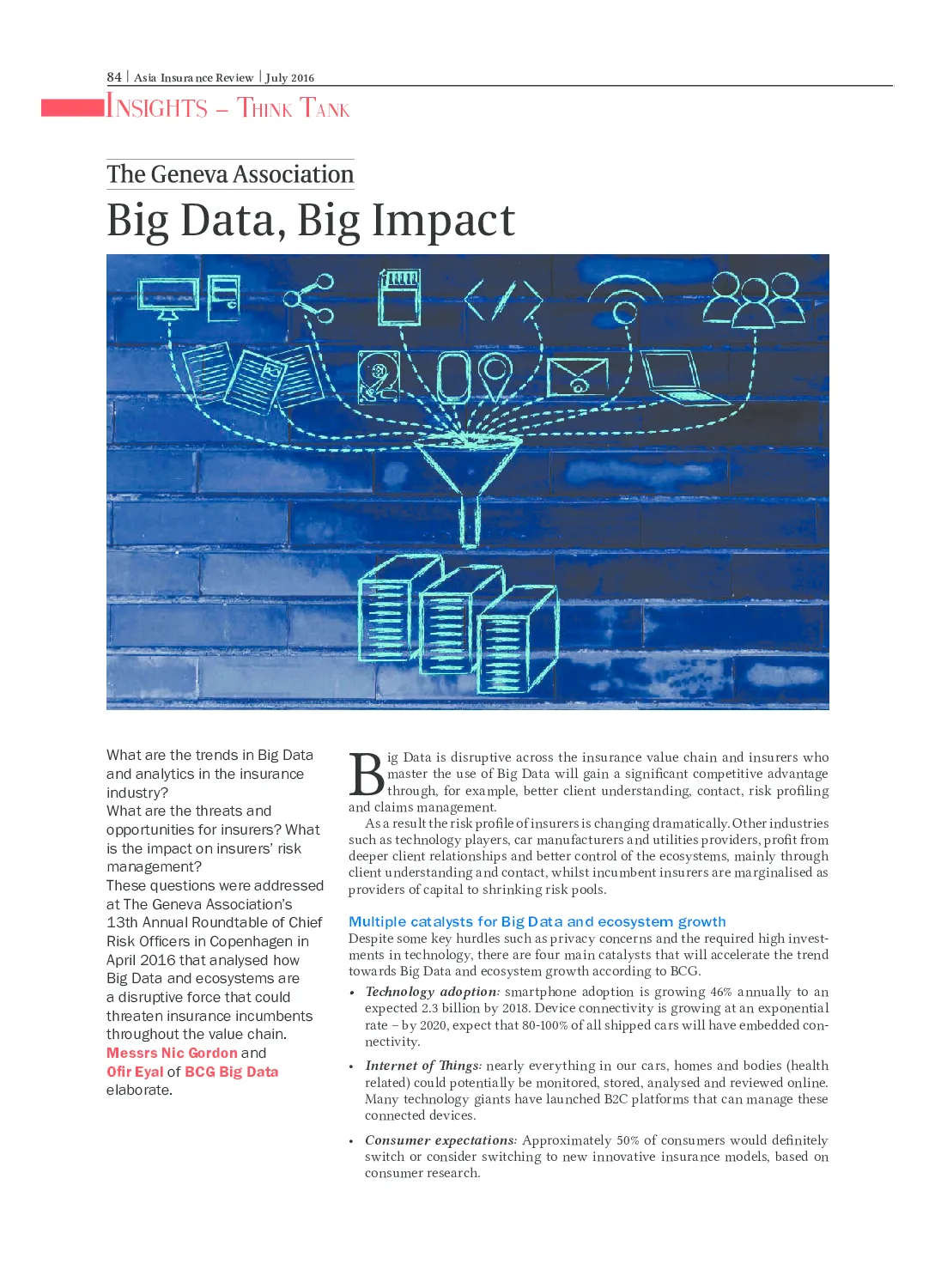
ig Data is disruptive across the insurance value chain and insurers whomaster the use of Big Data will gain a significant competitive advantagethrough, for example, better client understanding, contact, risk profilingAs a result the risk profile of insurers is changing dramatically. Other industriesexpected 2.3 billion by 2018. Device connectivity is growing at an exponentialrate – by 2020, expect that 80-100% of all shipped cars will have embedded con-nectivity.related) could potentially be monitored, stored, analysed and reviewed online.Many technology giants have launched B2C platforms that can manage theseconnected devices.switch or consider switching to new innovative insurance models, based onconsumer research. •Regulation:safety regulation willfurther accelerate the adoptionof connected devices. A clear ex-ample is the eCall EU initiativethat requires all cars from 2017 tobe equipped with a system that au-tomatically generates an emergencycall.Threat for insurers across thevalue chainThere is no doubt that Big Data ishaving a profound impact on the insur-ance industry – the Internet of Thingsand the rise of digital ecosystems areenabling new insurance models anddisruptive propositions that challengethe status quo.•Distribution:eEcosystem modelswill trigger a shift to non-tradi-tional channels with deeper levelsof customer understanding andengagement. What’s more, the“Mobile-first” design of new en-trants offers a superior customerexperience.•Underwriting and pricing:under-writing to become a data-drivengame as ecosystem models willincreasingly leverage their insightfrom novel data sources, such associal media and connected devices.The sharing economy is creatingdemand for new forms of insuranceand is enabling peer-to-peer insur-ance.•Administration and claims man-agement:ecosystem models to havean advantaged position to controland minimise their risk exposure.Focus will shift from re-active man-agement of a claim to the provisionof services that monitor and managerisks in real time.•Disintermediation:players withaccess to customers, devices anddata can position themselves as anaggregator. For insurers that wouldmean further loss of the customerrelationship and data ownership/controlKey actions for insurerswishing to gain a competitiveadvantageData alliances will grow rapidly, thecustomer journey will change dramati-cally and consumer trust becomes a we investing in the right techno-logical developments? What are thechanges to customer preferencesand needs?•Technical:is all available and rel-evant data in pricing and claimsbeing adequately used? What arethe client mix changes resultingfrom new rating capabilities andomni-channel? How is all of thisbeing incorporated into our riskmodels?•Operational:what is the cor-rect transformational programmerequired? How sound is our tech-nological infrastructure? What isthe vulnerability of the new digitalplatforms when it comes to internal/external fraud?•Compliance:how to ensure dataprotection and privacy across mul-tiple legal jurisdictions? How dowe continue to deliver on AML andrestricted entity requirements? Howdo we use data to identify compli-ance hot-spots?Big Data provides opportunities todrive value and competitive advantage.However, many insurers have notmade significant progress when com-pared to how far forward players fromother industries have moved to date.As competition intensifies frominside and outside the insurance in-dustry, inevitably rates will continue tolower in key lines of business, squeez-ing profitability.Put simply: insurers who take ad-vantage of the opportunity in dataand analytics will outperform thosewho do not. The greatest paradigmshift will depend on how different dataecosystems develop and the threat ofadjacent entries. Insurers should takenote of how technology providersapproach data and radically remodeltheir approach to innovation with theaim of shaping data asset markets andstrategic partnerships with other dataproviders.Mr Nic Gordon is Associate Director and Mr Ofir Eyalis Principal and co-lead of Insurance practice, bothat BCG Big Data. key competitive weapon in data usage.How should insurers be respondingright now?•Understand the economic oppor-tunity and threat – what is thepotential for new revenue streams,customer segments, and bettercross- and up-selling of existingproducts?•Prioritise offerings based on com-pany strength – what data doesthe company have, where can theyleverage external data and add realvalue to the ecosystem and producethe highest returns?•Transform the operating model tofoster innovation – does the currentorganisational structure have theright capabilities and structure toleverage Big Data tools and infra-structure?•Data alliances will grow rapidly inthe next three years along. So, whatare the key strategic partnershipsneeded and how to ensure they willdeliver value five years from now?•Test ideas in the market and scaleup quickly – Can ideas be taken tomarket quickly in a small scale, andhow