您的浏览器禁用了JavaScript(一种计算机语言,用以实现您与网页的交互),请解除该禁用,或者联系我们。[世界卫生组织]:流感最新消息N°534 - 发现报告

流感最新消息N°534

AI智能总结
查看更多
流感最新消息N°534

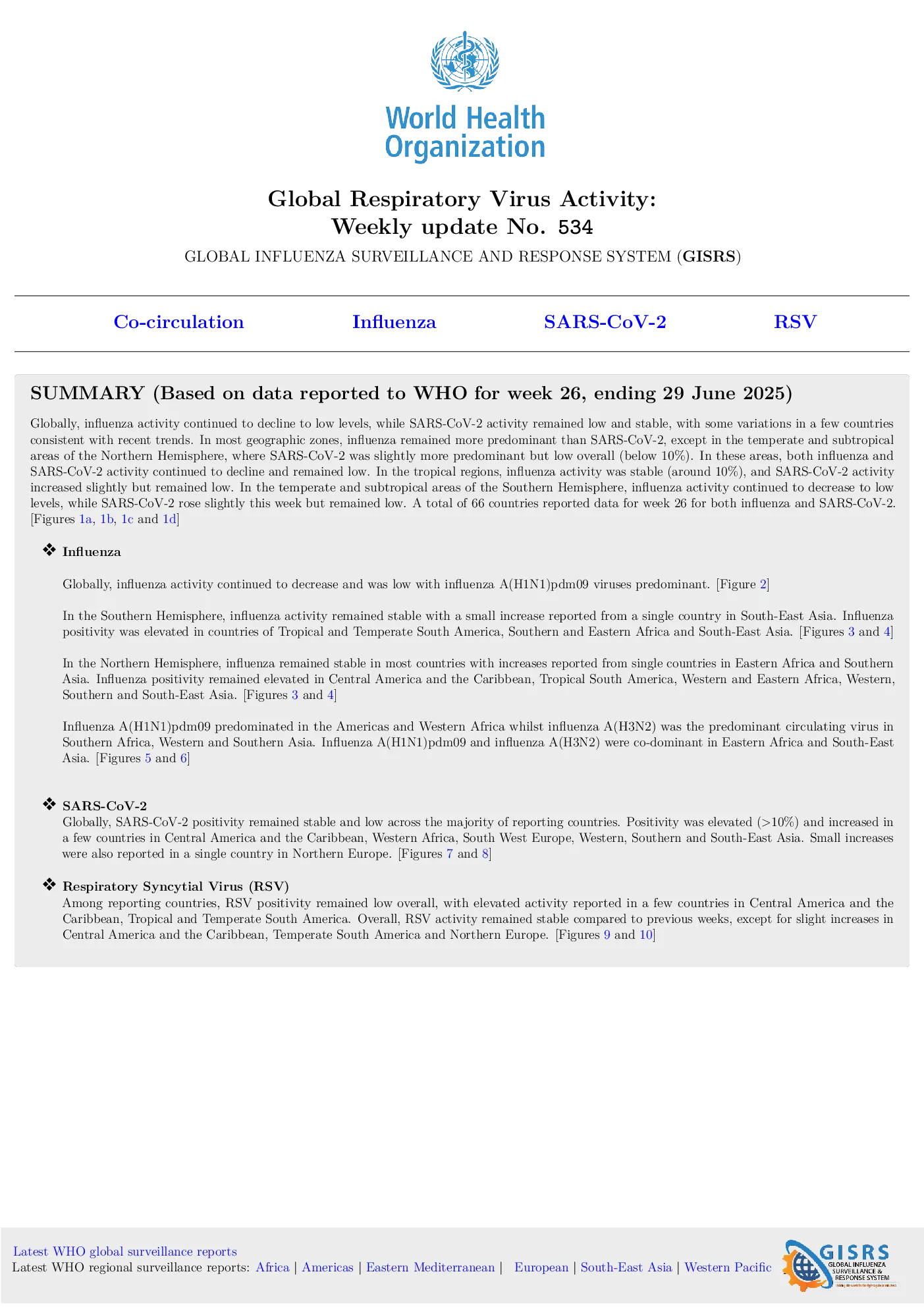
Co-circulationAsia. [Figures 5 and 6]Latest WHO global surveillance reports RSV [Figures 1a, 1b, 1c and 1d]qInfluenzaqSARS-CoV-2 Co-circulation of influenza and SARS-CoV-21a) Weekly numbers of influenza and SARS-CoV-2 virus specimens tested and percent positivity at the global level(last 12 months)1b) Weekly numbers of influenza andSARS-CoV-2 virus specimens tested andpercent positivity in Northern hemispheretemperate and subtropical areas1c) Weekly numbers of influenza andSARS-CoV-2 virus specimens tested andpercent positivity in Tropical areas1d) Weekly numbers of influenza andSARS-CoV-2 virus specimens tested andpercent positivity in Southern hemispheretemperate and subtropical areasLatest WHO global surveillance reportsLatest WHO regional surveillance reports: Africa | Americas | Eastern Mediterranean |European | South-East Asia | Western Pacific Influenza2) Weekly numbers of influenza virus positive specimens by type and subtype and percent positivity at the globallevel (last 12 months)3) Proportions of specimens that tested positive for4) Change in proportions of specimens that tested5) Proportions of influenza virus types and subtypes byinfluenza transmission zones (year-week:2025-26)6) Weekly distribution of influenza virus types andsubtypes by geographic zone (last 12 months)Latest WHO regional surveillance reports: Africa | Americas | Eastern Mediterranean |European | South-East Asia | Western Pacific influenza (year-week:2025-26)positive for influenza (year-week:2025-26)Latest WHO global surveillance reports SARS-CoV-27) Proportions of specimens that tested positive forSARS-CoV-2 (year-week:2025-26)8) Change in proportions of specimens that testedpositive for SARS-CoV-2 (year-week:2025-26)Respiratory syncytial virus9) Proportions of specimens that tested positive for RSV10) Change in proportions of specimens that testedpositive for RSV (year-week:2025-26)Latest WHO regional surveillance reports: Africa | Americas | Eastern Mediterranean |European | South-East Asia | Western Pacific (year-week:2025-26)Latest WHO global surveillance reports Additional informationData and methodsThe data presented in this report originates from virologic surveillance conducted by countries, areas, and territories (CATs) andsubmitted to WHO FluNet. These CATs employ diverse methodologies to monitor respiratory virus activity, which may result invariations between this report and other surveillance summaries published elsewhere.This report includes virologic data from bothsentinel surveillance and other systematically conducted surveillance. Dueto differences in surveillance strategies, direct comparisons of percent positivity between CATs should be interpreted with caution.The data source used for each CAT was decided jointly corresponding with WHO Regional Offices and the respective reporting entity.To assess trends, the proportion of specimens tested positive for influenza or SARS-CoV-2 was smoothed over a 3-weeks period.This analysis includes only countries that tested 10 or more specimens in at least two of the three weeks. Weekly changes in thesmoothed positivity rate for each virus were calculated as absolute differences from the previous week. These absolute changeswere categorized and visualized in the proportion change maps.The influenza transmission zones map is based on data aggregated over a 3-weeks period, moving backward from the current weekuntil a minimum threshold of 100 tested samples is reached within each influenza transmission zone. Pie charts are displayed onthe map only if the total percent positivity in a influenza transmission zones map is 20% or higher. All trend analyses are basedon ISO 8601 calendar week numbering.Activity summaries are organized by geographical groupings of CATs.These groupings are intended solely for geographicreference and do not imply uniformity in respiratory virus transmission patterns within each group. It is important to note thatspecimens tested for influenza, SARS-CoV-2, and RSV may not originate from the same sample sources within surveillance systems.Suggested citation:Global respiratory virus activity:weekly update No 534 (week 2025-26).Geneva:World HealthOrganization; 2025; Licence: CC BY-NC-SA 3.0 IGO.Disclaimer:The designations employed and the presentation of the material in this publication do not imply the expression of any opinionwhatsoever on the part of WHO concerning the legal status of any country, territory, city or area or of its authorities, or concerningthe delimitation of its frontiers or boundaries. Dotted and dashed lines on maps represent approximate border lines for whichthere may not yet be full agreement.The mention of specific companies or of certain manufacturers’ products does not imply that they are endorsed or recommendedby WHO in preference to others of a similar nature that are not mentioned.Errors and omissions excepted, the names ofproprietary products are distinguished by initial capital letters.All reasonable precaution