事件报告:德克萨斯州中部洪水
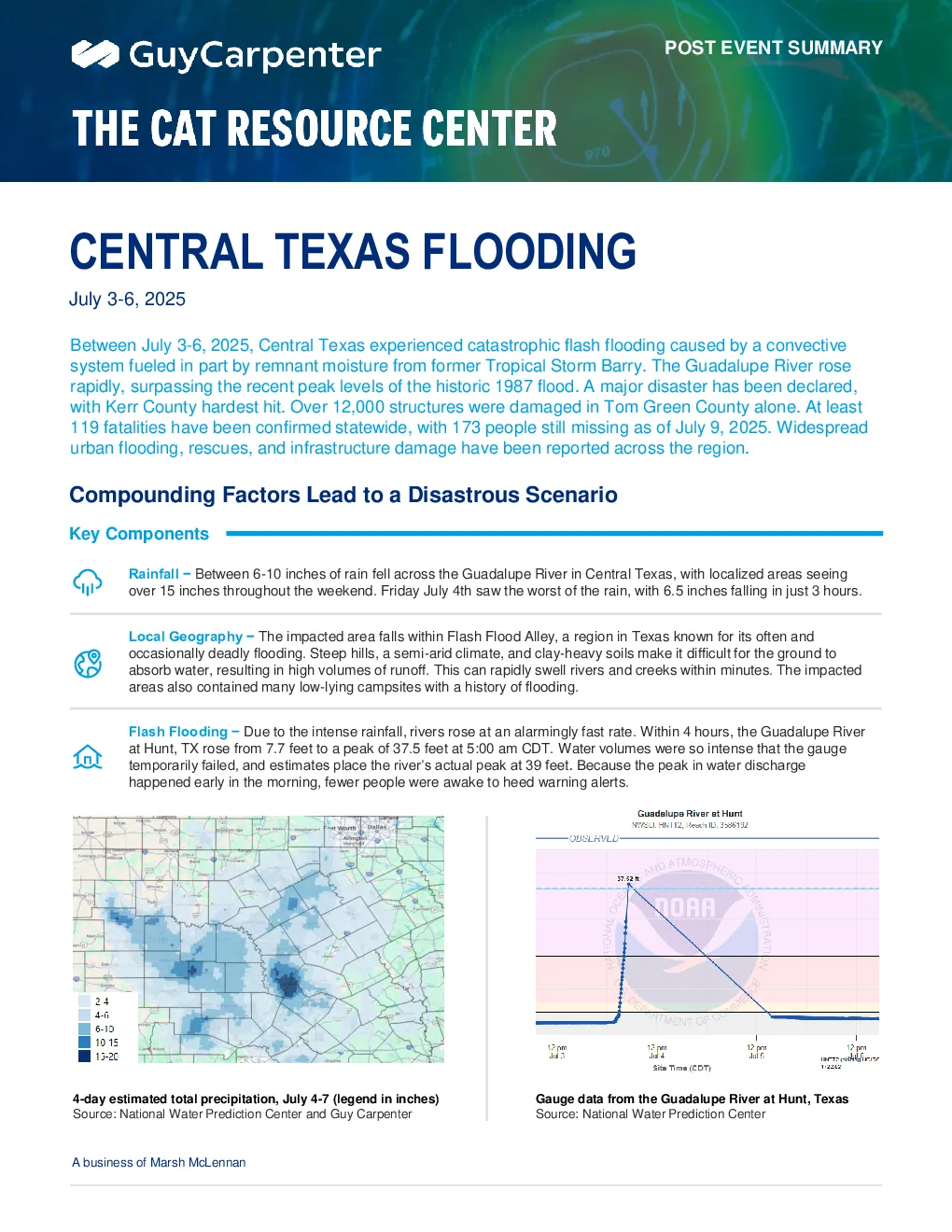
POST EVENT SUMMARY CENTRAL TEXAS FLOODING July 3-6, 2025 Between July 3-6, 2025, Central Texas experienced catastrophic flash flooding caused by a convectivesystem fueled in part by remnant moisture from former Tropical Storm Barry. The Guadalupe River roserapidly, surpassing the recent peak levels of the historic 1987 flood. A major disaster has been declared,with Kerr County hardest hit. Over 12,000 structures were damaged in Tom Green County alone. At least119 fatalities have been confirmed statewide, with 173 people still missing as of July 9, 2025. Widespreadurban flooding, rescues, and infrastructure damage have been reported across the region. Compounding Factors Lead to a Disastrous Scenario Key Components Rainfall −Between 6-10 inches of rain fell across the Guadalupe River in Central Texas, with localized areas seeingover 15 inches throughout the weekend. Friday July 4th saw the worst of the rain, with 6.5 inches falling in just 3 hours. Local Geography −The impacted area falls within Flash Flood Alley, a region in Texas known for its often andoccasionally deadly flooding. Steep hills, a semi-arid climate, and clay-heavy soils make it difficult for the ground toabsorb water, resulting in high volumes of runoff. This can rapidly swell rivers and creeks within minutes. The impactedareas also contained many low-lying campsites with a history of flooding. Flash Flooding −Due to the intense rainfall, rivers rose at an alarmingly fast rate. Within 4 hours, the Guadalupe Riverat Hunt, TX rose from 7.7 feet to a peak of 37.5 feet at 5:00 am CDT. Water volumes were so intense that the gaugetemporarily failed, and estimates place the river’s actual peak at 39 feet. Because the peak in water dischargehappened early in the morning, fewer people were awake to heed warning alerts. 4-dayestimated total precipitation, July 4-7 (legend in inches)Source: National Water Prediction Center and Guy Carpenter A business of Marsh McLennan Storm Timing and Rural Location Notably, the impacted sections of the Guadalupe River are home to popular campsites and summer programs. The 4th of Julyholiday weekend resulted in these rural campsites being busier, and thus more populated, than usual. Some of the camps are builtwithin FEMA regulatory flood zones, as shown below, and the risk of flooding is known in the region. While the local National Weather Service issued warnings ahead of the most intense flooding, the remote area reportedly has poorcell service, and some towns lacked adequate funding for warning sirens. There is currently no evidence to suggest that NWSwarnings were delayed. In addition to the system impacting a remote part of the state, the storm saw its highest intensity early in the morning. Fast-movingnighttime storms can be particularly disastrous, as most people will be asleep when warnings and alarms are issued. Insurance Implications and Guy Carpenter (GC) View of Flood Risk NFIP Take-Up Rates and CRS Class Most Central Texas counties devastated by the July 4 weekend flash flooding show extremely low NFIP participation levels.Despite the well-documented flood vulnerability of the Hill Country, these inland regions lack the insurance coverage seen incoastal counties, such as Harris and Galveston. The disaster along the Guadalupe River underscores the growing protection gapinareas where flood risk is high, but perceived risk and insurance uptake remain low. The Community Rating System (CRS), a voluntary program under NFIP, rewards communities for implementing floodplainmanagement practices that exceed minimum NFIP requirements. Only 17% of CRS-participating communities in Texas haveachieved a Class 5 or better rating, highlighting the limited uptake of the highest flood mitigation standards for the state. NFIP Take-up Rate and CRS Classes for Texas.Source: GC, NFIP, and KatRisk. GC View of Flood Risk GC developed a global riverineflood risk rating product as partof a multi-peril solution toenhance our clients’underwriting and portfoliomanagement. GC also incorporatedadjustments to the baselinefluvial risk rating by modelingthe effects of climate change infuture scenarios of 1.5°C, 2°C,and 3°C of warming to accountfor increased flood potentials. GCFluvial Risk Rating Map, showing Camp Mystic site within ExtremeRiverine Flood Risk.Source: GC Climate Change and Heavy Rainfall Events Heavy Precipitation More Common in a Warmer World The Intergovernmental Panel on Climate Change (IPCC) highlights that heavy precipitation events have increased in frequency andintensity in many regions, leading to greater risks of flooding and other related impacts (IPCC, 2021). For every degree Celsiusofwarming, the atmosphere can hold approximately 7% more moisture. This enhanced moisture content contributes to more intenserainfall events and a higher likelihood of heavy precipitation. The increase in extreme precipitation is not uniform; some regions are experiencing more frequent and intense downpours,