您的浏览器禁用了JavaScript(一种计算机语言,用以实现您与网页的交互),请解除该禁用,或者联系我们。[CEPR]:全球化的现状 - 发现报告

全球化的现状

2025-06-27CEPR杨***
AI智能总结
查看更多
全球化的现状

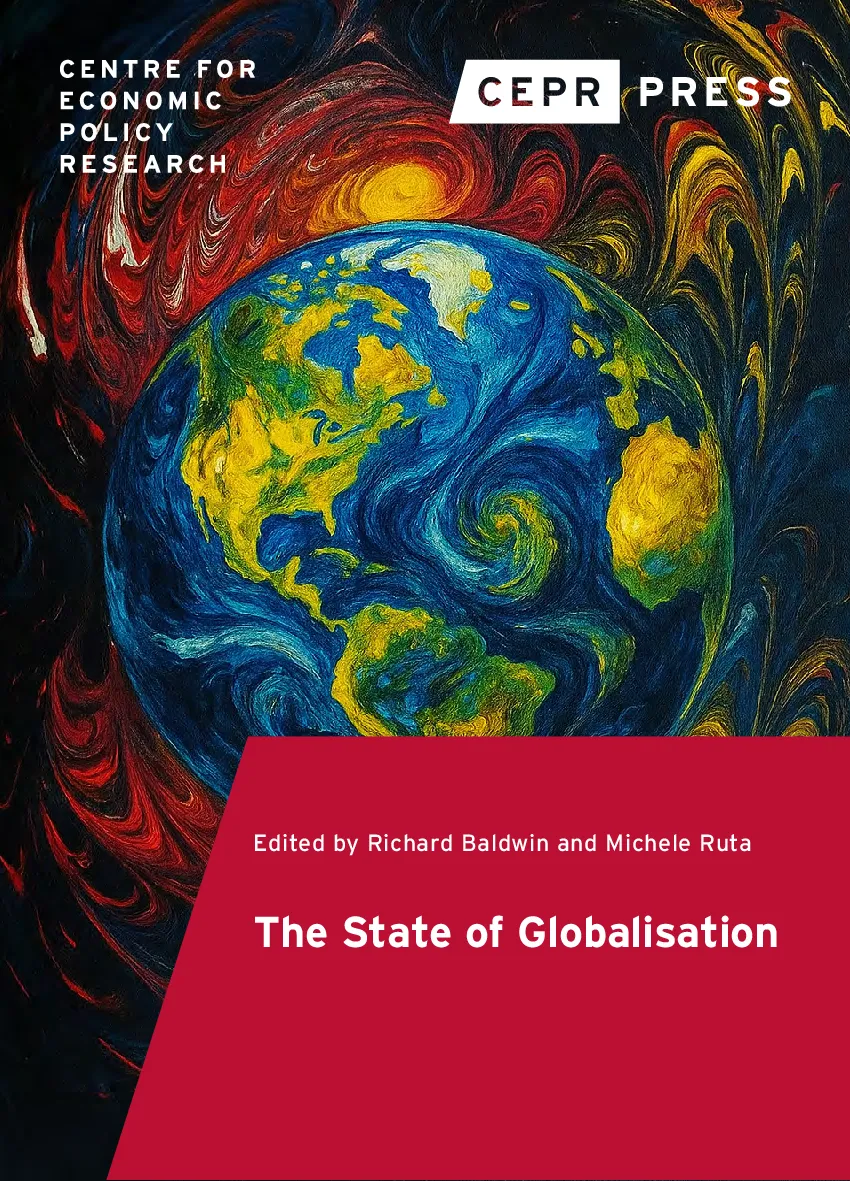
Edited by Richard Baldwin and Michele Ruta The State of Globalisation The State of Globalisation CEPR PRESS Centre for Economic Policy Research187 boulevard Saint-Germain75007, Paris, France 2 Coldbath SquareLondon EC1R 5HL, UK Tel: +44 (0)20 7183 8801Email: cepr@cepr.orgWeb: www.cepr.org ISBN: 978-1-912179-96-1 Copyright © CEPR Press/International Monetary Fund The State of Globalisation Edited by Richard Baldwin and Michele Ruta CENTRE FOR ECONOMIC POLICY RESEARCH (CEPR) The Centre for Economic Policy Research (CEPR) is a network of almost 1,900 researcheconomists based mostly in European universities. The Centre’s goal is twofold: topromote world-class research, and to get the policy-relevant results into the hands of keydecision-makers. CEPR’s guiding principle is ’Research excellence with policy relevance’.It was founded in the UK in 1983, where it is a Charity, and in November 2019 CEPRinitiated the creation of an Association under French law, in order to provide a vehicle foran expansion in France. The members of the Conseil d’Administration of the Associationare identical to the UK Board of Trustees. CEPR is independent of all public and private interest groups. It takes no institutionalstand on economic policy matters and its core funding comes from its InstitutionalMembers, projects that it runs and sales of publications. Because it draws on such a largenetwork of researchers, its output reflects a broad spectrum of individual viewpoints aswell as perspectives drawn from civil society. CEPR research may include views on policy,but the Trustees/members of the Conseil d’Administration of the Association do not giveprior review to its publications. The opinions expressed in this report are those of theauthors and not those of CEPR. Sir Charlie BeanRichard PortesBeatrice Weder di MauroMaristella BotticiniAntonio FatásUgo PanizzaHélène ReyTessa Ogden Chair of the BoardFounder and Honorary PresidentPresidentVice Presidents Chief Executive Officer Contents Forewordvi Introduction: Globalisation in flux1Richard Baldwin and Michele Ruta Part I: Trade and FDI patterns A new Cold War? How trade and investment linkages are changing13Gita Gopinath, Pierre-Olivier Gourinchas, Andrea Presbitero and Petia Topalova The trade cost of geopolitical risks21Alen Mulabdic and Yoto V. Yotov Geoeconomic fragmentation in services? Evidence from a new database29Nan Li and Robert Zymek Enduring dependence: De minimis, transshipment, and US-China trade37Caroline Freund, Aaditya Mattoo, Alen Mulabdic, Michele Ruta, andKarolina Wilczynska Part II: Policies Fragmentation and the future of global value chains49Francesco Paolo Conteduca, Michele Mancini, Giacomo Romanini, Simona Giglioli,Alessandro Borin, Maria Grazia Attinasi, Lukas Boeckelmann, and Baptiste Meunier Industrial policies: Handle with care61Sandra Baquie, Yueling Huang, Florence Jaumotte, Jaden Kim,Rafael Machado Parente, and Samuel Pienknagura Asia became the world’s factory – can it now be the world’s service hub?71Chikako Baba, Rahul Giri, Anne Oeking and Alasdair Scott Policies to facilitate adjustment to globalisation81Prachi Mishra, Lorenzo Rotunno, Michele Ruta, Petia Topalova and Robert Zymek Part III: Trade and the monetary system Trade cooperation under geopolitical rivalry93Aaditya Mattoo, Michele Ruta, Robert W. Staiger Globalisation, fragmentation, and the international monetary system101Barry Eichengreen Foreword This timely and rigorous collection of essays by some of the world’s leading economists,edited by Richard Baldwin (IMD Business School and CEPR) and Michele Ruta (IMF),originates from a conference, jointly organised by the IMF and UTokyo CARF, held inTokyo in April 2025, a moment marked not only by rich scholarly exchange but also byunfolding global events – most notably, the United States’ announcement of major newtrade tariffs. Against this backdrop, conference participants examined how economicintegration is being reshaped by the converging, and at times conflicting, forces oftechnological innovation, policy change, and geopolitical tension. This book sets outto understand these dynamics and their implications for the future of global economicgovernance. THE STATE OF GLOBALISATIONResearch and dissemination on this topic now is more urgent than ever. The globalisationdebate is too often cast in binary terms – either advancing or retreating – yet this volumeshows that the reality is far more complex. The chapters collected here demonstrate thatglobalisation is not retreating but transforming, with cross-border flows of goods, services,investment, and ideas being reconfigured rather than reduced. At CEPR, we believe thatinformed, evidence-based analysis is essential for making sense of these changes andfor equipping policymakers with the tools to respond constructively. By examining notonly the drivers of globalisation but also the institutions that must now evolve to manageit, this book offers valuable insig