您的浏览器禁用了JavaScript(一种计算机语言,用以实现您与网页的交互),请解除该禁用,或者联系我们。 [Jefferies]:2025年废物处理行业的量仍然疲软 - 发现报告

2025年废物处理行业的量仍然疲软

公用事业 2025-06-12 Jefferies 陳寧遠
报告封面

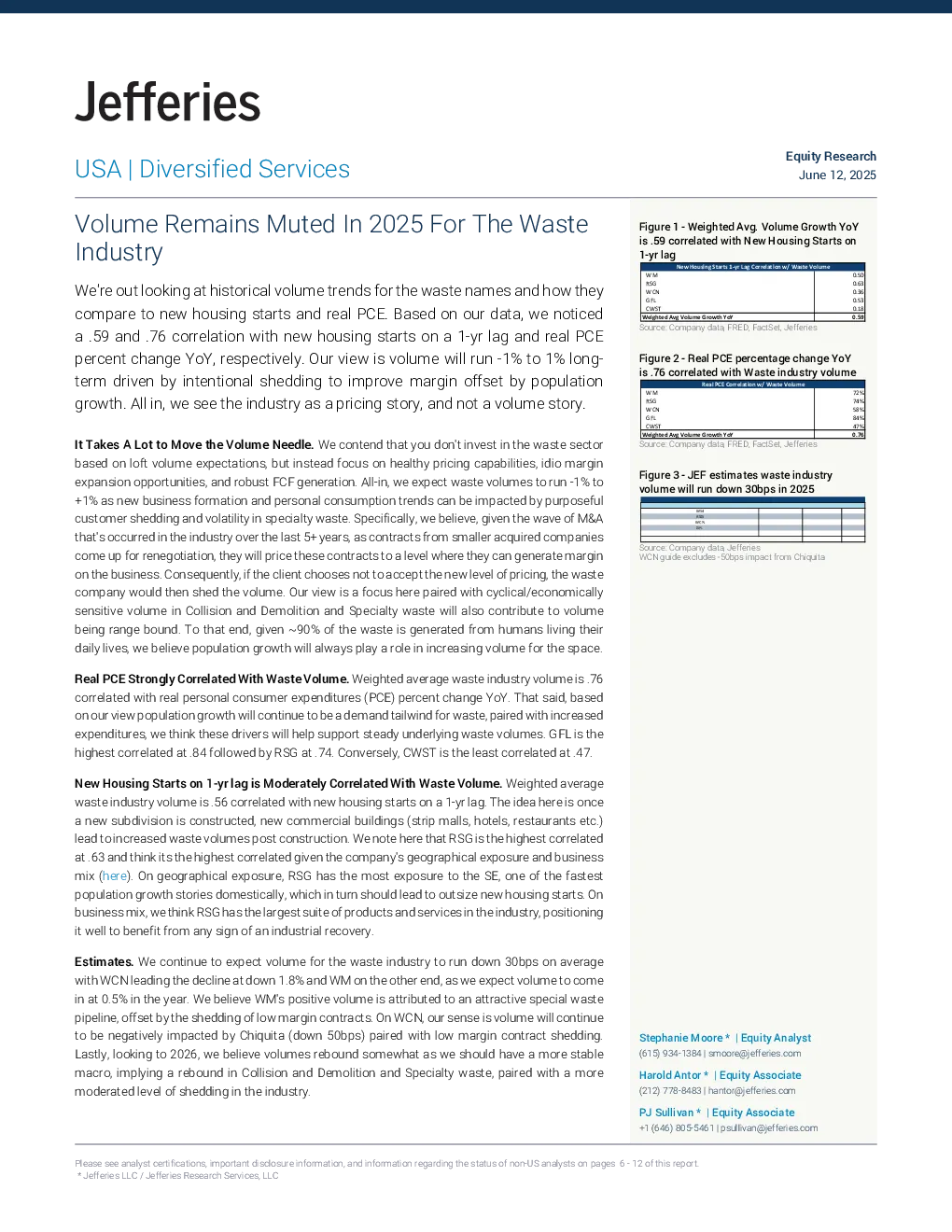
USA | Diversified Services Volume Remains Muted In 2025 For The WasteIndustry We're out looking at historical volume trends for the waste names and how theycompare to new housing starts and real PCE. Based on our data, we noticeda .59 and .76 correlation with new housing starts on a 1-yr lag and real PCEpercent change YoY, respectively. Our view is volume will run -1% to 1% long-term driven by intentional shedding to improve margin offset by populationgrowth. All in, we see the industry as a pricing story, and not a volume story. It Takes A Lot to Move the Volume Needle.We contend that you don't invest in the waste sectorbased on loft volume expectations, but instead focus on healthy pricing capabilities, idio marginexpansion opportunities, and robust FCF generation. All-in, we expect waste volumes to run -1% to+1% as new business formation and personal consumption trends can be impacted by purposefulcustomer shedding and volatility in specialty waste. Specifically, we believe, given the wave of M&Athat's occurred in the industry over the last 5+ years, as contracts from smaller acquired companiescome up for renegotiation, they will price these contracts to a level where they can generate marginon the business. Consequently, if the client chooses not to accept the new level of pricing, the wastecompany would then shed the volume. Our view is a focus here paired with cyclical/economicallysensitive volume in Collision and Demolition and Specialty waste will also contribute to volumebeing range bound. To that end, given ~90% of the waste is generated from humans living theirdaily lives, we believe population growth will always play a role in increasing volume for the space. Real PCE Strongly Correlated With Waste Volume.Weighted average waste industry volume is .76correlated with real personal consumer expenditures (PCE) percent change YoY. That said, basedon our view population growth will continue to be a demand tailwind for waste, paired with increasedexpenditures, we think these drivers will help support steady underlying waste volumes. GFL is thehighest correlated at .84 followed by RSG at .74. Conversely, CWST is the least correlated at .47. New Housing Starts on 1-yr lag is Moderately Correlated With Waste Volume.Weighted averagewaste industry volume is .56 correlated with new housing starts on a 1-yr lag. The idea here is oncea new subdivision is constructed, new commercial buildings (strip malls, hotels, restaurants etc.)lead to increased waste volumes post construction. We note here that RSG is the highest correlatedat .63 and think its the highest correlated given the company's geographical exposure and businessmix (here). On geographical exposure, RSG has the most exposure to the SE, one of the fastestpopulation growth stories domestically, which in turn should lead to outsize new housing starts. Onbusiness mix, we think RSG has the largest suite of products and services in the industry, positioningit well to benefit from any sign of an industrial recovery. Estimates.We continue to expect volume for the waste industry to run down 30bps on averagewith WCN leading the decline at down 1.8% and WM on the other end, as we expect volume to comein at 0.5% in the year. We believe WM's positive volume is attributed to an attractive special wastepipeline, offset by the shedding of low margin contracts. On WCN, our sense is volume will continueto be negatively impacted by Chiquita (down 50bps) paired with low margin contract shedding.Lastly, looking to 2026, we believe volumes rebound somewhat as we should have a more stablemacro, implying a rebound in Collision and Demolition and Specialty waste, paired with a moremoderated level of shedding in the industry. Stephanie Moore * | Equity Analyst(615) 934-1384 | smoore@jefferies.com Harold Antor * | Equity Associate(212) 778-8483 | hantor@jefferies.com PJ Sullivan * | Equity Associate+1 (646) 805-5461 | psullivan@jefferies.com Volume No Longer In Vogue Driven by increased industry consolidation, supply demand dynamics, focus on margin improvement,and improved pricing mechanisms, we believe the weaste sector is more of a pricing story vs. volumestory (here). That said, outside these drivers, we believe volume in the industry will remain range bound,running -1% to 1% long-term mainly due to intentional shedding, particularly on the residential booksfor waste companies, paired with macro sensitive volumes (~10% of volume), offset by populationgrowth. Intentional Shedding Leads To Improved Margin.On intentional shedding, recall when the publicwaste guys acquire private players, the margin in these business are typically lower than theconsolidated margin of the public waste company: solid waste margin for the public waste companiestypically run low to mid 30s vs the private waste companies whose margin run mid to high 20s orlower. As a result, to improve margin in the acquired businesses, once the contracts expire and hittheir renegotiation period (contra