AI智能总结
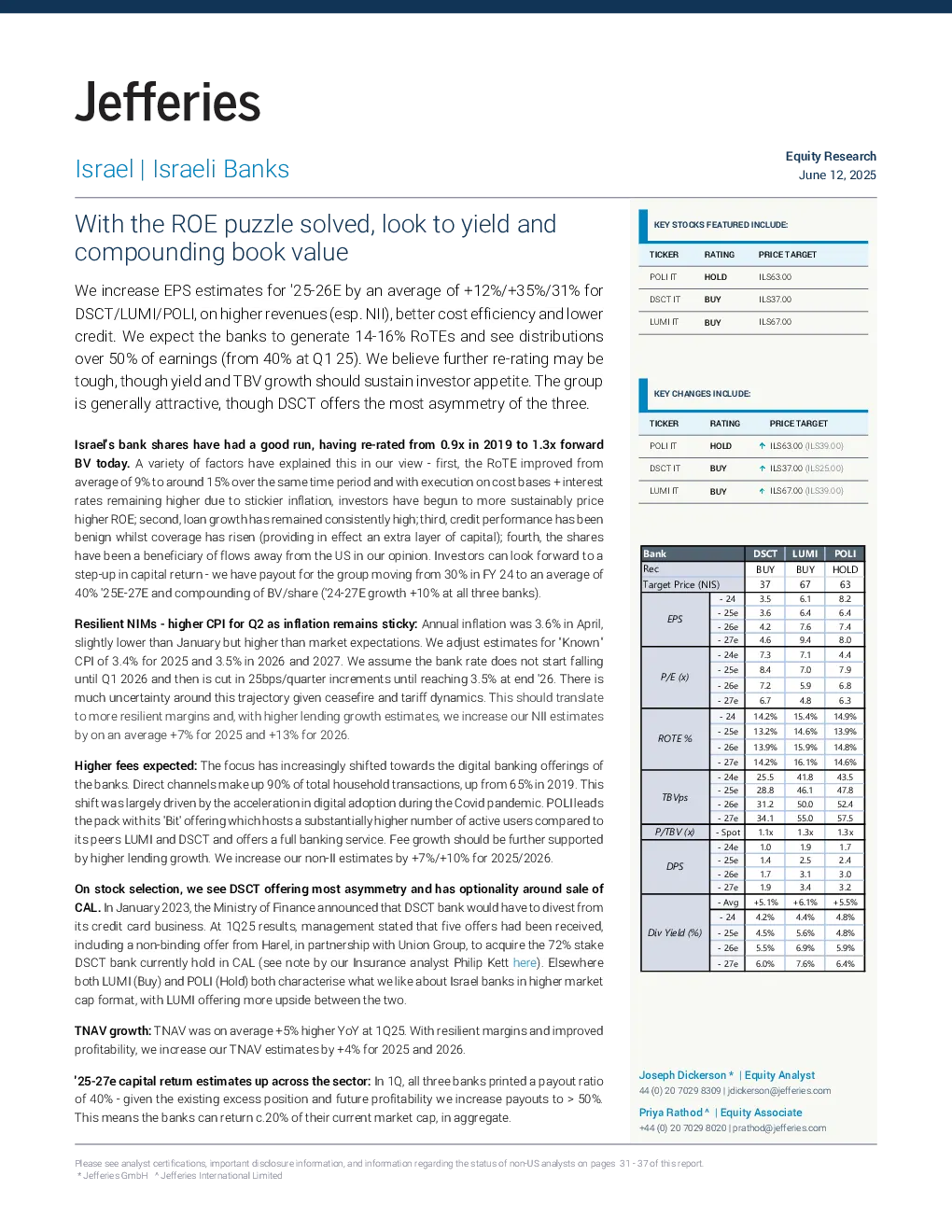
Israel | Israeli Banks With the ROE puzzle solved, look to yield andcompounding book value We increase EPS estimates for '25-26E by an average of +12%/+35%/31% forDSCT/LUMI/POLI, on higher revenues (esp. NII), better cost efficiency and lowercredit. We expect the banks to generate 14-16% RoTEs and see distributionsover 50% of earnings (from 40% at Q1 25). We believe further re-rating may betough, though yield and TBV growth should sustain investor appetite. The groupis generally attractive, though DSCT offers the most asymmetry of the three. Israel's bank shares have had a good run, having re-rated from 0.9x in 2019 to 1.3x forwardBV today.A variety of factors have explained this in our view - first, the RoTE improved fromaverage of 9% to around 15% over the same time period and with execution on cost bases + interestrates remaining higher due to stickier inflation, investors have begun to more sustainably pricehigher ROE; second, loan growth has remained consistently high; third, credit performance has beenbenign whilst coverage has risen (providing in effect an extra layer of capital); fourth, the shareshave been a beneficiary of flows away from the US in our opinion. Investors can look forward to astep-up in capital return - we have payout for the group moving from 30% in FY 24 to an average of40% '25E-27E and compounding of BV/share ('24-27E growth +10% at all three banks). Resilient NIMs - higher CPI for Q2 as inflation remains sticky:Annual inflation was 3.6% in April,slightly lower than January but higher than market expectations. We adjust estimates for "Known"CPI of 3.4% for 2025 and 3.5% in 2026 and 2027. We assume the bank rate does not start fallinguntil Q1 2026 and then is cut in 25bps/quarter increments until reaching 3.5% at end '26. There ismuch uncertainty around this trajectory given ceasefire and tariff dynamics. This should translateto more resilient margins and, with higher lending growth estimates, we increase our NII estimatesby on an average +7% for 2025 and +13% for 2026. Higher fees expected:The focus has increasingly shifted towards the digital banking offerings ofthe banks. Direct channels make up 90% of total household transactions, up from 65% in 2019. Thisshift was largely driven by the acceleration in digital adoption during the Covid pandemic. POLI leadsthe pack with its 'Bit' offering which hosts a substantially higher number of active users compared toits peers LUMI and DSCT and offers a full banking service. Fee growth should be further supportedby higher lending growth. We increase our non-II estimates by +7%/+10% for 2025/2026. On stock selection, we see DSCT offering most asymmetry and has optionality around sale ofCAL.In January 2023, the Ministry of Finance announced that DSCT bank would have to divest fromits credit card business. At 1Q25 results, management stated that five offers had been received,including a non-binding offer from Harel, in partnership with Union Group, to acquire the 72% stakeDSCT bank currently hold in CAL (see note by our Insurance analyst Philip Kett here). Elsewhereboth LUMI (Buy) and POLI (Hold) both characterise what we like about Israel banks in higher marketcap format, with LUMI offering more upside between the two. TNAV growth:TNAV was on average +5% higher YoY at 1Q25. With resilient margins and improvedprofitability, we increase our TNAV estimates by +4% for 2025 and 2026. Joseph Dickerson * | Equity Analyst44 (0) 20 7029 8309 | jdickerson@jefferies.com '25-27e capital return estimates up across the sector:In 1Q, all three banks printed a payout ratioof 40% - given the existing excess position and future profitability we increase payouts to > 50%.This means the banks can return c.20% of their current market cap, in aggregate. Priya Rathod ^ | Equity Associate+44 (0) 20 7029 8020 | prathod@jefferies.com Summary of Changes Table of Contents Rates + credit + growth = better ROEs and positive earnings revisions.4Updated medium-term targets for all three banks6DSCT - sale of CAL7Double clicking on NII8Digital implementation - a cost lever and fee growth driver10Asset quality11Estimate changes - in detail12Appendix18 Rates + credit + growth = better ROEs and positiveearnings revisions. We revise our earnings for the Israeli banks we cover materially upward (see Exhibit 1). There are avariety of assumptions in our prior forecasts that did not materialise as expected: First, this group of asset-sensitive banks has seen better NIM performance than we expected, primarilyattributed to higher inflation & interest rates. We had expected the BoI to directionally follow the FederalReserve on interest but stickier inflation (partially attributable to the war - see Exhibit 2) has kept interestrates higher. On the inflation point, we would remind investors that the banks have a meaningfulcontribution to net interest income from CPI-linked lending (see Exhibit 3 and Exhibit 4). .Source: Company reports, Jefferies Second, balance sheet