您的浏览器禁用了JavaScript(一种计算机语言,用以实现您与网页的交互),请解除该禁用,或者联系我们。[巴克莱银行]:rAlmo的一个人工智能通讯第65期:一个人工智能VAR调查显示应用采用率增长,基础设施仍在发展 - 发现报告

rAlmo的一个人工智能通讯第65期:一个人工智能VAR调查显示应用采用率增长,基础设施仍在发展

AI智能总结
查看更多
rAlmo的一个人工智能通讯第65期:一个人工智能VAR调查显示应用采用率增长,基础设施仍在发展

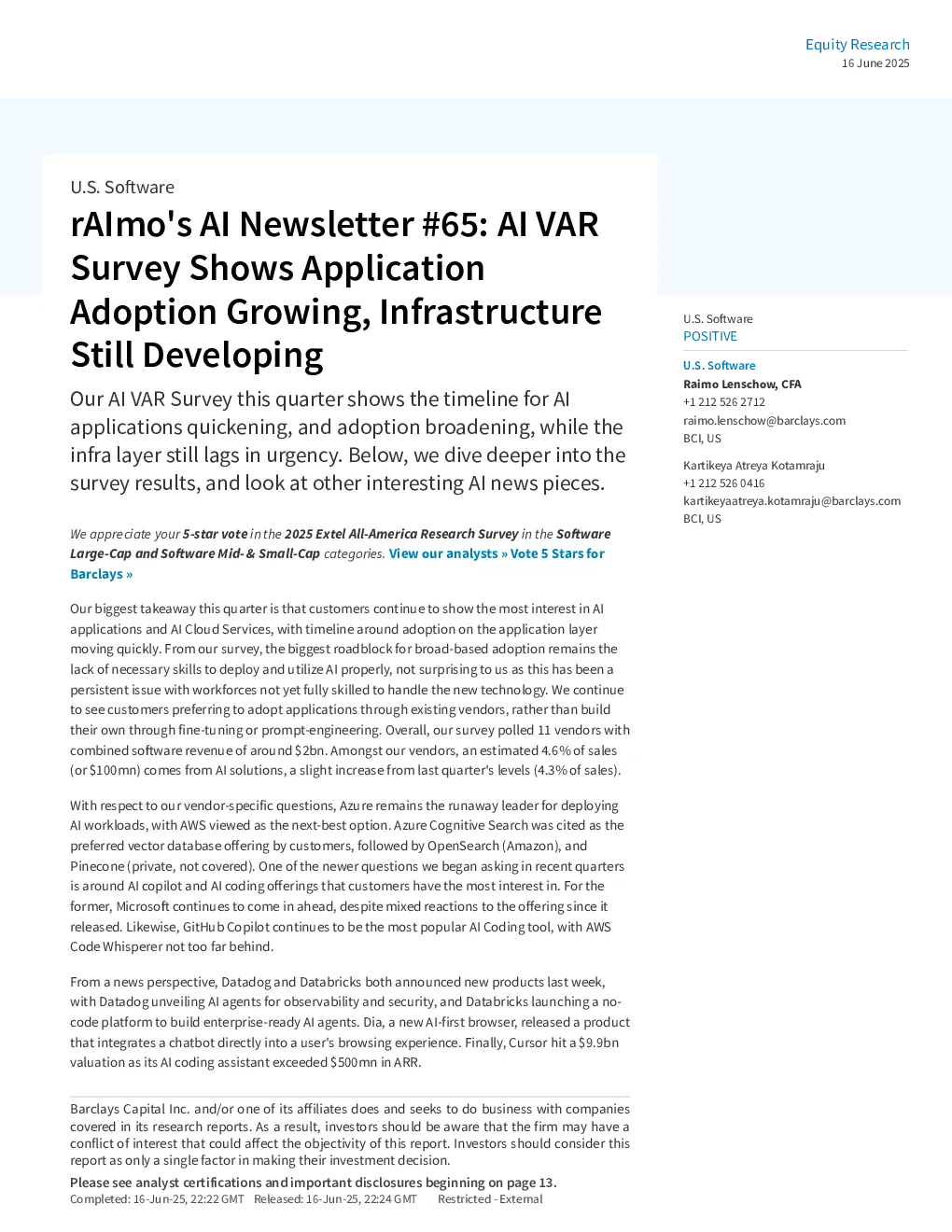
rAImo's AI Newsletter #65: AI VARSurvey Shows ApplicationAdoption Growing, InfrastructureStill Developing U.S.SoftwarePOSITIVE U.S.SoftwareRaimo Lenschow, CFA+1 212 526 2712raimo.lenschow@barclays.comBCI, US Our AI VAR Survey this quarter shows the timeline for AIapplications quickening, and adoption broadening, while theinfra layer still lags in urgency. Below, we dive deeper into thesurvey results, and look at other interesting AI news pieces. Kartikeya Atreya Kotamraju+1 212 526 0416kartikeyaatreya.kotamraju@barclays.comBCI, US We appreciate your5-star votein the2025Extel All-America Research Surveyin theSoftwareLarge-Cap andSoftwareMid- & Small-Capcategories.View our analysts » Vote 5 Stars forBarclays » Our biggest takeaway this quarter is that customers continue to show the most interest in AIapplications and AI Cloud Services, with timeline around adoption on the application layermoving quickly. From our survey, the biggest roadblock for broad-based adoption remains thelack of necessary skills to deploy and utilize AI properly, not surprising to us as this has been apersistent issue with workforces not yet fully skilled to handle the new technology. We continueto see customers preferring to adopt applications through existing vendors, rather than buildtheir own through fine-tuning or prompt-engineering. Overall, our survey polled 11 vendors withcombinedsoftwarerevenue of around $2bn. Amongst our vendors, an estimated 4.6% of sales(or $100mn) comes from AI solutions, a slight increase from last quarter's levels (4.3% of sales). With respect to our vendor-specific questions, Azure remains the runaway leader for deployingAI workloads, with AWS viewed as the next-best option. Azure Cognitive Search was cited as thepreferred vector databaseofferingby customers, followed by OpenSearch (Amazon), andPinecone (private, not covered). One of the newer questions we began asking in recent quartersis around AI copilot and AI codingofferingsthat customers have the most interest in. For theformer,Microsoftcontinues to come in ahead, despite mixed reactions to theofferingsince itreleased. Likewise, GitHub Copilot continues to be the most popular AI Coding tool, with AWSCode Whisperer not too far behind. From a news perspective, Datadog and Databricks both announced new products last week,with Datadog unveiling AI agents for observability and security, and Databricks launching a no-code platform to build enterprise-ready AI agents. Dia, a new AI-first browser, released a productthat integrates a chatbot directly into a user's browsing experience. Finally, Cursor hit a $9.9bnvaluation as its AI coding assistant exceeded $500mn in ARR. How Much AI Spending Is Within Current IT Budgets? The first question we asked VARs this quarter is what % of IT budgets they foresee goingtowards AI in the coming year. Results have changed a bit recently, with 55% of respondentslooking to spend 0-5% of IT budgets on AI (vs. TTM average of 57%) and the remaining 45%looking to spend 5-10% (vs. TTM average of 40%). This blended average of ~5% is in-line withthe % of sales our VARs are attributing to AI, giving us greater confidence in this level beingrepresentative of the broader environment. Following the initial spending in 2023, we thinkCIOs have established more concrete plans around AI, which echoes many of the commentsbeing made by management teams in our space. From a customer standpoint, we increasinglyhear that AI budgets are being somewhat separated from overall IT spend, giving us greaterconviction in the prioritization of these services over time and the durability of this spend. In thenear term, we expect levels to remain range bound at 4-5%, as 64% of survey respondentsindicated they expect spending to move lower due to the economy/investor confidence. FIGURE 1. What % of IT budgets do you foresee going to AI solutions in the coming year? What Are the Largest Roadblocks for Adoption? We next asked VARs about the biggest roadblocks to adopting AI solutions. One of the mostfrequent questions we have been getting from investors over the last year is why isn't AImonetization occurring more quickly, and we see that the main factor here for the sixthconsecutive reading is a "lack of necessary skills". Vendors across our space continue toemphasize that it takes time for customers to learn how to use these products and develop theskills necessary to maximize value out of AI. Persistently high emphasis on skills as a roadblock(39% this quarter, 43% last quarter, and having stayed in this range) demonstrates to us thattraining users on these products and services has been moredifficultthan initially anticipated.We've seen this reflected in company strategy as well, with a number of our vendors andbroader organizations announcing reduction in forces or capital allocations specifically towardssteering their businesses more towards AI. While this has likely served as a headwind forproduct adoption near term, it should be a ca