您的浏览器禁用了JavaScript(一种计算机语言,用以实现您与网页的交互),请解除该禁用,或者联系我们。[Jefferies]:隧道尽头的曙光(升级为买入) - 发现报告

隧道尽头的曙光(升级为买入)

2025-06-03Jefferies陈***
AI智能总结
查看更多
隧道尽头的曙光(升级为买入)

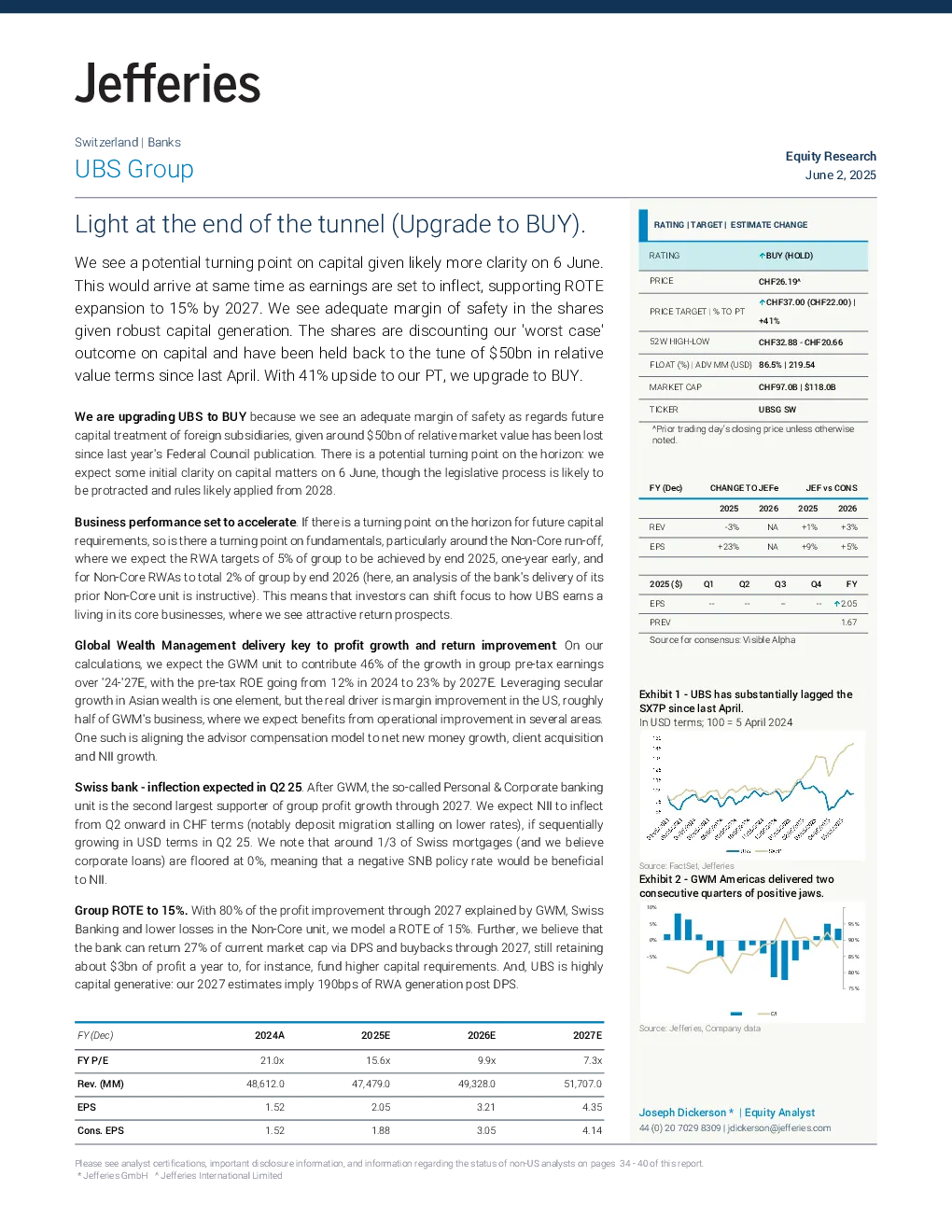
2025E2026E2027E15.6x9.9x7.3x47,479.049,328.051,707.01.522.053.214.351.521.883.054.14 Joseph Dickerson * | Equity Analyst44 (0) 20 7029 8309 | jdickerson@jefferies.com Table of ContentsPortfolio manager's summaryPortfolio manager's summary in chartsFlow of fundsQuality of capital - another issue in the Federal Council TBTF reportNon core & legacy unit - central to near-term capital directionGlobal Wealth ManagementInvestment BankPersonal & Corporate Banking (aka Swiss Bank)ValuationPlease see important disclosure information on pages 34 - 40 of this report.This report is intended for Jefferies clients only. Unauthorized distribution is prohibited. 447111315212528 The Long View: UBS GroupInvestment Thesis / Where We Differ•Shares have been weak since last April's publication of the Federal Council'sTBTF paper - if they had kept up with the SX7P in USD terms, for instance,the market cap might have been $50bn higher. We expect the 6 Junecommunication to shed clarity on the matter, but not fully drawing a lineunder it.•We rate UBS to BUY - we think the risk/reward is shaping up well v otherEuropean and global banks. The shares are at roughly 1x TBV for an ROTEwe see at 15% by 2027 and with high levels of free cash generation (i.e.190bps in 2027 post DPS) and 28% TBV growth '24-'27E.•An opportunity to pick up one of the world's Top 3 wealth managers at areasonable price.Base Case,CHF37, +41%•Revenues '27: $51.7bn•C/I '27: 67%•Reported PBT '27: $16.5bn•EPS '27: $4.35•RWAs '27: $498bn•CET1 '27: 15.1%Price target: CHF 37Sustainability MattersTop Material Issues:1) Following the GFC, regulators, working in concert with governments, created a more rigorous ever-evolving framework of capital and liquidity requirements. How regulators will implement ESG factors intothese requirements will be a critical concern; 2) Fines have become a key tool used by banking regulators,with global banking fines since the GFC exceeding $300bn. How effectively banks adopt ESG-responsiblepractices, particularly consumer protection, will likely determine how exposed they will be to potentialregulatory actions in the future.Company Targets:1) Net zero financed emissions by 2050 o/w $235bn invested assets by 2030. 2) By 2025: Net zero ownoperations & -15% of energy consumption (vs 2020). 3) $400bn in sustainable investments by 2025.Qs for Mgmt:1) What is the near-term & long-term strategy for the investment in GHG-intensive sectors ? 2) What ESGfinancing opportunities, and how meaningful to the bank's performance, is the bank undertaking (greenand transition finance, impact finance)? 3) How do ESG metrics affect the strategy's risk management?ESG Sector Deep Dive: BanksPlease see important disclosure information on pages 34 - 40 of this report.This report is intended for Jefferies clients only. Unauthorized distribution is prohibited. Upside Scenario,CHF42, +60%•Revenues '27: $53bn•C/I '27: 66%•PBT '27: $17.7bn•EPS '27: $4.7Price target: CHF 42 Downside Scenario,CHF22, -16%•Revenues '27: $48bn•C/I '27: 73%•PBT '27: $12.4bn•EPS '27: $3.27Price target: CHF 22Catalysts•6 June: Draft on capital requirement to bereleased by the Swiss Federal Council•30 July 2025: 2Q25 results•29 October 2025: 3Q25 results 3 Portfolio manager's summarySince the Swiss Federal Council released its document on financial stability on 10 April last year(accompanied by press reports such asSwiss Minister Sees UBS's New Capital Needs at $15 Bln to$25 Bln, Tages-Anzeiger Reports- DJ Newswires, 16 April 2024) suggesting a $15-25bn incrementalcapital requirement and without clarity on the form of capital or timeline, shares of UBS havesubstantially lagged Europe's listed bank sector (seeExhibit 3). Thus, on a simply illustrative basis,had UBS's market capitalization kept up with the SX7P in USD terms, it might have been $50bn higher.The investment community has been left having to effectively guess on outcomes and timing forjust over a year. We now have the potential for light at the end of the tunnel on 6 June, when theSwiss Federal Council is expected to opine further on the subject of too-big-to-fail (TBTF) banks ofwhich there is only one (UBS). We would expect the Federal Council to provide some more precisionon two areas - firstly (and of key import) is the backing of foreign subsidiaries and second on themater matter of refining capital quality in areas such as software intangibles and deferred tax assets(DTAs). For the former, ideally, we would like to know the extent to which foreign subsidiaries need tobe covered (from the current 60%) by the parent bank, the mechanism for which this would happen(gradually via a steady increase and met with both CET1 & AT1 capital, or fully backed by CET1)and then the timing (i.e. a multi-year phasing process), given none of this is likely to be applied until2028 for starters, in our view. Our base case is for the more reasonable (in the sense it requires lessonerous mitigating action) outcome: that is UBS will likely to hav