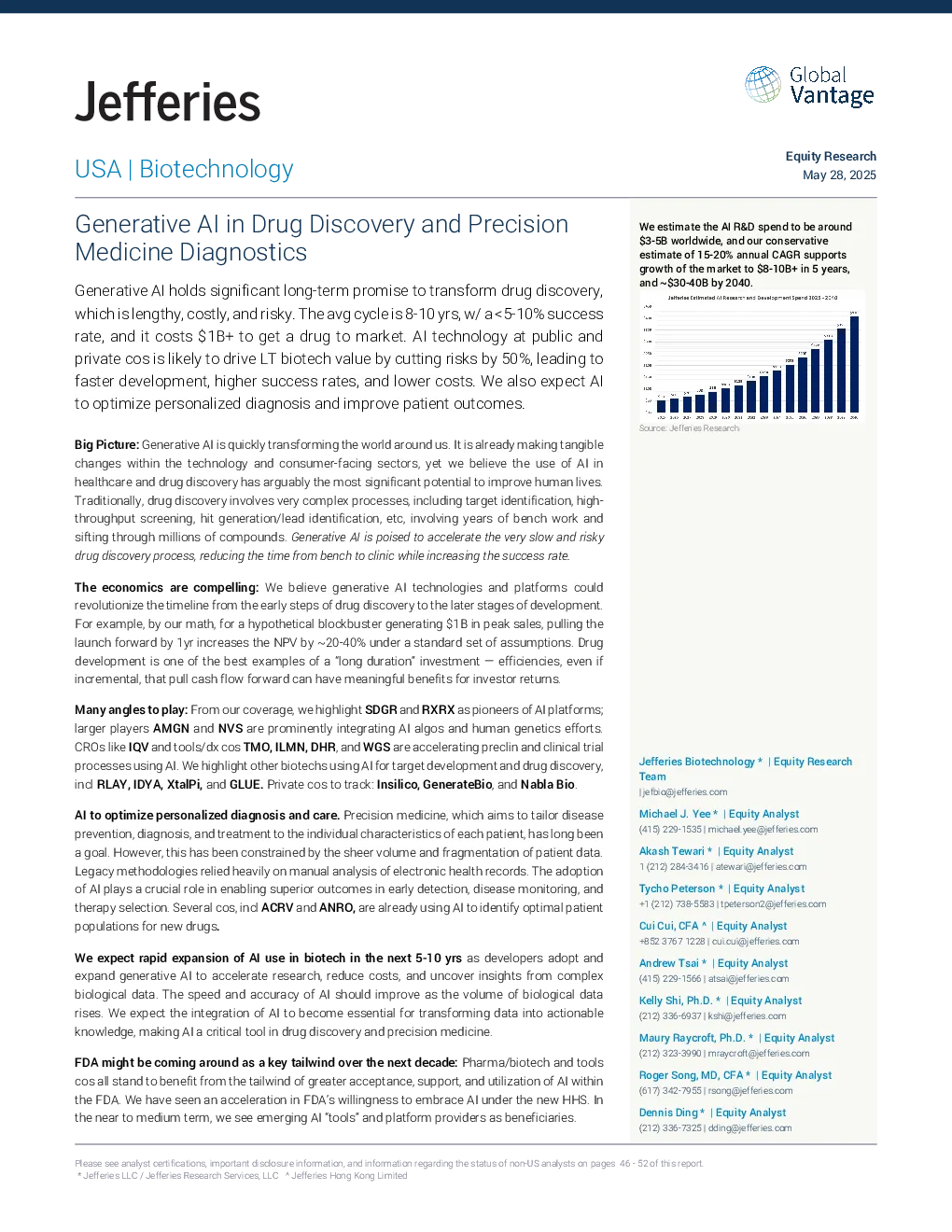
Equity ResearchMay 28, 2025Jefferies Biotechnology * | Equity ResearchMichael J. Yee * | Equity Analyst(415) 229-1535 | michael.yee@jefferies.comAkash Tewari * | Equity Analyst1 (212) 284-3416 | atewari@jefferies.comTycho Peterson * | Equity Analyst+1 (212) 738-5583 | tpeterson2@jefferies.comCui Cui, CFA ^ | Equity Analyst+852 3767 1228 | cui.cui@jefferies.comAndrew Tsai * | Equity Analyst(415) 229-1566 | atsai@jefferies.comKelly Shi, Ph.D. * | Equity Analyst(212) 336-6937 | kshi@jefferies.comMaury Raycroft, Ph.D. * | Equity Analyst(212) 323-3990 | mraycroft@jefferies.comRoger Song, MD, CFA * | Equity Analyst(617) 342-7955 | rsong@jefferies.comDennis Ding * | Equity Analyst(212) 336-7325 | dding@jefferies.comWe estimate the AI R&D spend to be around$3-5B worldwide, and our conservativeestimate of 15-20% annual CAGR supportsgrowth of the market to $8-10B+ in 5 years, Team| jefbio@jefferies.comand ~$30-40B by 2040..Source: Jefferies Research Table of ContentsPortfolio Manager SummarySection 1. Investment ThesisSection 2. AI in Drug Discovery and DevelopmentSDGR, RXRX, XtalPi and Insilico: Scalable Platform CompaniesRLAY, AlphaFold, GLUE, IDYA, and Xaira: Pushing AI-enabled DrugDevelopment ForwardSection 3. AI in Precision and Personalized MedicineACRV, ANRO: Advancing AI-based Approaches to Patient Identification andPrecision MedicineSection 4. AI in Manufacturing, Supply Chains, and CRO / CDMOsSection 5. Industry economics and Regulatory StandardsPlease see important disclosure information on pages 46 - 52 of this report.This report is intended for Jefferies clients only. Unauthorized distribution is prohibited. 35791931324244 Portfolio Manager SummaryGenerative AI holds significant long-term promise to transform drug discovery, which is a lengthy,costly, and risky process.The average cycle is 8-10 yrs, with a <5-10% success rate; it costs $1B+ toget a drug to market. AI technology at public and private cos is likely to drive long-term biotech valueby potentially cutting risks by 50%+ with higher success rates, shorter time to market, and lower cost.AI should also optimize personalized diagnosis and improve outcomes for patients.Generative AI is quickly transforming the world around us. We have already seen utilization of AI,which has brought tangible changes in the technology, and consumer-facing sectors, yet we believethe use of AI in healthcare and drug discovery has arguably the most significant potential to improvehuman lives. Generative AI is poised to accelerate the very slow and risky drug discovery process,reducing the time from bench to clinic while increasing the success rate.Traditionally, drug discovery involves very complex processes, including target identification, high-throughput screening, hit generation/lead identification, etc., involving years of bench work andsifting through millions of compounds. Many companies are at the forefront of using generativeAI technologies and platforms to revolutionize and accelerate processes, particularly to improvethe early stages of discovery, which should improve the likelihood of success in the later steps ofdevelopment.Even the FDA may be starting to come around — a key tailwind.FDA Commissioner Marty Makaryhas recently commented on opportunities for the Agency to accelerate the speed and efficiencyof regulatory reviews by incorporating AI tools (e.g., large language models – LLMs) to assistdrug reviewers and help to streamline applications (e.g., abstracting some parts of applicationswhere appropriate). In the longer term, there could be opportunities for value creation as companiesdecrease overall development timelines by using AI tools and platforms supported by new regulatoryframeworks — e.g., using AI to streamline preclinical testing, optimize trial enrollment, or evensupport full regulatory packages.For investors, earlier launches and additional years of patent exclusivity could translate to billionsin additional cash flow (especially at the “tail” of launches) and higher marginal returns overall.For example, for a hypothetical blockbuster drug generating $1B in peak revenues and launching twoyears from today, pulling the launch year forward by one year increases the NPV of the drug programby ~30-40% under a standard set of assumptions. Drug development is one of the best examplesof a “long duration” investment; thus, efficiencies (even if incremental) that pull revenues and cashflow forward can have meaningful benefits for investment returns.Many angles to play:•From our coverage, we highlightSDGRandRXRXas early pioneers of AI platforms for drugdiscovery, while larger playersAMGNandNVSare prominently talking about AI algos andhuman genetics efforts.•Across healthcare, we note CROs such asIQVand tools/dx cosTMO, ILMN, DHR, andWGSareaccelerating preclinical and clinical trial processes using AI.•We highlight other biotechs using AI for target development and drug discovery includingRLAY,IDYA, XtalPi,andGLUE.•Private cos to track includeInsil