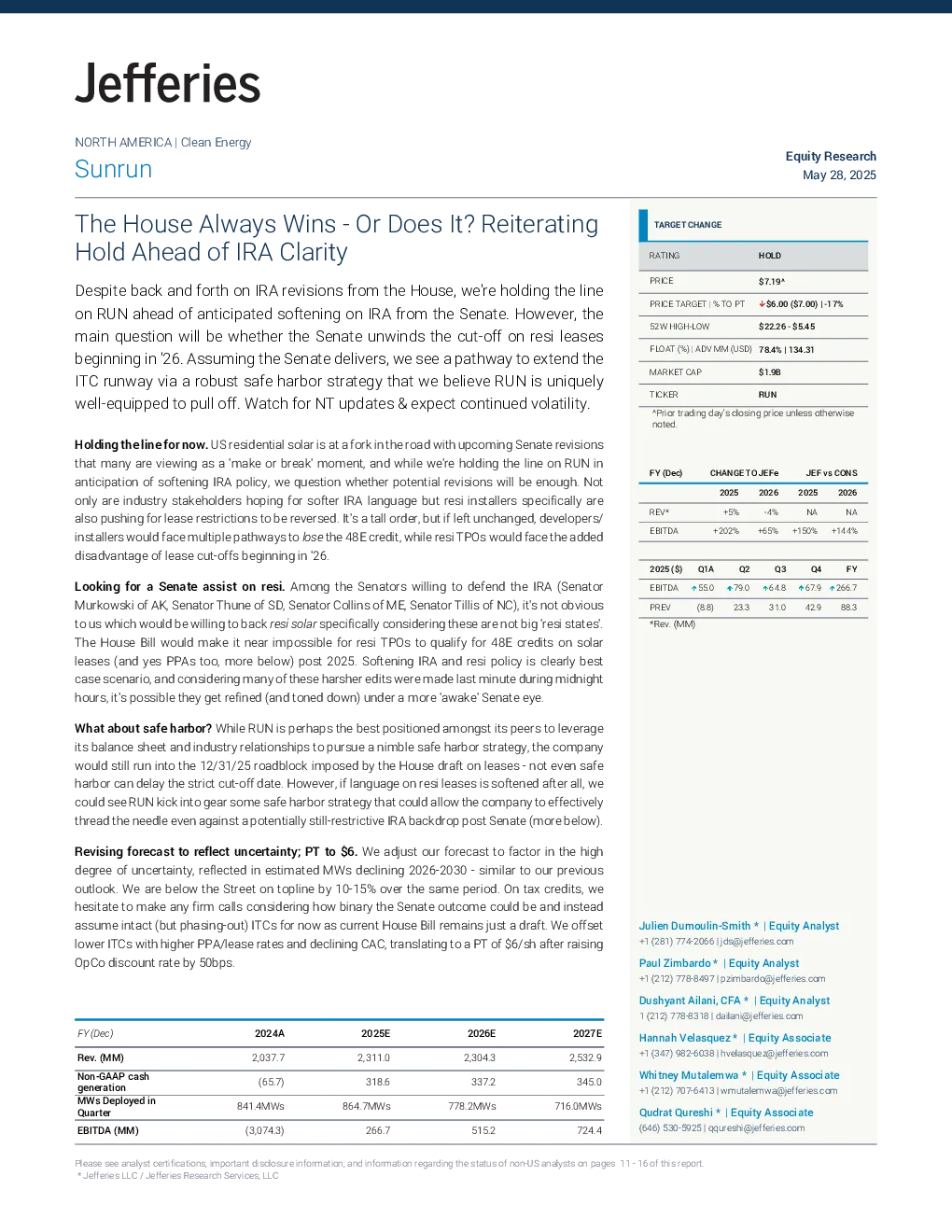
2024A2025E2026E2027E2,311.02,304.32,532.9(65.7)318.6337.2345.0864.7MWs778.2MWs716.0MWs266.7515.2724.4 Julien Dumoulin-Smith * | Equity Analyst+1 (281) 774-2066 | jds@jefferies.comPaul Zimbardo * | Equity Analyst+1 (212) 778-8497 | pzimbardo@jefferies.comDushyant Ailani, CFA * | Equity Analyst1 (212) 778-8318 | dailani@jefferies.comHannah Velasquez * | Equity Associate+1 (347) 982-6038 | hvelasquez@jefferies.comWhitney Mutalemwa * | Equity Associate+1 (212) 707-6413 | wmutalemwa@jefferies.comQudrat Qureshi * | Equity Associate(646) 530-5925 | qqureshi@jefferies.com The Long View: SunrunInvestment Thesis / Where We DifferAs the leading clean energy provider under a subscription service, Sunrunis well positioned to maintain market share and compete effectively againstnew entrants in the space. However, a disappointing 2023/2024 is likely toextend into 2025 while impending policy updates from the Inflation ReductionAct (IRA) raise questions on the overall viability of residential solar, especiallyfollowing the exit of peer Sunpower and challenged positioning of Sunnova.While we see NT upside driven by a positive outcome on IRA, we stress manyunknowns remain that make it difficult to defend any rebound in the space.Base Case,$6, -17%•Our price target assumes uncertainty on IRApolicy translates to a 44% ITC rate in 2025 anddeclining to 34% in 2030, while lack of recoveryon resi solar market impacts origination growth.•We assume RUN raises PPA/lease pricesincrementallyto offset lower tax creditmonetization and lack of origination growth.•We assume cost of debt increases onsecuritized debt to a range of 7.5-8%•We assume a 2.0x multiple on the non-projectbusiness (Systems & Purchase less corporateoverhang).Sustainability MattersTop Material Issue(s):1.GHG Emissions:Companies should be cognizant of the emissions profiles of theirdistribution processes. Companies should prioritize eliminating Scope 1-3 emissionswhere applicable.2.Air Quality:Companies should consider the release of hazardous air pollutants (HAPs)in their operations including, particulate matter (PM 2.5), nitrous oxides (NOx), sulfuroxides (SOx), and other ozone-depleting substances (ODS).3.Materials Sourcing & Efficiency / Waste:Companies should ensure that their materialsare responsibly sourced and follow guidance in reference to “conflict minerals”. Theyshould focus on reducing environmental impact from waste across the value chain.Company Target(s):1)Adopt science-based emissions reduction targets and achieve net zero by 2040;2)Decrease the overall carbon intensity of ops by 20% from 2021 levels by the end of 2030;3)Achieve 100%recycling of solar panels by the end of 2024 and 100% recycling of batteries/inverters by the end of 2025Qs to Mgmt: 1) How do you perceive evolution of cash generation targets?Please see important disclosure information on pages 11 - 16 of this report.This report is intended for Jefferies clients only. Unauthorized distribution is prohibited. Upside Scenario,$11, +53%•Our upside price target is based on higher taxequity proceeds raised (on a $/watt basis) thanthe Base Case, driven by current IRA policyintactthat allows RUN to achieve a~45%blended ITC•We assume same PPA/lease rates as the basecase and interest expense lower vs. base caseby 50bps (7.5-7.75%)•We assume a 4.0x multiple on the non-projectbusiness (Systems & Purchase less corporateoverhang). Downside Scenario,$3, -58%•Our downside price target is based on theassumption that material changes are made toIRA policy such that RUN can no longer maintaina blended ITC rate >40% post 2025 down to~30% by 2031•As an offset, we assume RUN raises PPA/leaseprices while cost of debt is higher than the basecase by 25bps (7.75-8.25%)•We assume a 1.0x multiple on the non-projectbusiness (Systems & Purchase less corporateoverhang).Catalysts•Rising utility rates continues to highlight thevalue prop of resi solar•Updates to IRA policy (reiteration of currentpolicy or material changes)•Improving residential solar market, return togrowth in the market•Backup storage raising margins and NSV 2 Safe harbor still the top priority - what can RUN do?Regardless of how restrictive the currentHouse Bill is on broader IRA policy, the main limiting factor for resi TPOs is undoubtedly the 12/31/25placed in service requirement for resi leases. But if that requirement were to be removed (as this wasinserted at the last minute in the overnight hours of the final House vote), RUN would in theory bewell positioned to execute on a robust safe harbor strategy that would allow the company to meetboth the 'commence construction' and 'place in service' provisions while also avoiding the 2025 YEFEOC limitations. This would be positive for the stock and doesn't necessarily require everything togo right all at once regarding IRA revisions. In fact, we'd consider it ahomeRUNeven if the ban onresi-leases post '25 were removed because it would create a pathway (albeit a narrow one) to safeharboring under s