5月联邦公开市场委员会会议纪要:灵活平均通胀目标制(FAIT)不再适用
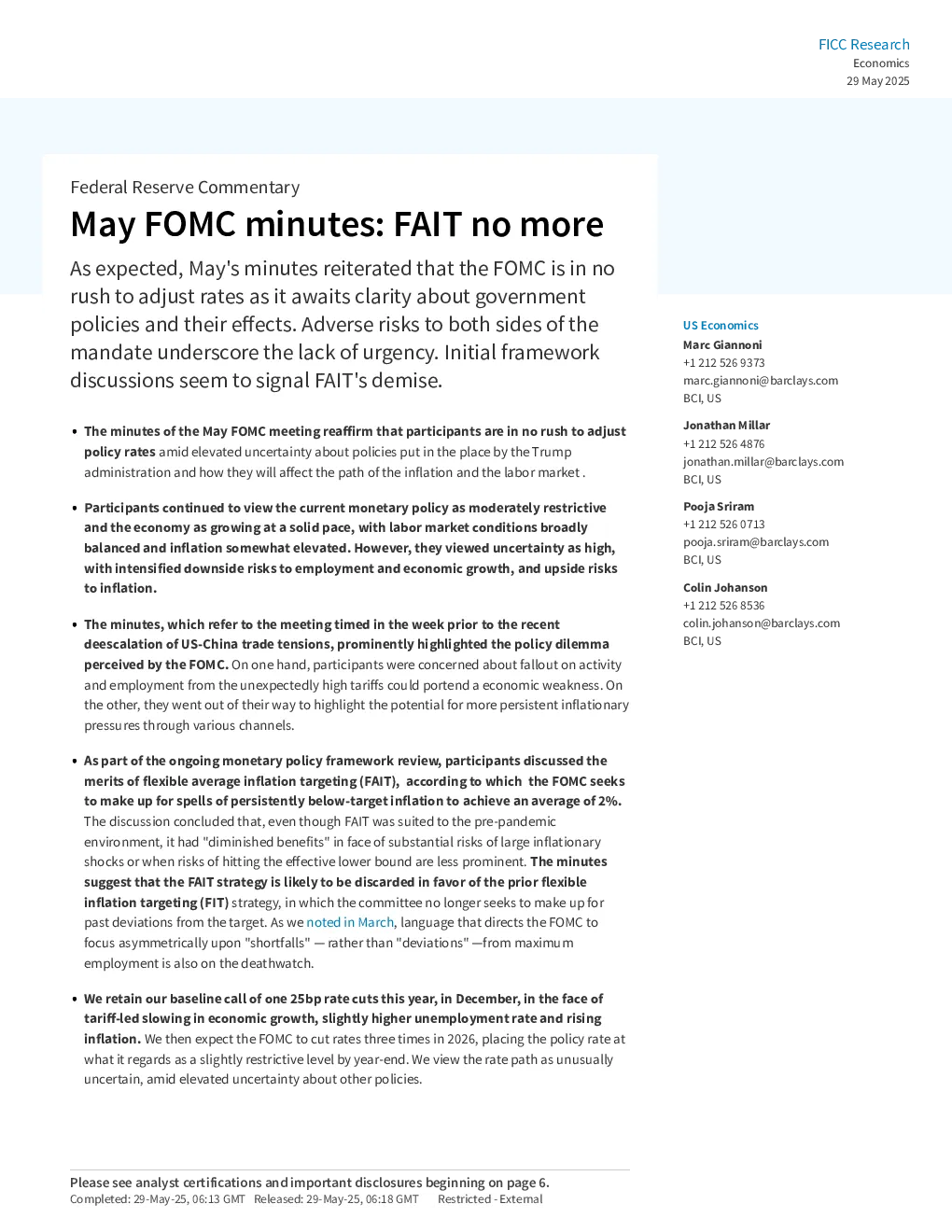
Restricted - External US EconomicsMarc Giannoni+1 212 526 9373marc.giannoni@barclays.comBCI, USJonathan Millar+1 212 526 4876jonathan.millar@barclays.comBCI, USPooja Sriram+1 212 526 0713pooja.sriram@barclays.comBCI, USColin Johanson+1 212 526 8536colin.johanson@barclays.comBCI, US Minutes underscore the Fed's stagflationary dilemmaThe minutes of the May 6-7 FOMC meetingreaffirmedthat participants are in no rush to adjustthe policy rates amid the elevated uncertainty about the path of the economy, inflation andpolicies put in place by the Trump administration. Participants continued to view the economyas growing at a solid pace, with labor market conditions broadly balanced and inflationsomewhat elevated.At the time of the May FOMC meeting, which took place the week prior to the recentdeescalation of US-China trade tensions, FOMC participants assessed that thetariffincreaseshad been "significantly larger and broader than they had anticipated." Accordingly, the minutessuggest that participants had become significantly more concerned about the inflation outlookand elevated inflation expectations than had been the case in prior meetings. They also vieweddownside risks to employment and economic activity as having risen.Economic conditionsFOMC participants assessed that economic activity had continued to grow solidly, with theweakness in real GDP growth in Q1 reflecting swings in next exports and likely measurementissues. While they viewed considerable uncertainty about the evolution of trade policy and itseffectson the economy, they judged that downside risks to employment and economic activityand upside risks to inflation had risen, primarily reflecting the potentialeffectsoftariffincreases.Participants continued viewed inflation as "somewhat elevated," with inflation having madeuneven progress in recent months. However, the minutes suggest that participants had becomesignificantly more concerned about the inflation outlook and elevated inflation expectations.Participants expected inflation to be boosted by highertariffs,with "many" reporting thatbusinesses were planning to pass ontariff-relatedcost increases to consumers, "some" arguingthattariffson intermediate goods could lead to more persistent inflation, and "some"expressing concern that the increase in near-term inflation expectations could also lead firms toraise prices. While participants had regularly mentioned in prior meetings that longer-runinflation expectations remained well anchored despite very large increases in, e.g., theUniversity of Michigan measure of longer-term inflation expectations, they seemed lesssanguine this time around. Indeed "some" participants saw risks that longer-term inflationexpectations coulddriftupward, which could further push up inflation.On the labor market, participants continued to judge that labor market conditions were broadlyin balance, with low unemployment rate, solid employment gains, low levels oflayoffs.Participants saw a risk that labor market conditions would weaken in coming month dependingon trade policy and other government policies.Monetary policyWith inflation remaining somewhat elevated and activity continuing to grow at a solid pace, andthe unemployment rate having stabilized at a low level, "all participants viewed it asappropriate to maintain the target range for the federal funds rate at 4¼ to 4½ percent."Participants also judged it appropriate to continue to reduce the Fed's securities holdings.Regarding the monetary policy outlook, the minutes suggest that the FOMC remains in no rushto adjust rates. They continued to view the current monetary policy as restrictive, and witheconomic growth and the labor market still solid, they thought they were well positioned towait for more clarity on the outlook for inflation and economic activity.In terms of risks,afterhaving seen larger-than-expectedtariffsbeing put in place, "participantsagreed that the risks of higher inflation and higher unemployment had risen." In contrast to2 prior meetings, "almost all participants commented on the risk that inflation could prove to bemore persistent than expected" and "participants emphasized the importance of ensuring thatlonger-term inflation expectations remained well anchored"."... participants agreed that the risks of higherinflation and higher unemployment had risen.Almost all participants commented on the riskthat inflation could prove to be more persistentthan expected. Participants emphasized theimportance of ensuring that longer-terminflation expectations remained well anchored,with some noting that expectations might beparticularly sensitive because inflation had beenabove the Committee’s target for an extendedperiod. Participants noted that the Committeemight facedifficulttradeoffsif inflation proves tobe more persistent while the outlooks for growthand employment weaken." -- Minutes of the May6-7 FOMC meetingStaffprojectionsIn preparation for the FOMC meeting, thestaffprojection for real GDP growth w