您的浏览器禁用了JavaScript(一种计算机语言,用以实现您与网页的交互),请解除该禁用,或者联系我们。[巴克莱]:第一季度第二次GDP:最新估计凸显经济活动放缓 - 发现报告

第一季度第二次GDP:最新估计凸显经济活动放缓

2025-05-29巴克莱陳***
AI智能总结
查看更多
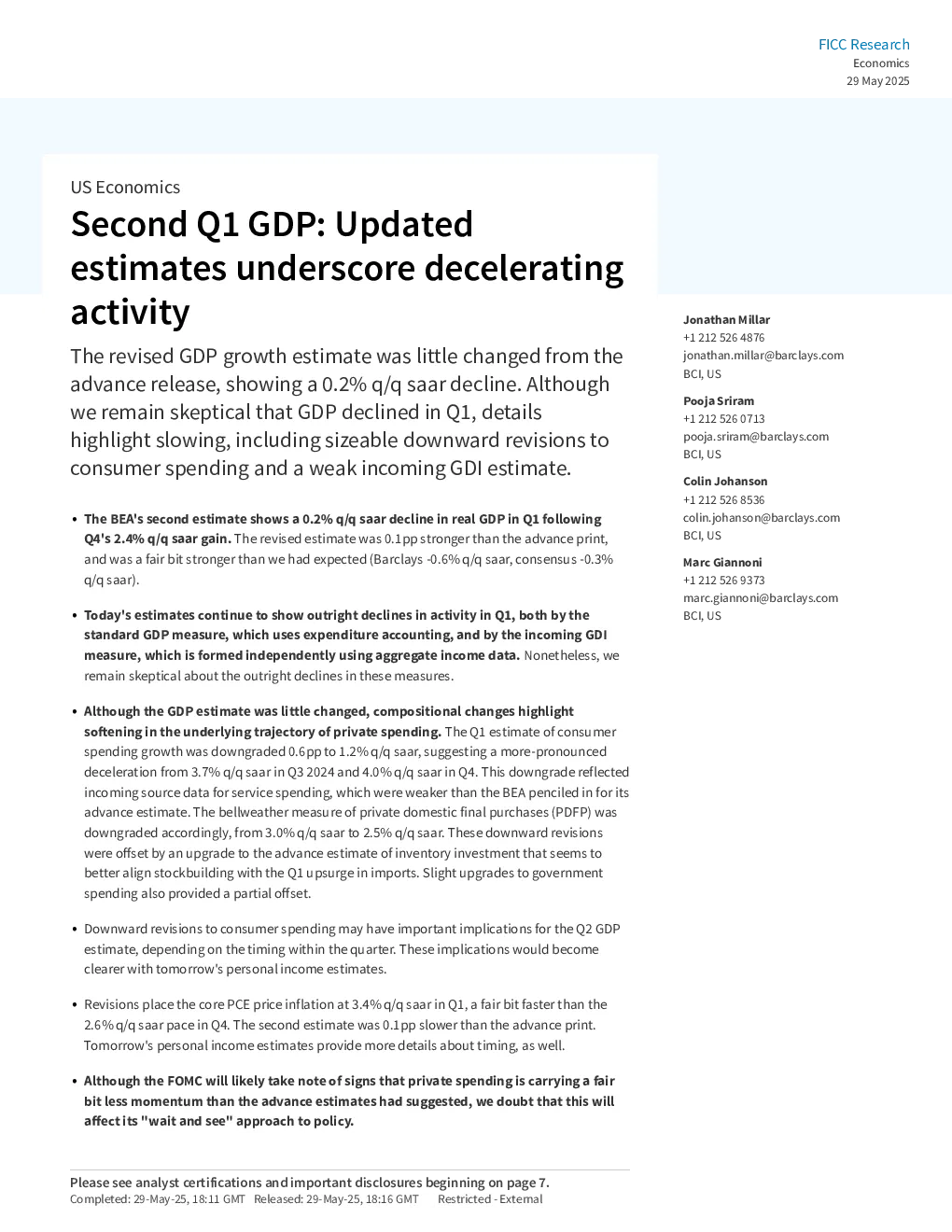
第一季度第二次GDP:最新估计凸显经济活动放缓

Restricted - External Jonathan Millar+1 212 526 4876jonathan.millar@barclays.comBCI, USPooja Sriram+1 212 526 0713pooja.sriram@barclays.comBCI, USColin Johanson+1 212 526 8536colin.johanson@barclays.comBCI, USMarc Giannoni+1 212 526 9373marc.giannoni@barclays.comBCI, US Even with revisions, the Q1 decline in measured GDP remains questionableAs shown in Figure 1, the broad contours of the Q1 estimates are similar following today'srelease. The estimates continue to point to a modest decline in GDP, with a huge mechanicaldrag from net exports (-4.9pp) more thanoffsettingpositive contributions from final domesticexpenditures (+2.2pp) and inventory investment (+2.6pp) (Figure 2). The drag from the tradebalance is more than explained by a 43% q/q saar increase in imports, reflecting front-runningoftariffsthat, as the president had widely telegraphed, were set to takeeffectin April.Nonetheless, we remain skeptical that GDP actually declined in Q1. The drag from imports isonly mechanical. Conceptually, imports are excluded from GDP measurement. By expenditureaccounting, whatever they subtract, in direct terms, should beoffsetby what they contributeindirectly to domestic spending (C+I+G). In practice, this may not be the case due tomeasurement shortcomings. Although today's estimates incorporate a bigger inventoryaccumulation than the initial estimates, our sense is that the latest vintage must eitheroverstate imports, understate inventory accumulation, or some combination of both. As wediscussed in more detail following the advance estimates, available direct measures ofproduction (such as Q1's 1.2% q/q saar increase in industrial production), consumer servicespending (+1.7% q/q saar in today's estimate), and production inputs (such as Q1's 0.8% q/qsaar increase in hours worked) seem inconsistent with aggregate production declines.According to the May FOMC statement, and yesterday's minutes, the Fed had come to a similarconclusion, which has factored into its willingness to remain on hold as developments play out.We suspect that it will retain its skepticism about the measured decline in Q1 GDP. 2 Private final domestic expenditures now show more noticeable signs of deceleration.Theestimates place the pace of increase in PDFP at 2.5% q/q saar, 0.5pp slower than the advanceestimate, and at the low-end of the range of readings seen since year-end 2022 (Figure 4).This revision mainly reflects consumer spending, which was revised down to show a 1.2% q/qsaar increase in Q1 (Barclays 1.4% q/q saar, consensus 1.7% q/q saar), a fair bit slower than the1.8% q/q saar gain in the advance estimate. The bulk of this revision came from servicespending (-0.7pp to 1.7% q/q saar), which was marked down to reflect incoming source datafrom the Quarterly Services Survey (QSS) showing slower gains in healthcare, recreation, andfinancial services than penciled in for the advance estimate. The BEA also downgraded itsestimate for goods spending from 0.5% q/q saar to 0.1% q/q saar, reflecting revisions to sourcedata for retail sales. With these revisions, the latest estimates suggest that consumer spendingposted a broad-based slowdown in Q1 from 4.0% q/q saar to 1.2% q/q saar, despite obviousindications of front-running for automobiles and other durable goods components (Figure 3).Estimates of private fixed investment, both residential and nonresidential, were little changedfrom the advance prints. The one notable development on this front was a 0.5pp upwardrevision to the estimate of intellectual property investment, to 4.6% q/q saar, likely reflectingincoming data onsoftwarespending from the QSS. 3 Inventory metrics point to even morepretariffstockbuilding in Q1.The level of privatenonfarm inventory investment in Q1 was revised up nearly $23bn to $163bn saar, boosting theGDP growth contribution by 0.4pp to 2.7pp. The upward revision appears to reflecteffortsbythe BEA to adjust available book value inventory estimates using industry-level detail, as well asnewly available source data from the Quarterly Financial Reports. With these revisions, variousmeasures now show a more-substantial run-up of stocks in relation to sales (Figure 6), whichmay provide more cushion for businesses to smooth throughtariff-relateddistruptions.4 Source: BEA, Haver Analytics, Barclays Research29 May 2025 The incoming GDI estimate shows imprints from margin pressuresGDI estimates for a given quarter tend to become available with the second GDP estimate, whenthe BEA typically has source data needed to estimate missing income components such ascorporate profits. The incoming estimate shows a 0.2% q/q saar decline in Q1, a notabledownswing from the revised Q4 2024 estimate (+5.2% q/q saar). This latter estimate was revisedup 0.6pp, with the BEA folding in more comprehensive estimates of wage and salarycompensation from Q4 Quarterly Census of Employment and Wages.Looking at contributions to GDI (Figure 9) — which we form using available estimates for various