您的浏览器禁用了JavaScript(一种计算机语言,用以实现您与网页的交互),请解除该禁用,或者联系我们。 [汇丰银行]:步履蹒跚:最新制造业采购经理人指数对亚洲意味着什么 - 发现报告

步履蹒跚:最新制造业采购经理人指数对亚洲意味着什么

2025-06-03 Ines Lam,Frederic Neumann,Abanti Bhaumik 汇丰银行 申明华
报告封面

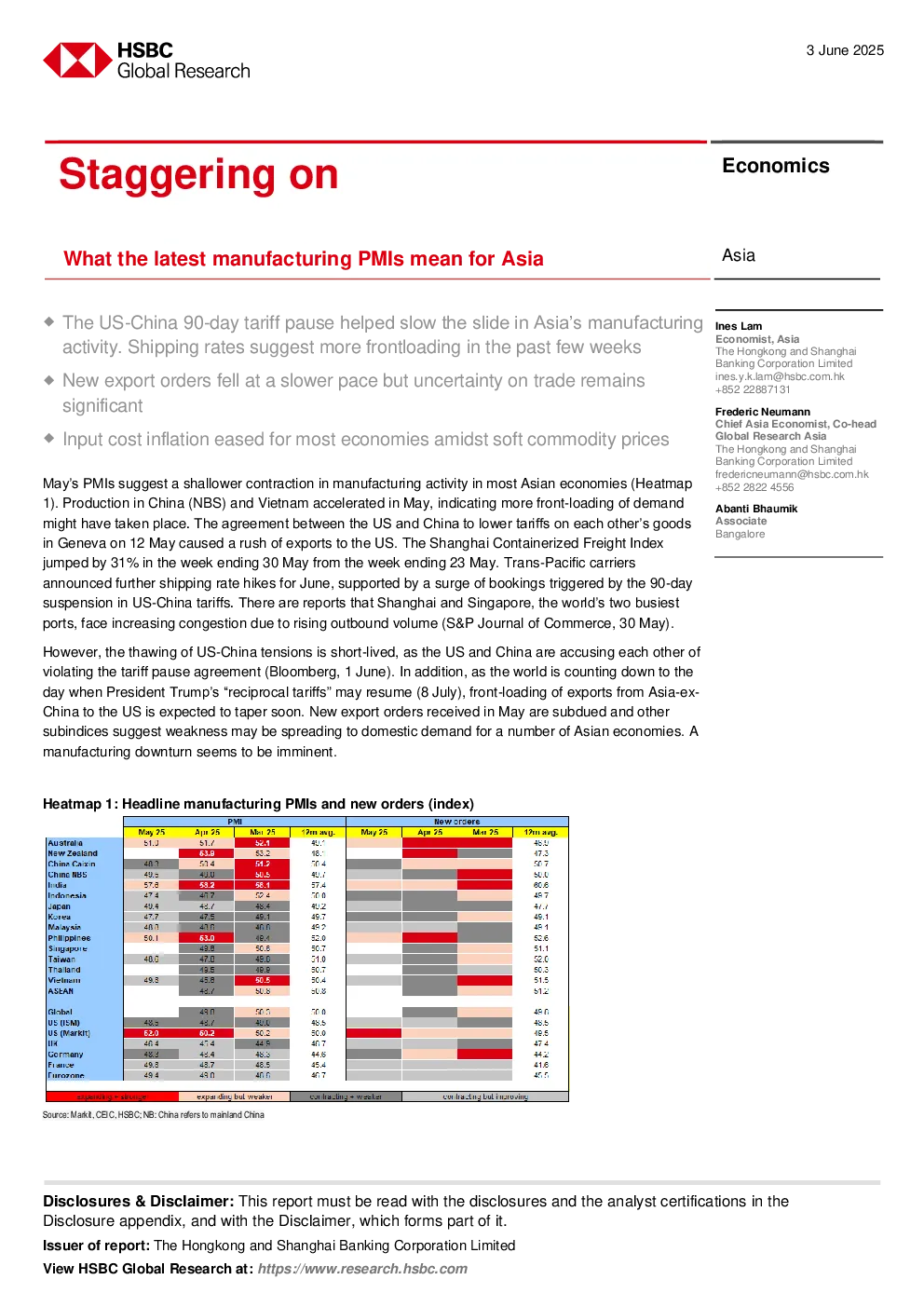
Disclosure appendix, and with theDisclaimer, which forms part of it.Issuer of report:The Hongkong and Shanghai Banking Corporation LimitedView HSBC Global Research at:https://www.research.hsbc.comMay’s PMIs suggesta shallower contraction in manufacturing activity in most Asian economies (Heatmap1).Production in China (NBS) and Vietnam accelerated in May,indicatingmorefront-loadingof demandmighthavetaken place. The agreement between the US and China to lower tariffs on each other’s goodsin Geneva on 12 May caused a rush of exports to the US. The Shanghai Containerized Freight Indexjumped by 31% in the week ending 30 May from the week ending 23 May.Trans-Pacific carriersannounced further shipping rate hikes for June, supported by asurge ofbookingstriggered bythe90-daysuspensioninUS-China tariffs. There are reports that Shanghai and Singapore, the world’s two busiestports,faceincreasingcongestiondue to rising outbound volume(S&PJournal of Commerce, 30 May).However,the thawing of US-China tensionsisshort-lived,as the US and China are accusing each other ofviolating the tariff pause agreement (Bloomberg, 1 June).In addition,as the world is counting downto theday whenPresidentTrump’s“reciprocal tariffs”may resume (8 July), front-loadingof exportsfrom Asia-ex-Chinato the USis expected to taper soon. New export orders receivedin Mayare subduedand othersubindicessuggestweaknessmay bespreading to domestic demand for a number of Asian economies.Amanufacturing downturnseems to beimminent.Heatmap 1: Headlinemanufacturing PMIs and new orders (index)Source:Markit, CEIC, HSBC; NB: China refers to mainland ChinaTheUS-China90-daytariffpausehelped slow the slide in Asia’s manufacturingactivity. Shipping rates suggest more frontloadingin the past few weeksNew export ordersfell at a slower pacebutuncertainty on trade remainssignificantInputcost inflation eased for most economies amidst soft commodity pricesStaggering onWhat the latest manufacturing PMIs mean for Asia ◆◆◆ 2The global PMIfor May was not released yet at the time of writing. Yet apart from the US S&P survey, PMIs in most Asian andEuropean economies were below 50. This suggests the global PMI would very likely also stay below the 50-breakeven level,indicating a contraction in the global manufacturing industry.The S&P survey showsan unexpected increase in US manufacturingsector in May, accompanied bya rise in new export ordersto 50.3,from 45.2 in April(Heatmap 2), suggesting the front-loading ofimports from the US into the rest of the world could also have taken place.On 12 May,China reduced tariffs on American goods from125% to 10%. However, the ISM manufacturingPMI painted a vastly different picture. The headline PMI indicates a larger thanexpecteddeclinein factory activity and the new export orders index shows another steep fall.The imports index plummeted to 39.9,the lowest level since 2009 (April: 47.1, March: 50.1). The sharp decline in foreign inputs portends supply chain disruptionsandfurtherdecreasein production.Chart 1: Manufacturing PMIs: developed markets vs Asia ex-Japan & China (index)Source: S&P Global, CEIC, HSBC; NB: CH refers to mainland China and DM refers to US, UK, Eurozone and JapanNew export orders inChinadeclinedat a faster rate inMay according totheS&P survey.The NBS survey, on the other hand,indicated a smaller contraction.While access to American consumersnarrows as a result of tariffs, China’s export marketis exposedto shrinkingfurtherif other trading partners also raise protectionist measurestargeted atChinese imports, a risk that we have beenflagging (Asia Economics Comment: China and the “tariff cascade”, 17 April 2025).The European Union’s decision to excludeChina’s medical device makers from participating in large public tenders in Europeisthe latestexample of a spread oftradedisputesbetween China and other countries(Reuters, 2 June).Heatmap 2:New export orders and employment (index)Source: S&P Global, CEIC, HSBC; NB: China refers to mainland China 3For Asia ex-Japan and China, theaggregatenew export order index continued to stay above the 50-breakeven lineonly because ofIndia, which carries a large weight in the index (Chart 2). As Heatmap 2 shows, new export orders of most Asian economies were inthe contraction territory, although the fall was at a slower pace in May. This could be because the most precipitous drop already tookplace in April, when Trump announced the reciprocal tariffs.Korea’s new export orders recovered slightly to 48.9 in May from 47 in April. Actualexports in Mayfell by less than expected,supported by strong semiconductor shipments. In addition, the Bank of Korea’s monthly survey for May showed that local exportershave turned more optimistic for the following month. These data points indicated that exportsmay hold up in Q2. In contrast,domestic demand continuesto be the more problematic aspect of the economy.Despite the rise in new export orders, the neworders index dropped to 43.9 in May (April: 45.4), the lo