AI智能总结
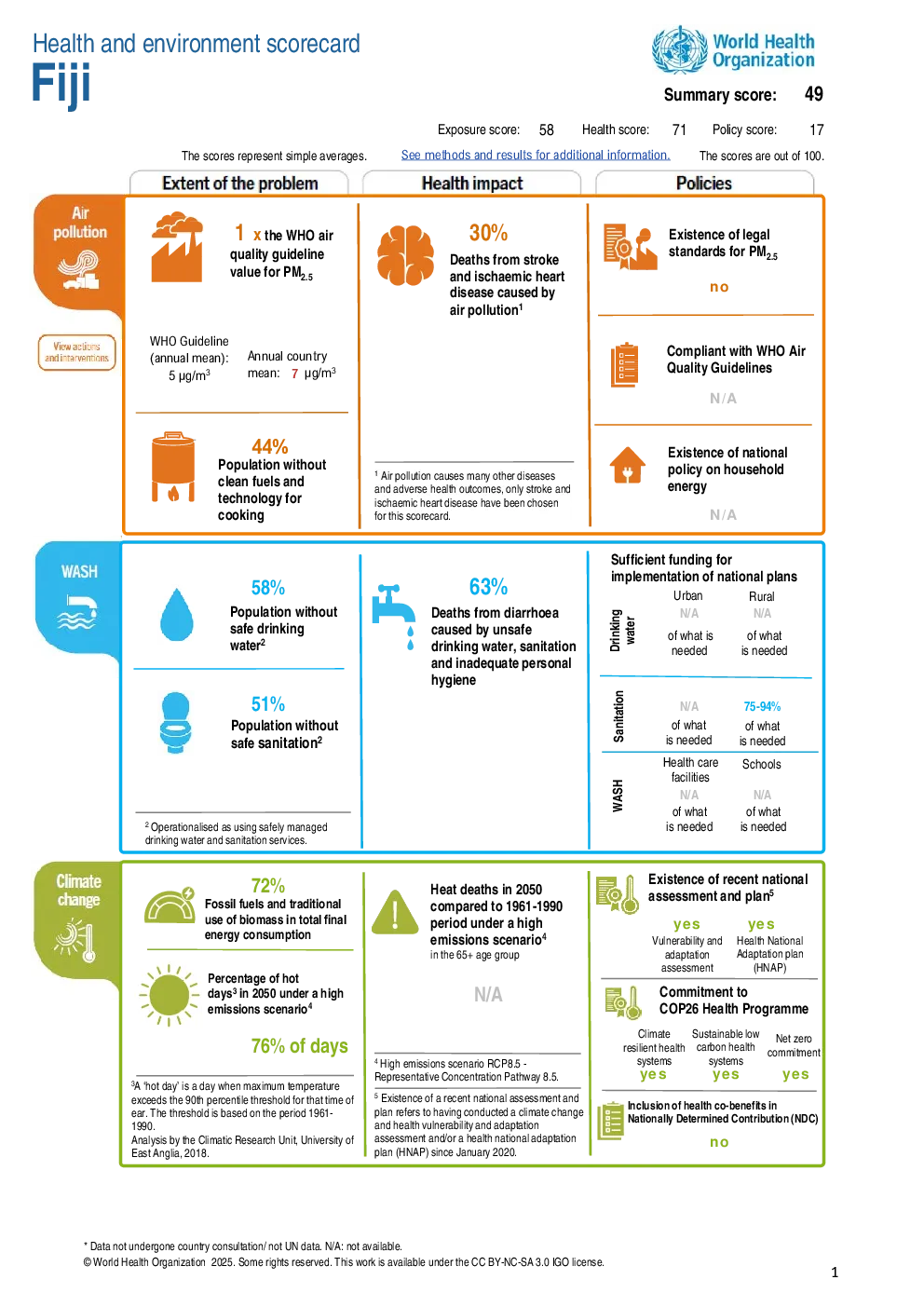
Health and environment scorecardFiji1%21%2 000km22μg/dL80%(out of 100%)80%(out of 100%)Terrestrial and marinearea protectedGlobal target: Conserve 30% of land,waters and seas by 2030.Change in forest area 1990-2020Change in forest area(%)Change in forest area(km2)Mean blood lead level inchildren under 5 years*International Health Regulations(IHR) capacity score for chemicalevents66Key informants report on attainment of a set ofattributes for chemical events (core capacity 14)using a standard WHO instrument.International Health Regulations(IHR) capacity score for radiationemergencies77Key informants report on attainment of a set ofattributes for radiation emergencies (core capacity15) using a standard WHO instrument.View actionsand interventions* Data not undergone country consultation/ not UN data. N/A: not available.© World Health Organization 2025. Some rights reserved. This work is available under the CC BY-NC-SA 3.0 IGO license. Health and environment scorecardFijiN/A9%32%91%58%44%N/APlease access the reading guidehereInformalemployment in totalemploymentWorking agepopulation exposedto long workinghours (≥55 hours/week)Health care facilities withoutbasic servicesHealth care facilitieswithout reliable electricitysupplyView actionsand interventions* Data not undergone country consultation/ not UN data. N/A: not available.© World Health Organization 2025. Some rights reserved. This work is available under the CC BY-NC-SA 3.0 IGO license. Health and environment scorecardFijiReferencesAir pollution- WHO global air quality guidelines 2021- WHO SDG Indicator 11.6.2, Concentrations of fine particulate matter (PM2.5);2019 data- WHO household air pollution data; 2022 data- WHO Air pollution data portal; health impact data for 2019- UNEP 2021: Regulating air quality: the first global assessment of air pollutionlegislation; 2020 data- WHO Household energy policy repository; updated 2024.Water, sanitation and hygiene- WHO, UNICEF: Joint Monitoring Programme for Water Supply, Sanitationand Hygiene; 2022 data- WHO water, sanitation and hygiene: burden of disease, 2019 data- WHO GLAAS 2021/2022 cycleClimate change- IEA 2023: Share of modern renewables in total final energy consumption- WHO Health and Climate Change Country Profiles- Honda et al. 2014; projections for 2050- Kendrovski et al. 2017; projections for 2050- WHO Health and Climate Change Global Survey, 2021- WHO: Alliance forTransformative Action on Climate and Health (ATACH):Country Commitments, 2024 update- WHO 2023: 2023 WHO review of health in nationally determined contributionsand long-term strategies: health at the heart of the Paris Agreement- ATACH baselines, 2024 dataBiodiversity:- World Bank Group, Terrestrial and marine protected areas, 2022 data- World Population Review 2024: Deforestation rates by country- FAO 2020: Global Forest Resources Assessment, 2020 data- CBD Online Reporting Tool 2024, updated 31 December 2024This scorecard is based on already published data (see references). It is a tool to measure and track the progressof Member Statesand is not intended for ranking. Update 2025.* Data not undergone country consultation/ not UN data. N/A: not available.© World Health Organization 2025. Some rights reserved. This work is available under the CC BY-NC-SA 3.0 IGO license. Chemicals- IHME: Lead exposure estimates, 2023 data- WHO: International Health Regulations core capacity scores, 2023 data- WHO: Mortality rate attributed to unintentional poisonings; data for 2021- WHO: Legally binding controls for lead paint, updated 2024- WHO: World directory of poisons centres, updated 2024- UNEP: Minamata Convention on Mercury, 2024 data.Radiation- WHO: International Health Regulations core capacity scores, 2023 data- WHO: Deaths from melanoma and other skin cancers, 2021 data- IHME: Deaths from residential radon, 2021 data- WHO: Electromagnetic fields, updated 2018- WHO: Sunbeds: Existence of national regulations, updated 2021- WHO: Existence of national radon regulations, 2019 data.Occupational health- ILOSTAT: Statistics on the informal economy, updated 2024- WHO: Disease burden from long working hours, 2016 data- WHO/ILO: Joint estimates of the work-related burden of disease and injury,2016 data- Pega et al. 2023- WHO: Occupational Burden of Disease Application- WHO: Existence of national policy instruments for occupationalhealth and safety for health workers, 2023 data- ILO ratifications of:Health care facilities- WHO/UNICEF 2024: WASH in health care facilities 2023 data update:special focus on primary health care- WHO: Database on electrification of health-care facilities, updated 2023- WHO/UNICEF Country progress tracker, updated 2023. C155,161 andC187, updated 2024.