您的浏览器禁用了JavaScript(一种计算机语言,用以实现您与网页的交互),请解除该禁用,或者联系我们。[巴克莱银行]:原则与利息:在未来几个月,量化紧缩(QT)可能在市场中占据更重要的地位。从狭义的原则判断,货币政策委员会(MPC)几乎没有理由暂停积极抛售。然而,从更广泛的公共部门利益角度来看,暂停抛售是合理的,并且将支持金边债券的附加利差(ASW)估值。 - 发现报告

原则与利息:在未来几个月,量化紧缩(QT)可能在市场中占据更重要的地位。从狭义的原则判断,货币政策委员会(MPC)几乎没有理由暂停积极抛售。然而,从更广泛的公共部门利益角度来看,暂停抛售是合理的,并且将支持金边债券的附加利差(ASW)估值。

2025-05-15巴克莱银行艳***
AI智能总结
查看更多
原则与利息:在未来几个月,量化紧缩(QT)可能在市场中占据更重要的地位。从狭义的原则判断,货币政策委员会(MPC)几乎没有理由暂停积极抛售。然而,从更广泛的公共部门利益角度来看,暂停抛售是合理的,并且将支持金边债券的附加利差(ASW)估值。

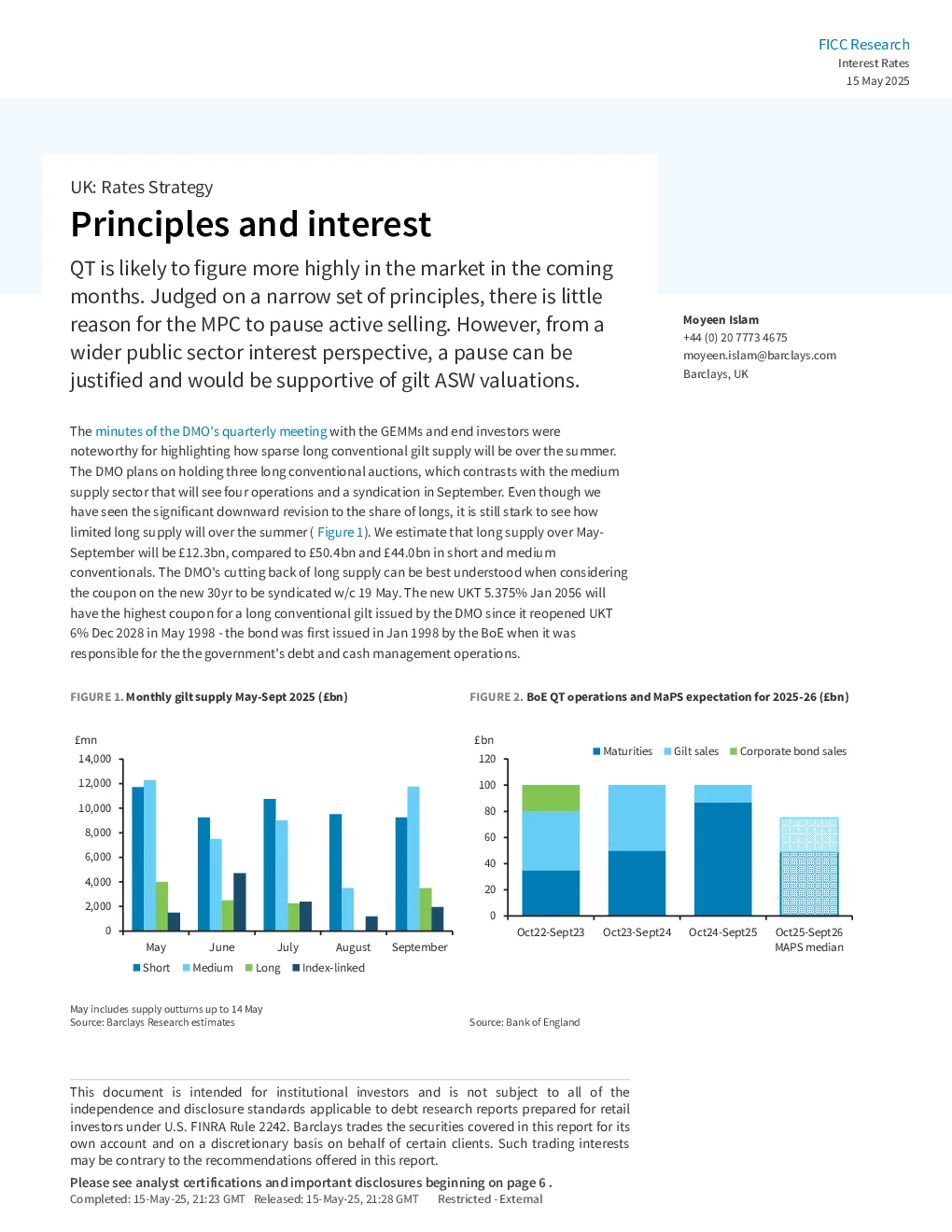
JulyAugustSeptemberLongIndex-linked FIGURE 2. BoE QT operations and MaPS expectation for 2025-26 (£bn)020406080100120Oct22-Sept23Oct23-Sept24£bnMaturitiesSource: Bank of EnglandRestricted - External Oct24-Sept25Oct25-Sept26MAPS medianGilt salesCorporate bond salesMoyeen Islam+44 (0) 20 7773 4675moyeen.islam@barclays.comBarclays, UK FIGURE 3. MaPS Survey expectations for 25/26 QT quantum (£bn)Keeping QT on the QTWithin the context of long supply and market management, there has been increasingdiscussion over prospects for the next round of BoE asset sales ("QT"), which will be decidedupon as part of the MPC's September meeting deliberations. Recall that the current programmewas for a £100bn reduction in the Asset Purchase Facility's (APF) gilt holdings. Figure 2 showsthe historic size of operations broken down by the passive component (maturities) and theactive part (gilt sales). We have added the median expectation from the BoE's latest MaPSsurvey taken before the May MPC meeting for the next period (Oct 2025 - Sept 2026). Here, wesee that the median expectation of the overall quantum of reduction is £75bn. With APFredemptions of £49bn over Oct 2025 - Sept 2026, it implies an active sales size of £26bn. Theoverall expectation for the next period has also evolved since the start of the currentprogramme. Figure 3 shows the 25/50/75 percentile responses for expectations for the overallsize of reduction that survey respondents expect for the Oct 2025 - Sept 2026 period and Figure4 shows the implied range of expectations for active selling (ie, lowered by £49bn, theredemptions due to the APF). For both, we have added the 50th percentile value. Medianexpectations, or the overall expectation for the quantum of QT, had oscillated between£80-85bn up until May, when it dropped to £75bn. This leaves the implied expectation for activeselling as moving between £31-36bn before dropping to £26bn in May with a range ofexpectations of between £13-51bn.Why would expectations have dropped between March and May? The MaPS Survey data wascollected between 23-25 April. It is surely not coincidental that in a market notice issued on 10April, the Bank announced an amendment to its sales programme that saw its reschedule thelong QT operation that had been scheduled for 14 April and replace it with a short operationwith the long operation to be moved to Q3 25. This decision and others regarding the modalitiesof QT operations (pace of reduction, timing and frequency of operations, size of operations, etc.)are taken by the Bank Executive (ie seniorofficialswithin the Bank) and not the MPC. The latteronly authorise the quantum of reduction under advisement from the Bankstaff.The Bank cited"recent market volatility" as the reason for amending the schedule. The reduction inexpectations perhaps is an implicit reflection of the risk that the MPC sees a need to reduce thefootprint of asset sales in the market and adjust any prior expectations accordingly.In assessing this, we should revisit the underlying principles of QT that were most recentlyoutlined in an exchange of letters between Governor Bailey and the Chancellor regarding the FIGURE 4. MaPS implied active selling expectation (£bn)3131363136260102030405060Sep-24Nov-24Dec-24Feb-25Mar-25May-25£bn25th percentile50th percentile75th percentileCalculated by lowering headline expectation by £49bnSource: Bank of England and Barclays Research calculations2 QT is coming into focus againahead of the summerSource: Bank of EnglandExpectations for active sellinghave fallen in the MaPSQT governed by three keyprinciples15 May 2025 operations of the APF. In his correspondence, Governor Bailey reiterated the three key principlesthat underpin the Bank's approach to gilt sales:•the policy rate remains the active tool of monetary policy when adjusting for the stance of•monetary policy;•gilt sales will be conducted so as not to disrupt broader market functionality; and••sales will be conducted in a gradual and predictable way in support of minimising any•market impact.At first glance, it would seem that the market functionality principle might be used by the MPCto scale back the quantum of QT given recent volatility However, in the same letter, GovernorBailey states (our emphasis)"The unwind of the APF has continued to proceed smoothly, andthere has been no evidence of gilt sales having a negative impact on market functioning across arange of financial markets measures".This is a clear refutation of the view that the secondprinciple has been breached from Governor Bailey. By extension, we can infer that this is thecollective view of the Bank Executive that will be reflected to the MPC. If that is the case, thenthere is little to support this being the reason for the MPC to cease active gilt sales. BoE ChiefEconomist Huw Pill described the decision to reschedule the long operation as a "tacticalapproach" but did raise the question as to whether QT might exacerbate bond yields in times ofacute market