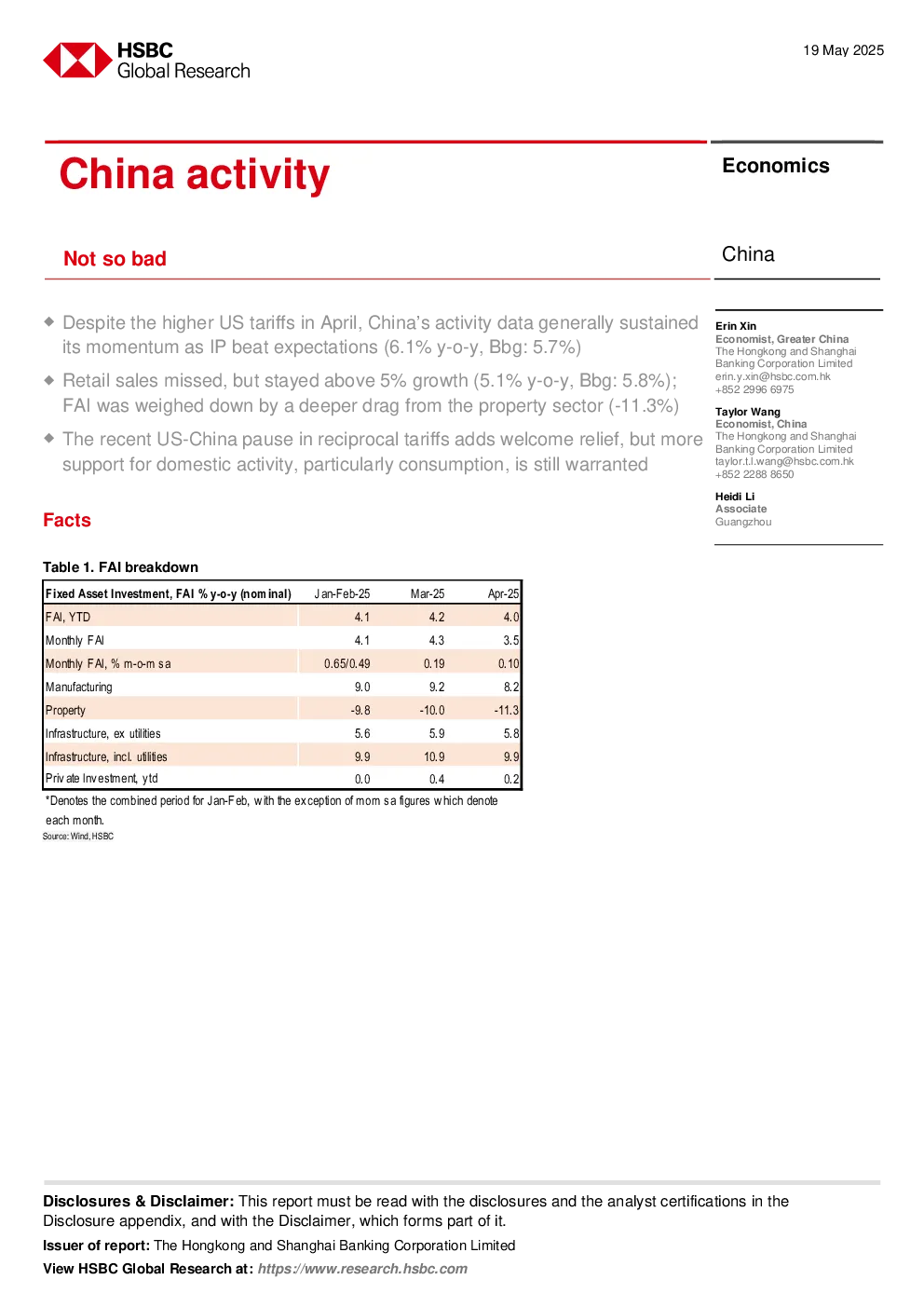
Erin XinEconomist, Greater ChinaThe Hongkong and ShanghaiBanking Corporation Limitederin.y.xin@hsbc.com.hk+852 2996 6975Taylor WangEconomist, ChinaThe Hongkong and ShanghaiBanking Corporation Limitedtaylor.t.l.wang@hsbc.com.hk+852 2288 8650Heidi LiAssociateGuangzhouEconomicsChina Mar-25Apr-254.14.24.04.14.33.50.190.109.09.28.2-9.8-10.0-11.35.65.95.89.910.99.90.00.40.2◆◆◆ 2Source:Wind, HSBCImplicationsApril was a volatile monthdue to the escalationinUS tariffs implemented on Chinese goods, thoughthe hit seems to have beenrelatively limitedon the activity data. And with the recent pauseand pullback in reciprocal tariffsfrom both sides, the dragfrom theexternal side maylessenfornow,withthe potential for bringing upside for growthif the pauseis sustained(seeChina-UStradetalks,12 May).April’sactivitysaw the pace of growth soften across the board, butit wasgenerallystill a strong bill of health.IPgrowthcame inbetter than expected(6.1%; HSBC: 6.2%, Bbg: 5.7%), reflecting the stronger-than-expected exportsgrowthwhich was driven bytrade restructuring(seeChina trade,9 May).Meanwhile,consumptioncontinued tobe pushed by policy supportfrom trade-inprogramsas retail salesrose5.1%(HSBC: 5.7%, Bbg:5.8%), thoughasofterpacethan inMarch(5.9%).Investment(FAIytd 4.0%,HSBC: 4.3%, Bbg: 4.2%)continued to see divergent growth withfiscal policysupporting infrastructure investment, whilemanufacturing investmentsawsome softening, likely due to the heightened uncertainty fromtrade policies.The property sectorremainedadrag askeyindicators showeddeteriorationin April (e.g. sales, investment, prices).The stronger-than-expected AprilIPgrowthhighlights that perhaps the initial hit from theUS reciprocal tariffsmay not besobad.Inthe near term,increased trade diversification with more exports to intermediary markets like ASEAN and LatAmhavehelped to keepproductionlevels elevated,whileanongoing policy push for new growthdrivers have kepthigh-tech sectors more elevated.Byproducts,some labour-intensive sectors such as textiles (2.9%y-o-y)may have been hit due to the increasedexternaluncertainties.There were still some drags fromindustriesalong the domestic housing value chain and with excess capacity, such asnon-metal minerals(e.g. cement) which rose only a tepid0.4% y-o-y.We think ongoing moves toeliminateinefficient capacity andrebalance demand and supplywill still benecessary to revive their prices and profits.**Denotes the combined period for Jan-Feb, w ith the ex ception of mom sa figures w hich denote each month. 3Meanwhile,policy incentives to promote large-scale equipment upgrading (RMB200bn of funding support) as well as cultivatetechnology and innovationhelped boost relatedproduction. Hi-tech and equipment manufacturing wereup 10.0% and 9.8% y-o-yinApril,both faster than headlineIPgrowth.Likewise, high-techrelated investment also continued toreceivea boost, with computer &related equipment and aviation, spacecraft & related equipment investment up 29% and 24% y-o-yytd,respectively.Retail sales sawsofter growth of 5.1%y-o-y,though it was generally still a strong reading. Aside fromMarch’s 5.9%y-o-y growth,retail salesgrowthwasrunning below5% over the last year.Trade-in programs are working asfunding was expanded again(RMB162bn in funds have been released, more than theRMB150bn last year). Covered productshave seenstrongdouble digitgrowth such asincommunication appliances (19.9%y-o-y)andhousehold appliances (38.8%).For autos, volumesalescontinued tobe strong(up 15% y-o-y, whileEVswere up34%, based on CPCA data)though the NBS data showedy-o-y price declines in April,thoughhadnarrowed from March,due in part toongoingprice competition(NBS, 10 May).However,there were some areas of softness in the retail sales data.Fallingglobal crude oil pricesin Aprilcontributed to theretailsales ofpetroleum-related products,which were down5.7% y-o-y.Services consumptionsawsome pullback as cateringsalesofabovedesignated sizeslowed to 3.7% y-o-y. This reflects the still relatively soft consumer confidence, which will likelyneed morepolicy support, particularly on structural aspectssuch as in social welfare, incomeand employment support, to help provide a lift(seeFast and furious tariffs, 17 April).The PBoC recently launched a RMB500bn relending program forservicesconsumption and elderlycare, with financial institutions incitiessuch as Beijing already starting to issue related loans to firms (ce.cn, 14 May).Akey drag on the economy remained the property sector, which saw deeper falls ininvestment (-11.3% y-o-y),primary home sales (-2.4% y-o-yin volume terms)and home prices(second hand home prices-0.4% m-o-m).The government may need to step upsupport to help reverse the slump, and itstill has ample tools to do so.Data from CRIC showed that issuance of SLGBs aimedatland acquisition exceeded RMB170bn in April, more thanfirst three months combined (stcn, 15 May).Meanwhile, the centralgovernment alsoannouncedto use proceeds from ultra-long dated special treasury