股票波动动态的现实建模
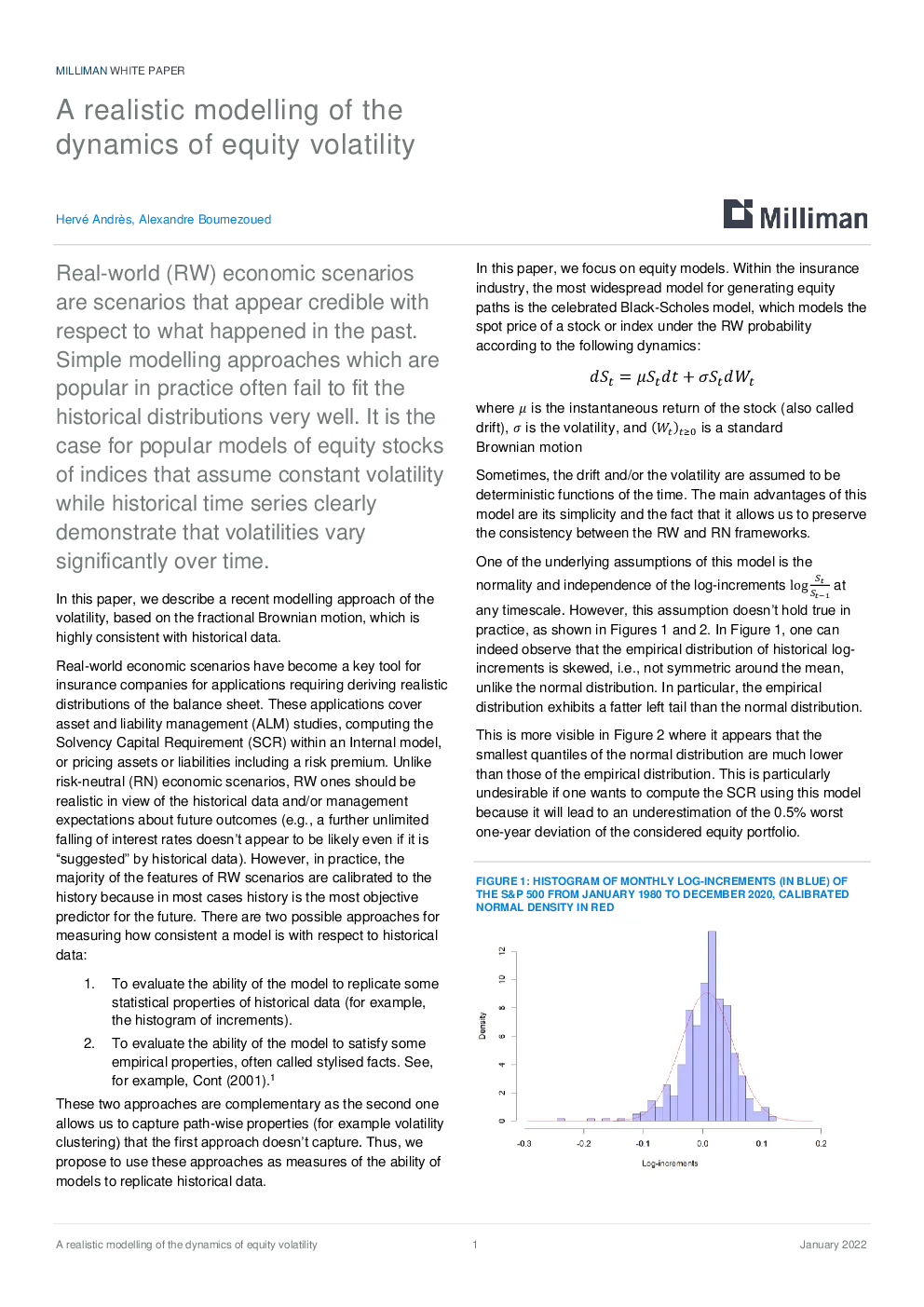
A realistic modelling ofthedynamics ofequityvolatility Hervé Andrès, Alexandre Boumezoued In this paper, we focus on equity models. Within the insuranceindustry, the mostwidespread model for generating equitypaths is the celebrated Black-Scholes model, which models thespot price of a stock or index under the RW probabilityaccording to the following dynamics: Real-world(RW)economic scenariosare scenarios that appear credible withrespect to what happened in the past.Simple modelling approaches which arepopular in practice often fail to fit thehistorical distributions very well. It is thecase forpopular models of equity stocksof indicesthatassume constant volatilitywhile historical time series clearlydemonstrate that volatilities varysignificantlyover time. where𝜇is the instantaneousreturn of the stock (also calleddrift),𝜎is the volatility,and(𝑊𝑡)𝑡≥0is a standardBrownian motion Sometimes, the drift and/or the volatility are assumed to bedeterministic functions of the time. The main advantages of thismodel are its simplicity and the fact that it allowsusto preservethe consistency between the RW and RN frameworks. One of theunderlying assumptions of this model is thenormality and independence of the log-incrementslog𝑆𝑡𝑆𝑡−1atany timescale. However, this assumption doesn’t hold true inpractice, as shown in Figures 1 and 2. In Figure 1, one canindeed observe that the empirical distribution of historical log-increments is skewed, i.e.,not symmetric around the mean,unlike the normal distribution. In particular, the empiricaldistribution exhibits a fatter left tail than the normal distribution. In this paper, we describe arecentmodelling approachof thevolatility, based on the fractional Brownian motion, which ishighly consistent with historical data. Real-world economic scenarios have become a key tool forinsurance companies for applications requiring deriving realisticdistributions of the balance sheet. These applications coverasset and liability management (ALM)studies, computing theSolvency Capital Requirement(SCR)within an Internal model,or pricing assets or liabilities including a risk premium. Unlikerisk-neutral(RN)economic scenarios,RWones should berealistic in view of the historical dataand/or managementexpectations about future outcomes (e.g.,afurther unlimitedfalling of interest ratesdoesn’t appear to be likely even if itis“suggested” by historical data).However, in practice, themajority ofthe features ofRWscenarios are calibrated to thehistorybecausein most cases history is the most objectivepredictor for the future. There are twopossibleapproachesformeasuring how consistenta modeliswith respect to historicaldata: This is more visible inFigure 2 where it appears that thesmallest quantiles of the normal distribution are much lowerthan thoseof the empirical distribution. This is particularlyundesirable if one wants to compute the SCR using this modelbecause it will lead to an underestimation of the 0.5% worstone-year deviation of the considered equity portfolio. 1.Toevaluate the abilityof themodel to replicate somestatistical properties of historical data (for example,the histogram of increments). 2.Toevaluate the ability of the modelto satisfy someempirical properties, often calledstylisedfacts.See,for example,Cont (2001).1 These two approaches are complementary as the second oneallowsusto capture path-wise properties (for examplevolatilityclustering) that the first approach doesn’t capture. Thus, wepropose to use these approaches as measures oftheability ofmodels to replicate historical data. Formally, the fBm(𝑊𝑡𝐻)𝑡∈ℝis a centered self-similar Gaussianprocess with stationary increments satisfying the followingscaling property: with𝐾𝑞=𝔼[|𝐺|𝑞]and𝐺~𝒩(0,1). In particular, the increments𝑊𝑡+Δ𝐻−𝑊𝑡𝐻of a fBmare normally distributed with mean 0 andvarianceΔ2𝐻. Moreover, when𝐻=12the fBm reduces to the standardBrownian motion (and independence between increments isrecovered in that case). A natural way to improve this modelling is to assume that thevolatility is not deterministic anymore but stochastic. Suchextension is not new andthe first successful attempt toconstruct a continuous-time model with stochastic volatility isdue to Heston (1993).2In the original paper, this model hasbeen constructed for RN modelling,butsimilar dynamics couldbe also considered in a RW framework, where the parametersof the Cox-Ingersoll-Ross stochastic volatility dynamics arederived from the price timeseries. An alternative modellingapproach is to use aGeneralised AutoRegressive ConditionalHeteroscedasticity(GARCH)process. Although it is not strictlyspeaking a continuous-time stochastic volatility model, it allowsusto achieve a good fit to financial time series. Moreover, itallows for volatility clustering, which is a widely acceptedstylisedfact. The Hurst parameter𝐻allowsusto control the regularity (inthe sense of Hölder) of the sample paths of𝑊𝐻: when𝐻iscloser toone, the sample paths becom