您的浏览器禁用了JavaScript(一种计算机语言,用以实现您与网页的交互),请解除该禁用,或者联系我们。[IRENA]:尼泊尔农业分散的可再生能源 - 发现报告

尼泊尔农业分散的可再生能源

农林牧渔2025-05-16IRENA张***
AI智能总结
查看更多
尼泊尔农业分散的可再生能源

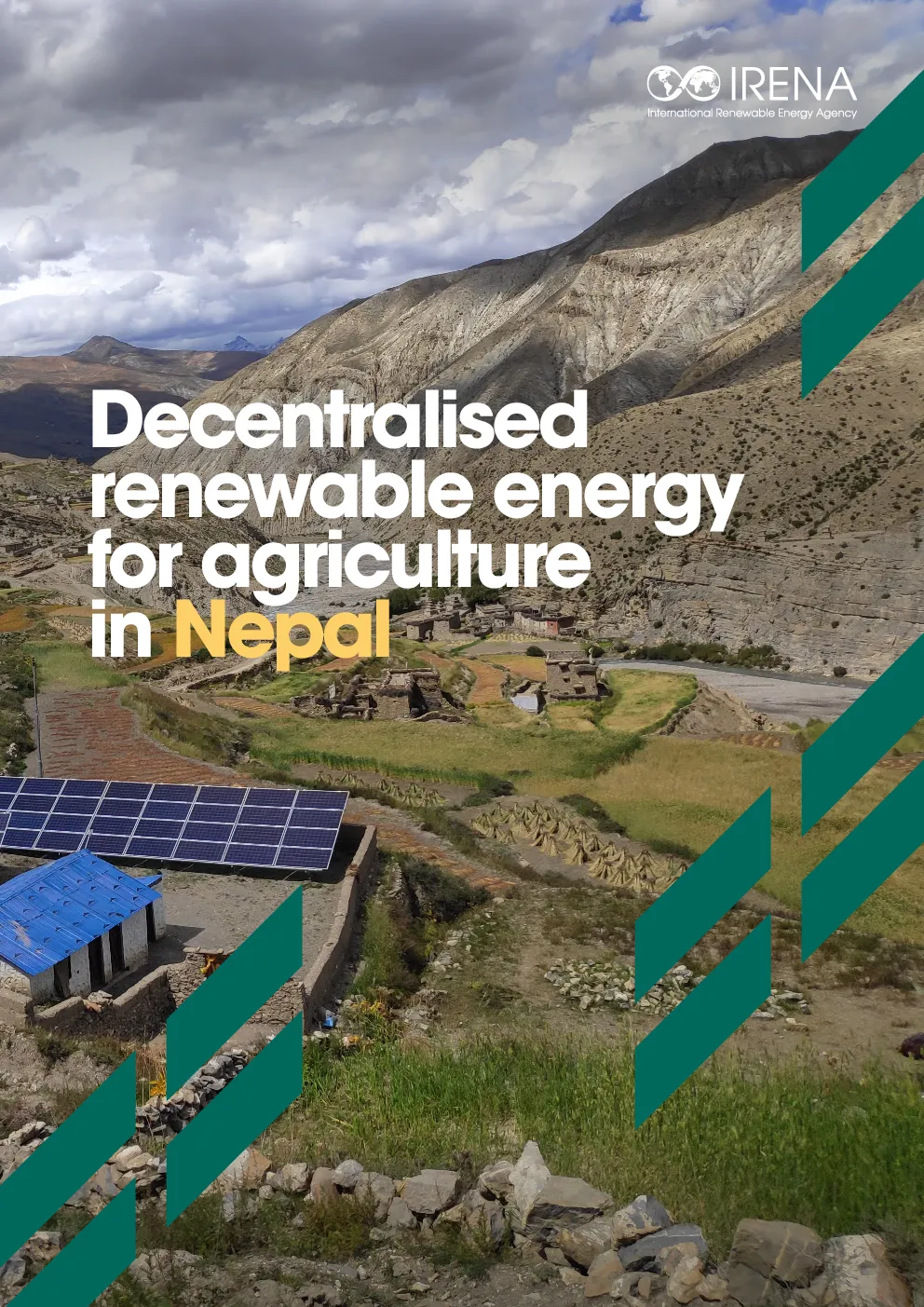
Decentralisedrenewable energyfor agricultureinNepal © IRENA 2025 Unless otherwise stated, material in this publication may be freely used, shared, copied, reproduced, printed and/or stored, provided thatappropriate acknowledgement is given of IRENA as the source and copyright holder. Material in this publication that is attributed to thirdparties may be subject to separate terms of use and restrictions, and appropriate permissions from these third parties may need to besecured before any use of such material. Decentralised renewable energy for agriculture in Nepal, International Renewable Energy Agency, Abu Dhabi. Acknowledgements This report was developed under the guidance of Gürbüz Gonül (Director, IRENA Country Engagement and Partnerships),and authored by Kavita Rai (IRENA) and Kushal Gautam, Yamuna Ghale, Chitra Narayanswamy and Stephanie Pinnington(Consultants). This report also benefitted from contributions by Nawa Raj Dhakal, Santosh Rai, and Amanul Hak Ansari(Alternative Energy Promotion Centre), Sabnam Shivakoti and Dipak Bharadwaj (Ministry of Agriculture and LivestockDevelopment), Lenneke Braam and Subash Dhakal (SNV Nepal), Asha Singh (University College London), Nipunika Perera(Expert), Bishal Parajuli, Jiwoo Sun and Wilson Matekenya (IRENA). Technical review was provided by Paul Komor. Publication and editorial support were provided by Francis Field and Stephanie Clarke. The report was edited by JonathanGorvett, with design provided by Elkanodata. Unless otherwise indicated, all the photographs used inside this report are the copyright of Kushal Gautam. The cover page photograph by Siddhartha Shrestha shows a village powered by a solar mini-grid in the mountainous UpperDolpo region of Nepal. The assessment was financially supported through voluntary contributions by the Government of United Arab Emiratesand the Open Society Foundations. The data collection and country co-ordination were facilitated by the Ministry of Agriculture and Livestock Development(MoALD) and the Alternative Energy Promotion Centre (AEPC). For further information or to provide feedback, go to:publications@irena.org Download fromwww.irena.org/publications Disclaimer This publication and the material herein are provided “as is”. All reasonable precautions have been taken by IRENA to verify the reliabilityof the material in this publication. However, IRENA, nor any of their officials, agents, data or other third-party content providers provides awarranty of any kind, either expressed or implied, and they accept no responsibility or liability for any consequence of use of the publicationor material herein. The information contained herein does not necessarily represent the views of all Members of IRENA. The mention of specific companies orcertain projects or products does not imply that they are endorsed or recommended by IRENA in preference to others of a similar naturethat are not mentioned. The designations employed and the presentation of material herein do not imply the expression of any opinion onthe part of IRENA concerning the legal status of any region, country, territory, city or area or of its authorities, or concerning the delimitationof frontiers or boundaries. The designations employed and the presentation of material herein do not imply the expression of any opinion on the part of IRENAconcerning the legal status of any region, country, territory, city or area or of its authorities, or concerning the delimitation of frontiers orboundaries. Contents Executive summary9 1Introduction131.1Datacollection:Methods,sourcesandinputs13 2.1Socio-economiccontextwithinachangingclimate162.2Policylandscapeforagriculturalmechanisation172.3Decentralisedrenewableenergy,electricityaccessanddemandin17 3Energy use patterns and estimated investmentsin selected agri-food value chains20 3.1Maize203.2Apples253.3Fish303.4Millet33 4Key renewable energy powered technologyand equipment options for enhancing agri-food value chains36 4.1ColdStorage374.2Solardryers374.3Solarirrigationpumps384.4Renewableenergypoweredmini-grids40 5Models for the provisionof agri-equipment services41 5.1Co-operative,orprivately-runcustomhiringcentres415.2Co-operativeownership435.3Commercialenterprisesandindustries435.4Accesstofinance45 6Key recommendations46 6.1Cross-cuttingrecommendationsapplicableacrossalltechnologies466.2Technology-specificrecommendations47 7References52 Annual CO2emissions offset63 Figures Figure 1Locations visited for the study14Figure 2Electricity sales for water supply and irrigation (GWh), 2013-202318Figure 3Agricultural sector energy consumption (PJ), 2019-202119Figure 4Maize value chain20Figure 5Maize value chain: Potential DRE interventions in the short term24Figure 6Maize value chain: Investment and percentage fossil fuel offset25Figure 7Apple value chain25Figure 8Apple value chain: Potential DRE interventions in the short term29Figure 9Apple value chain: Investment and percentage fossil fuel offset2