您的浏览器禁用了JavaScript(一种计算机语言,用以实现您与网页的交互),请解除该禁用,或者联系我们。[经济合作与发展组织]:酱果树 - 发现报告

酱果树

酱果树

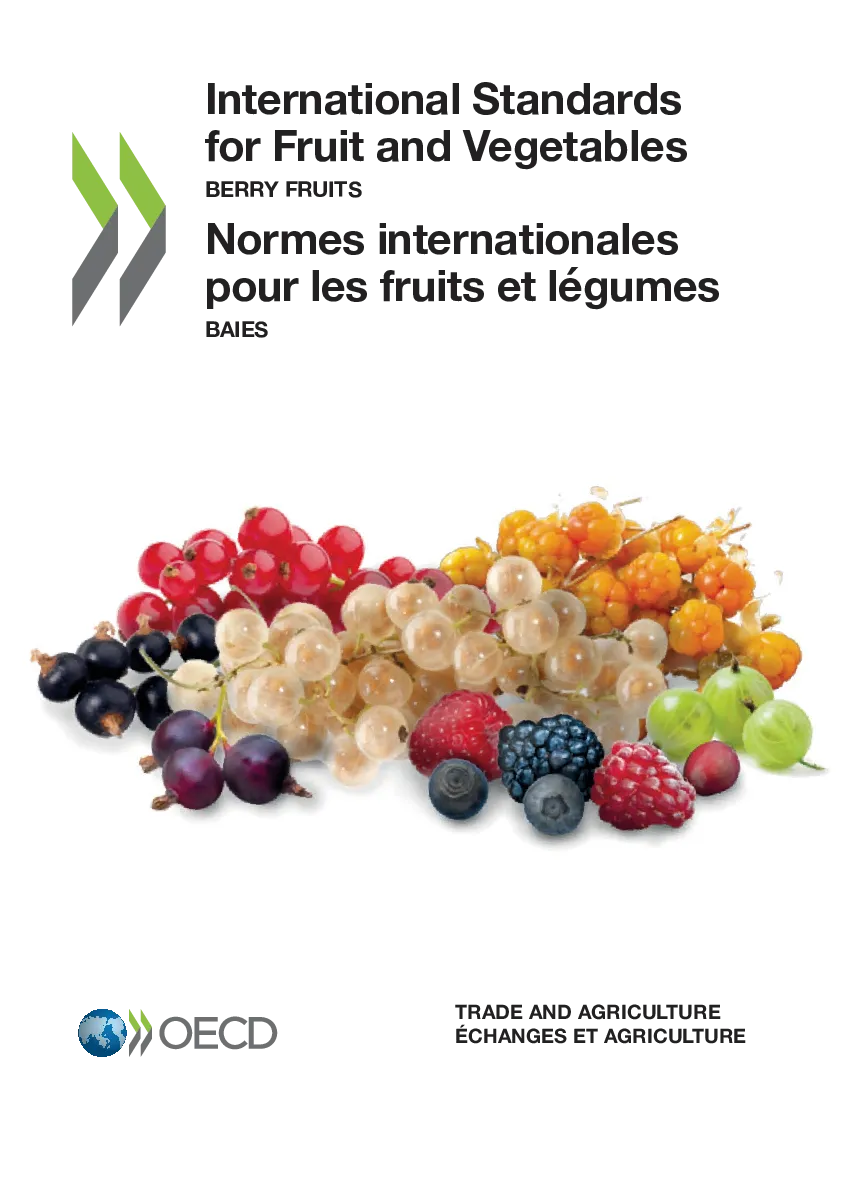
ORGANISATION FOR ECONOMIC CO-OPERATION AND DEVELOPMENTORGANISATION DE COOPERATION ET DE DEVELOPPEMENT ECONOMIQUESBerry fruitsBaiesINTERNATIONAL STANDARDS FORFRUIT AND VEGETABLESNORMES INTERNATIONALESPOUR LES FRUITS ET LEGUMES No reproduction, copy, transmission or translation of this publication may be made without written permission. Applicationsshould be sent to OECD Publishing: rights@oecd.org or by fax (33 1) 45 24 13 91. Permission to photocopy a portion of this workshould be addressed to the Centre français d’exploitation du droit de copie, 20, rue des Grands-Augustins, 75006 Paris, France(contact@cfcopies.com).ORGANISATION FOR ECONOMIC CO-OPERATION AND DEVELOPMENTThe OECD is a unique forum where governments work together to address the economic, social and environmental challenges ofglobalisation. The OECD is also at the forefront of efforts to understand and to help governments respond to new developments andconcerns, such as corporate governance, the information economy and the challenges of an ageing population. The Organisationprovides a setting where governments can compare policy experiences, seek answers to common problems, identify good practiceand work to co-ordinate domestic and international policies.The OECD member countries are: Australia, Austria, Belgium, Canada, Chile, Colombia, Costa Rica, the Czech Republic, Denmark,Estonia, Finland, France, Germany, Greece, Hungary, Iceland, Ireland, Israel, Italy, Japan, Korea, Latvia, Lithuania, Luxembourg,Mexico, the Netherlands, New Zealand, Norway, Poland, Portugal, the Slovak Republic, Slovenia, Spain, Sweden, Switzerland,Türkiye, the United Kingdom and the United States. The Commission of the European Union takes part in the work of the OECD.OECD Publishing disseminates widely the results of the Organisation’s statistics gathering and research on economic, social andenvironmental issues, as well as the conventions, guidelines and standards agreed by its members.ORGANISATION DE COOPERATION ET DE DEVELOPPEMENT ECONOMIQUESL’OCDE est un forum unique en son genre où les gouvernements œuvrent ensemble pour relever les défis économiques, sociauxet environnementaux que pose la mondialisation. L’OCDE est aussi à l’avant-garde des efforts entrepris pour comprendre lesévolutions du monde actuel et les préoccupations qu’elles font naître. Elle aide les gouvernements à faire face à des situationsnouvelles en examinant des thèmes tels que le gouvernement d’entreprise, l’économie de l’information et les défis posés par levieillissement de la population. L’Organisation offre aux gouvernements un cadre leur permettant de comparer leurs expériencesen matière de politiques, de chercher des réponses à des problèmes communs, d’identifier les bonnes pratiques et de travailler à lacoordination des politiques nationales et internationales.Les pays membres de l’OCDE sont : l’Allemagne, l’Australie, l’Autriche, la Belgique, le Canada, le Chili, la Colombie, la Corée,le Costa Rica, le Danemark, l’Espagne, l’Estonie, les États-Unis, la Finlande, la France, la Grèce, la Hongrie, l’Irlande, l’Islande,Israël, l’Italie, le Japon, la Lettonie, la Lituanie, le Luxembourg, le Mexique, la Norvège, la Nouvelle-Zélande, les Pays-Bas,la Pologne, le Portugal, la République slovaque, la République tchèque, le Royaume-Uni, la Slovénie, la Suède, la Suisse et laTürkiye. La Commission européenne participe aux travaux de l’OCDE.Les Éditions OCDE assurent une large diffusion aux travaux de l’Organisation. Ces derniers comprennent les résultats de l’activitéde collecte de statistiques, les travaux de recherche menés sur des questions économiques, sociales et environnementales, ainsi queles conventions, les principes directeurs et les modèles développés par les pays membres.Toute reproduction, copie, transmission ou traduction de cette publication doit faire l’objet d’une autorisation écrite.Les demandes doivent être adressées aux Éditions OCDE rights@oecd.org ou par fax (33 1) 45 24 13 91. Les demandesd’autorisation de photocopie partielle doivent être adressées directement au Centre français d’exploitation du droit de copie, 20,rue des Grands-Augustins, 75006 Paris, France (contact@cfcopies.com). 2© OECD 2024© OCDE 2024 ForewordWithin the framework of the activities of the Scheme for the Application of InternationalStandards for Fruit and Vegetables set up by OECD in 1962, explanatory brochures comprisingcomments and illustrations are published to facilitate the common interpretation of standards inforce by both the Inspection Authorities and professional bodies responsible for the applicationof standards or interested in the international trade in these products1.The Scheme for the Application of International Standards for Fruit and Vegetables shallbe open to States being Member countries of the United Nations or its specialised agencies orthe World Trade Organization desiring to participate therein in accordance with the procedurefor participation set out in the Decision C(2006)95