您的浏览器禁用了JavaScript(一种计算机语言,用以实现您与网页的交互),请解除该禁用,或者联系我们。[经济合作与发展组织]:城市零碳建筑:全生命周期方法 - 发现报告

城市零碳建筑:全生命周期方法

AI智能总结
查看更多
城市零碳建筑:全生命周期方法

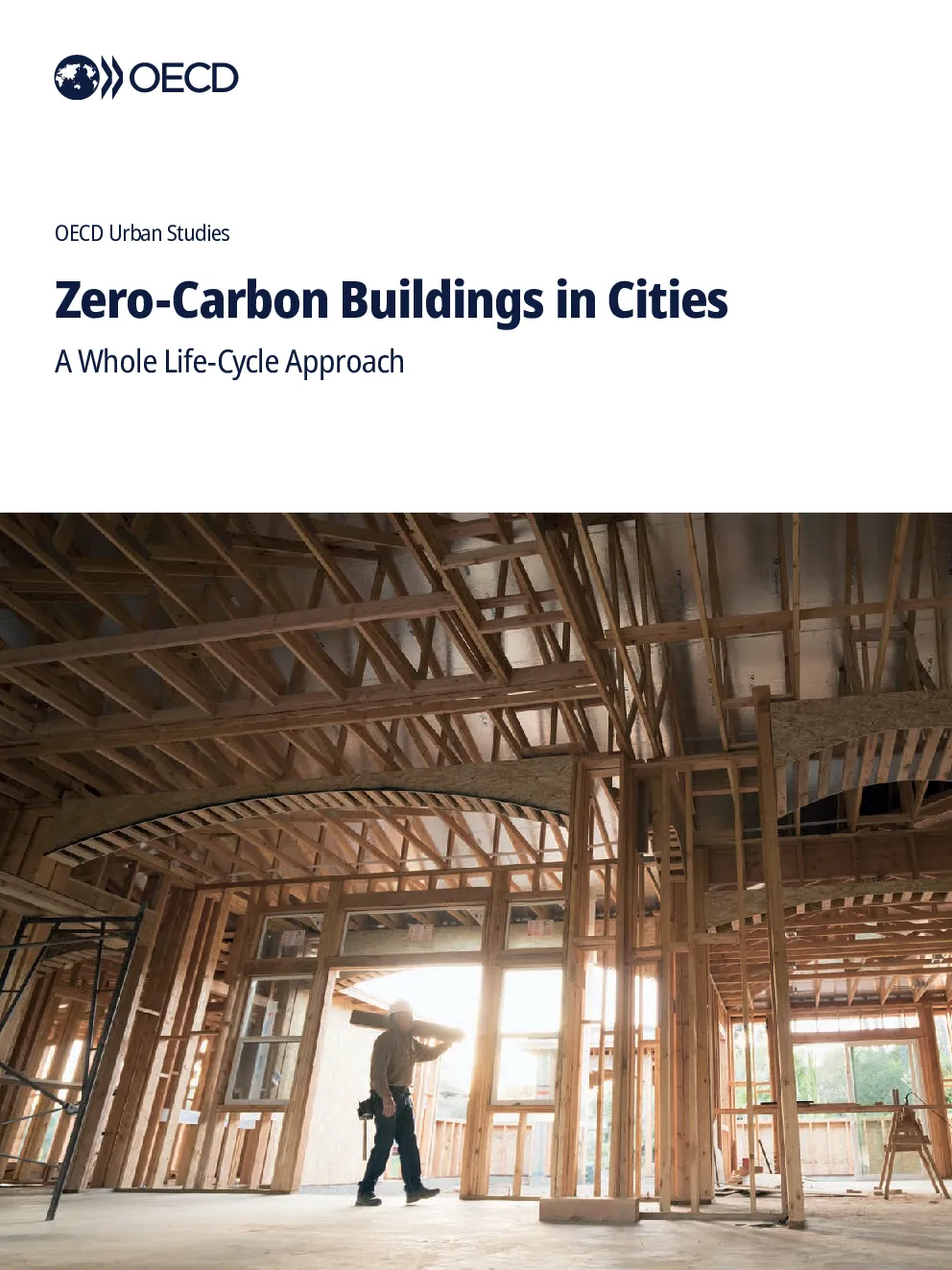
Zero‑Carbon Buildings inCities A Whole Life‑Cycle Approach OECD Urban Studies Zero‑Carbon Buildingsin Cities A WHOLE LIFE‑CYCLE APPROACH This document, as well as any data and map included herein, are without prejudice to the status of or sovereignty overany territory, to the delimitation of international frontiers and boundaries and to the name of any territory, city or area. The statistical data for Israel are supplied by and under the responsibility of the relevant Israeli authorities. The use ofsuch data by the OECD is without prejudice to the status of the Golan Heights, East Jerusalem and Israeli settlements inthe West Bank under the terms of international law. OECD Urban StudiesISSN 2707-3432 (print)ISSN 2707-3440 (online) Photo credits:Cover © Eternity in an Instant/Getty Images Plus. Corrigenda to OECD publications may be found at: https://www.oecd.org/en/publications/support/corrigenda.html.© OECD 2025 Attribution 4.0 International (CC BY 4.0) This work is made available under the Creative Commons Attribution 4.0 International licence. By using this work, you accept to be bound by the terms of this licence(https://creativecommons.org/licenses/by/4.0/).Attribution– you must cite the work.Translations– you must cite the original work, identify changes to the original and add the following text:In the event of any discrepancy between the original work and thetranslation, only the text of original work should be considered valid.Adaptations– you must cite the original work and add the following text:This is an adaptation of an original work by the OECD. The opinions expressed and arguments employed inthis adaptation should not be reported as representing the official views of the OECD or of its Member countries.Third-party material– the licence does not apply to third-party material in the work. If using such material, you are responsible for obtaining permission from the third party and forany claims of infringement.You must not use the OECD logo, visual identity or cover image without express permission or suggest the OECD endorses your use of the work.Any dispute arising under this licence shall be settled by arbitration in accordance with the Permanent Court of Arbitration (PCA) Arbitration Rules 2012. The seat of arbitration shallbe Paris (France). The number of arbitrators shall be one. Foreword Buildings are among the largest contributors to greenhouse gas emissions, accounting for nearly 40% ofenergy-relatedCO2emissions.These reflect emissions from operational use, but also emissions relatedto energy used in the construction of buildings, as well as significant indirect emissions related to theupstream production of construction materials. Indeed, in part because of progress made in improving theenergy efficiency of buildings, by 2050, these non-operational emissions, including those related todemolition, referred to collectively asembodied carbonor embodied emissions, areprojected to accountfor half of the carbon footprint of new buildings. Operational carbon, i.e., emissions related to the use phase of a building (e.g., heating, cooling andpowering), has traditionally been the focus of decarbonisation efforts. In a recent OECD survey, close to90% of responding countries had introduced mandatory energy efficiency codes and over 60% hadintroducedEnergy Performance Certificate.However,by comparison,only 21%of countries hadintroduced regulations addressing whole life carbon, despite the significant scale of embodied carbon andits impact on climate change, and despite the fact that much of the progress made on reducing operationalemissions has been through the construction of new energy efficient buildings. In other words, a whole lifecarbon approach thatensures buildings remain sustainable throughout their entire life-cycle, fromconstruction to demolition, is needed. The OECD’sGlobal Monitoring of Policies for Decarbonising Buildings: A Multi-level Approach (2024)revealed that while countries have predominantly focused on energy-related measures to reduceemissions, whole life carbon policies are gaining momentum. Accordingto the report, 43%of respondingcountries are expected to prioritise these inthe futurecompared to only 14% today. Similarly,policies toincrease thecircularity of materials, a crucial element in reducing embodied carbon,are also expected tosee greater uptake. Currently, only11%of responding countries set circularity as one of their priorities, butthis is expected to increaseto 68%. In response to this growing challenge, the OECD hascarried outaGlobal Survey on Whole Life Carbonof Buildings (2024).This survey gathers advanced data from 15 countries and cities, representing diverseeconomic contexts, geographicconditions, and governance structures. By providing a common frameworkforcomparisonand policy analysis, this report, entitledZero-Carbon Buildings in Cities: A Whole Life-CycleApproach,highlights best practices and successful strategies, enabling countries and