您的浏览器禁用了JavaScript(一种计算机语言,用以实现您与网页的交互),请解除该禁用,或者联系我们。[世界卫生组织]:世界卫生组织疟疾政策咨询小组:2025年4月会议第2天 - 发现报告

世界卫生组织疟疾政策咨询小组:2025年4月会议第2天

AI智能总结
查看更多
世界卫生组织疟疾政策咨询小组:2025年4月会议第2天

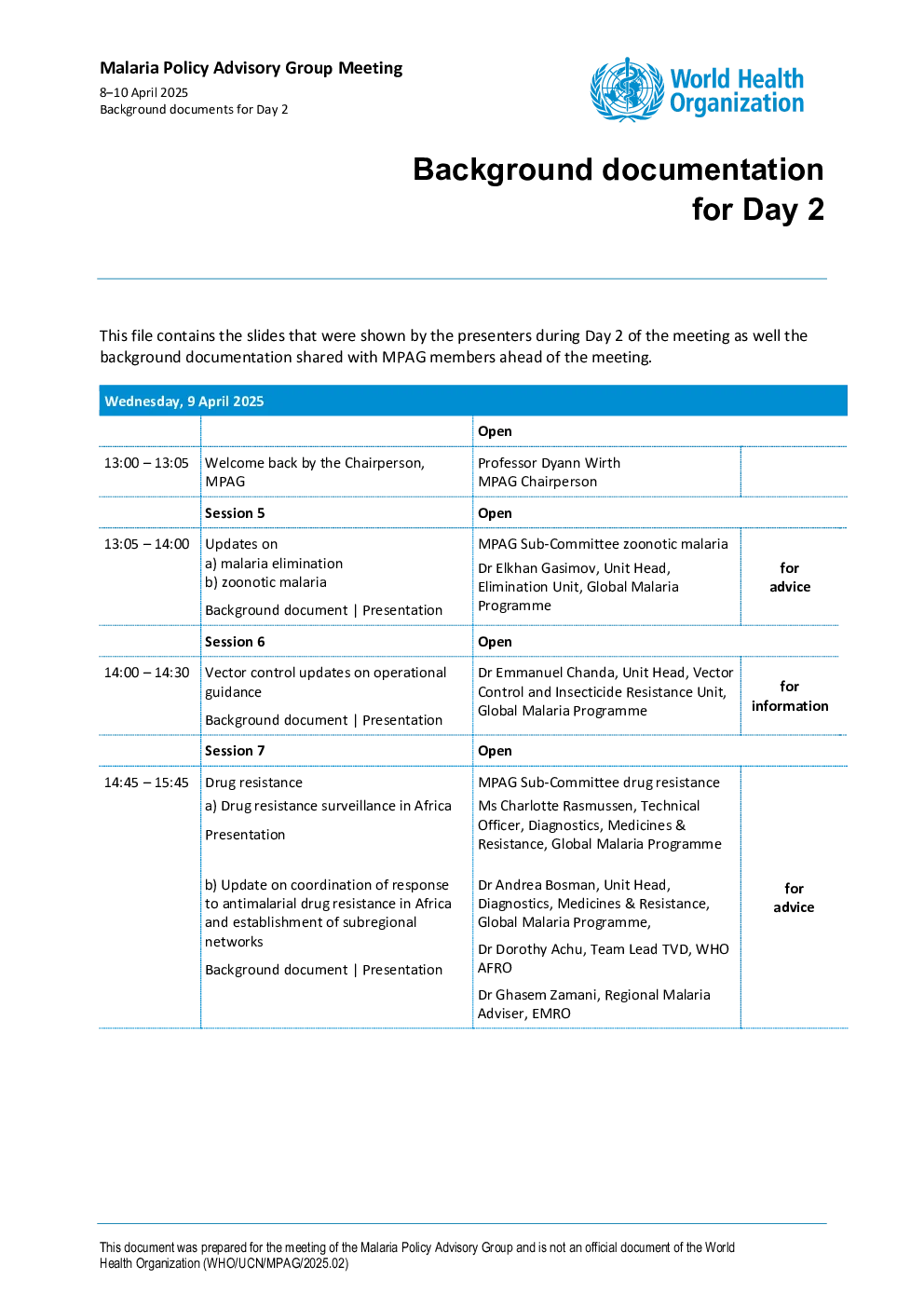
8‒10 April 2025Background documents for Day 2 Background documentationfor Day 2 This file contains the slides that were shown by the presenters during Day 2 of the meeting as well thebackground documentation shared with MPAG members ahead of the meeting. 27thmeeting of theMalaria Policy Advisory Group 8–10 April 2025, Geneva, SwitzerlandBackground document for Session5 Update on malaria eliminationand zoonotic malaria Update on malaria elimination Globally,there has been notable progress inefforts to eliminate malaria, with more countriesachievingzero indigenous cases.The number ofcountries reporting fewer than 10000 casesincreasedby 68%, from 28 countries in 2000 to47 in 2023(1). Despite limited resources, implementation oftheElimination-2025(E-2025)initiative continues.According to theWorld malaria report 2024(1),the following E-2025 countries and areas met theirtargets by the end of 2023, using 2019 as the baseline: •Dominican Republic reached the milestone ofreducing the number of indigenous cases frommorethan1000 tofewer than1000 at the end of 2023–moving from 1291 indigenous cases to 253over this time period.•Ecuadoralsoreached the milestoneof reducing the number of indigenous casesfrom more than1000 in 2019 (1803) tofewer than1000 at the end of 2023 (604).•Mexico and Nepal reached the milestoneofreducing the number of indigenous casesfrom100–999 in 2019 tofewer than100at the end of 2023,bringing their caseloadsfrom 618to 42and 131to15,respectively.•Saudi Arabiaand Timor-Lestereportedzero indigenous cases for three consecutive years (2021–2023).•Bhutanreportedzero indigenous cases for two consecutive years (2022 and 2023). Despite these achievements,however,some countrieshavefaced resurgencesof malaria.Between2022 and 2023, 12 countries and one territory oftheE-2025 initiative reporteda 40.5% increaseinthe number of reported cases. InOctober 2024,Egyptwas declaredmalaria-freebythe World Health Organization(WHO). In January2025, theWHO Director-Generalcertifiedtheelimination of malaria inGeorgia.A total of45countriesand one territory havenowbeen awardedmalaria-freecertification by WHO.Currently, the GlobalMalaria Programme is working with several countries to prepare for certification of malariaelimination. Work continues on the update ofA framework for malaria elimination(2)and development of globalguidance onprevention of re-establishment of malaria transmission. Both documents are expected tobe finalized in 2025. Zoonoticmalaria Since large numbers of human cases ofPlasmodium knowlesiwere reportedin Malaysian Borneo in2004, this zoonotic malaria has emerged as a significant public health concern, particularly acrossSouth-East Asiaand the Western Pacific.To address the challenge ofP.knowlesimalaria,the WHOGlobal Malaria Programmeconvened atechnical consultation on control of zoonotic malaria inGeneva, Switzerland,on 5–7 November 2024. The meeting brought together national malariaprogrammemanagers from affected countries, membersofthe Malaria Policy Advisory Group and theTechnical Advisory Group on Malaria Elimination and Certification, research experts and WHO staff.Sessionscovered global and country updates,clinical aspects,vector control,reservoirs,environmental drivers,control strategies,and research and development needs. There arecurrentlyno proven control interventions for zoonotic malaria.While some interventionssuch aspersonal protection, including chemoprophylaxis andtheuse oftopicalrepellents,can beimplemented immediately, these alone cannot address the increasing mosquito–macaque–humantransmission through which the majority of casesarelikelytooccur. The emergence ofP. knowlesiposes unique challenges to malaria elimination, particularly for countriesapproaching or having achieved elimination ofthe“human malaria” species (P.falciparum, P. vivax, P.malariae, P. ovale).Currently, countries where transmission of “human malaria” has been interruptedbutP. knowlesicases persist cannot be officially certified by WHO as malaria-free. In response to thischallenge,the Global Malaria Programmehas established a subgroup on zoonotic malaria within theTechnical Advisory Group on Malaria Elimination and Certification to develop procedures andrequirements for certification of malaria eliminationinsuch countries. The consultation concluded that coordinated efforts are urgently needed as the burden ofP.knowlesiincreases. There was consensus that successful control will require intersectoral collaboration acrosshealth, forestry, agriculture and private sectors, along with strong community engagement.Researchpriorities were established, focusing on developing species-specific diagnostics, improving surveillancefor riskmapping, and developing vector control and macaque management strategiestodecrease theinteraction between macaque and human populations. Next steps include implementing the research priorities to inform the development of specific WHOguidelines forP. knowlesicontrol. To resolve t