AI智能总结
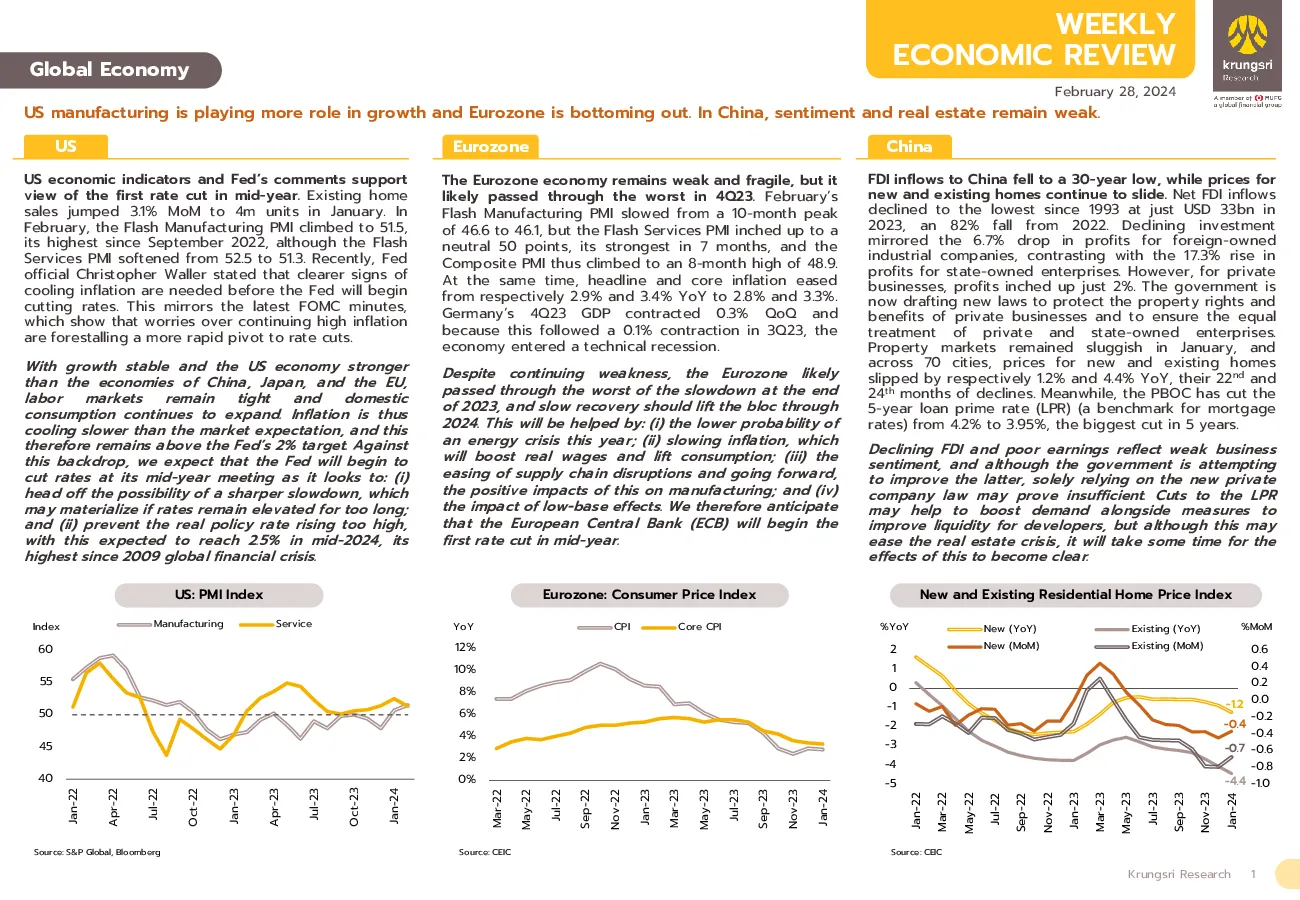
US manufacturing is playing more role in growth and Eurozone is bottoming out. In China, sentiment and real estate remain weak. US China Eurozone US economic indicators and Fed’s comments supportview of the first rate cut in mid-year.Existing homesalesjumped 3.1%MoM to 4m units in January.InFebruary, the Flash Manufacturing PMI climbed to 51.5,its highest since September 2022, although the FlashServices PMI softened from 52.5 to 51.3. Recently, Fedofficial Christopher Waller stated that clearer signs ofcooling inflation are needed before the Fed will begincuttingrates.This mirrors the latest FOMC minutes,which show that worries over continuing high inflationare forestalling a more rapid pivot to rate cuts. FDI inflows to China fell to a 30-year low, while prices fornew and existing homes continue to slide.Net FDI inflowsdeclinedto the lowest since 1993 at just USD 33bn in2023,an 82%fall from 2022.Declining investmentmirroredthe 6.7%drop in profits for foreign-ownedindustrialcompanies,contrasting with the 17.3%rise inprofits for state-owned enterprises. However, for privatebusinesses, profits inched up just 2%. The government isnow drafting new laws to protect the property rights andbenefits of private businesses and to ensure the equaltreatmentofprivateandstate-ownedenterprises.Propertymarkets remained sluggish in January,andacross70 cities,prices for new and existing homesslipped by respectively 1.2% and 4.4% YoY, their 22ndand24thmonths of declines. Meanwhile, the PBOC has cut the5-year loan prime rate (LPR) (a benchmark for mortgagerates) from 4.2% to 3.95%, the biggest cut in 5 years. The Eurozone economy remains weak and fragile, but itlikelypassed through the worst in 4Q23.February’sFlash Manufacturing PMI slowed from a 10-month peakof 46.6 to 46.1, but the Flash Services PMI inched up to aneutral 50points,its strongest in 7 months,and theComposite PMI thus climbed to an 8-month high of 48.9.Atthe same time,headline and core inflation easedfrom respectively 2.9% and 3.4% YoY to 2.8% and 3.3%.Germany’s4Q23 GDP contracted 0.3%QoQ andbecause this followed a 0.1% contraction in 3Q23, theeconomy entered a technical recession. Withgrowth stable and the US economy strongerthanthe economies of China,Japan,and the EU,labormarketsremaintightanddomesticconsumptioncontinues to expand.Inflation is thuscooling slower than the market expectation, and thistherefore remains above the Fed’s 2% target. Againstthis backdrop, we expect that the Fed will begin tocut rates at its mid-year meeting as it looks to: (i)head off the possibility of a sharper slowdown, whichmay materialize if rates remain elevated for too long;and (ii) prevent the real policy rate rising too high,withthis expected to reach 2.5%in mid-2024,itshighest since 2009 global financial crisis. Despitecontinuing weakness,the Eurozone likelypassed through the worst of the slowdown at the endof 2023, and slow recovery should lift the bloc through2024. This will be helped by: (i) the lower probability ofan energy crisis this year; (ii) slowing inflation, whichwillboost real wages and lift consumption;(iii)theeasing of supply chain disruptions and going forward,the positive impacts of this on manufacturing; and (iv)the impact of low-base effects. We therefore anticipatethat the European Central Bank (ECB) will begin thefirst rate cut in mid-year. Declining FDI and poor earnings reflect weak businesssentiment, and although the government is attemptingto improve the latter, solely relying on the new privatecompanylaw may prove insufficient.Cuts to the LPRmayhelp to boost demand alongside measures toimprove liquidity for developers, but although this mayease the real estate crisis, it will take some time for theeffects of this to become clear. Thai economy will see a cyclical recovery in 2024 but growth will remain uncertain and uneven. January export growth benefited from low-base effect. Thaiexports grew for the 6th straight month inJanuary. For 2024, exports are forecast to expandby 2.5%.The Ministry of Commerce reports that inJanuary,exports generated receipts worth USD22.6bn, up 10.0% YoY, thoughthis falls to 9.2%ifgold and oil are excluded. The largest gains wereseen in iron, steel & related products (+106.5%), rice(+45.9%), computers & computer equipment (+32.2%),fresh,chilled,frozen&dried fruit(+30.1%),rubber(+5.5%),and processed&canned seafood(+5.2%).The best performing markets were the US (+13.7%),China(+2.1%),the EU(+4.5%),Japan(+1.0%),theASEAN-5 (+18.1%), and the CLMV group (+16.6%). KrungsriResearch has revised down 2024 economicgrowthforecastfrom3.4%to2.7%amidhighuncertainty.Growth should be up from 2023’s 1.9%largely thanksto domestic drivers of the economy.(i)Improving capacity and government support will boostthetourism sector,and as such,35.6m arrivals areexpected in 2024. (ii) Private consumption is forecast toexpand by 3.1% on the back of continuing recovery inthetourismsector,strongerlabormarket,andgovernment measures to help with