每周经济评论
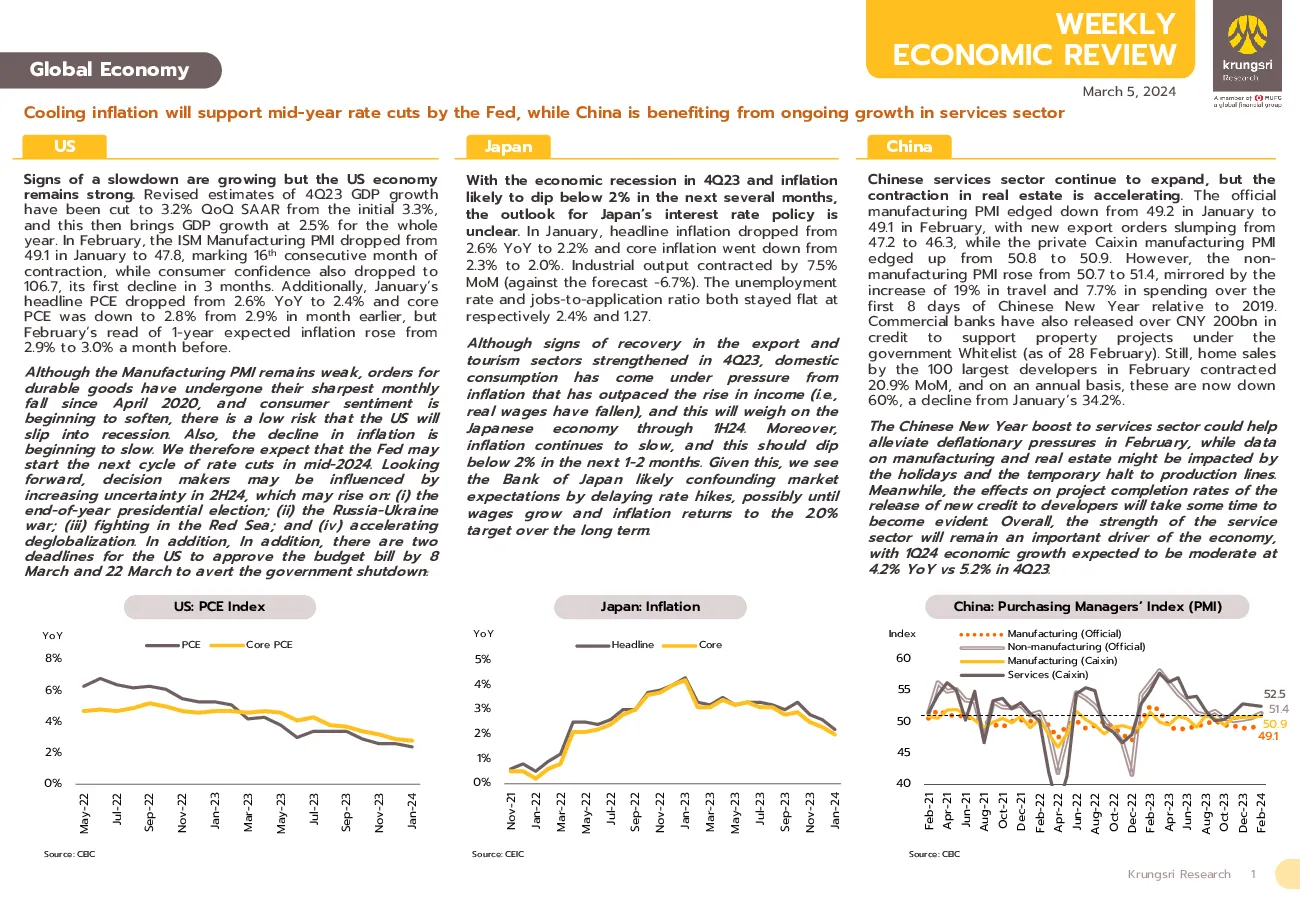
Cooling inflation will support mid-year rate cuts by the Fed, while China is benefiting from ongoing growth in services sector US China Japan Signs of a slowdown are growing but the US economyremains strong.Revised estimates of 4Q23 GDP growthhave been cut to3.2%QoQ SAAR from the initial 3.3%,and this then brings GDP growth at2.5% for the wholeyear. In February, the ISM Manufacturing PMI dropped from49.1in January to47.8, marking16thconsecutive month ofcontraction, while consumer confidence also dropped to106.7, its first decline in 3 months. Additionally, January’sheadline PCE dropped from2.6% YoY to 2.4% and corePCE wasdown to 2.8% from 2.9% in month earlier,butFebruary’s read of 1-year expected inflation rose from2.9% to3.0% a month before. Chineseservices sector continue to expand,but thecontractionin real estate is accelerating.The officialmanufacturing PMI edged down from49.2 in January to49.1in February, with new export orders slumping from47.2to 46.3, while the private Caixin manufacturing PMIedgedup from 50.8 to 50.9.However,the non-manufacturing PMI rose from50.7to51.4, mirrored by theincrease of19% in travel and 7.7% in spending over thefirst8 days of Chinese New Year relative to 2019.Commercial banks have also released over CNY200bn incredittosupportpropertyprojectsunderthegovernment Whitelist (as of28February). Still, home salesbythe 100 largest developers in February contracted20.9% MoM, and on an annual basis, these are now down60%, a decline from January’s34.2%. With the economic recession in4Q23 and inflationlikely to dip below2% in the next several months,theoutlook for Japan’s interest rate policy isunclear.In January, headline inflation dropped from2.6% YoY to2.2% and core inflation went down from2.3% to 2.0%. Industrial output contracted by 7.5%MoM (against the forecast-6.7%). The unemploymentrate and jobs-to-application ratio both stayed flat atrespectively2.4% and1.27. Althoughsigns of recovery in the export andtourismsectors strengthened in 4Q23,domesticconsumptionhas comeunderpressurefrominflation that has outpaced the rise in income (i.e.,real wages have fallen), and this will weigh on theJapaneseeconomythrough1H24.Moreover,inflationcontinues to slow,and this should dipbelow2% in the next1-2months. Given this, we seetheBank of Japan likely confounding marketexpectations by delaying rate hikes, possibly untilwagesgrow and inflation returns to the 2.0%target over the long term. Although the Manufacturing PMI remains weak, orders fordurable goods haveundergone their sharpest monthlyfallsince April 2020,and consumer sentiment isbeginning to soften, there is alow risk that the US willslipinto recession.Also,the decline in inflation isbeginning to slow. We therefore expect that the Fed maystart thenext cycle of rate cuts in mid-2024.Lookingforward,decisionmakersmaybeinfluencedbyincreasing uncertainty in2H24, which may rise on: (i) theend-of-year presidential election; (ii) the Russia-Ukrainewar; (iii) fighting in the Red Sea; and (iv) acceleratingdeglobalization.In addition,In addition,there are twodeadlinesfor the US to approve the budget bill by 8March and22March to avert the government shutdown. The Chinese New Year boost to services sector could helpalleviate deflationary pressures in February, while dataon manufacturing and real estate might be impacted bythe holidays and the temporary halt to production lines.Meanwhile, the effects on project completion rates of therelease of new credit to developers will take some time tobecomeevident.Overall,the strength of the servicesector will remain an important driver of the economy,with1Q24economic growth expected to be moderate at4.2% YoY vs5.2% in4Q23. The Thai economy continues to grow at the start of2024, though only slowly. BOT issued regulations to better support debt relief in specializedfinancial institutions. Theeconomic conditions continued to improve inJanuary,but growth remains sluggish.The Bank ofThailand (BOT) reports that in January, the economybenefitedfrom growing private consumption andservicesector,which has itself benefited fromcontinuing recovery in the tourism industry. Thus, forthemonth,seasonally adjusted tourist arrivals andreceiptsrose 1.5%and+17.1%MoM sa respectively.Exportvalue was also up+0.7%MoM sa,helped inparticularby improvements in overseas demand forrice,electronics,and chemical products.Privateinvestment also improved slightly on stronger importsofcapital goods and increased investment in plantand machinery, but delays to the2024 budget havemeant that central government spending (both regularoutgoings and investments) has continued to contract. The BOT has rolled out measures to support the long-term management of NPLs accumulating in specializedfinancial institutions.The BOT has said that followingdiscussions with the Ministry of Finance, it has becomeevidentthatadditionalsupportisneededbyborrowerswith NPLs owed to specialized financialinstitutions(SFIs).TheBOThasthusapprovedmeasuresto allow