每周经济评论
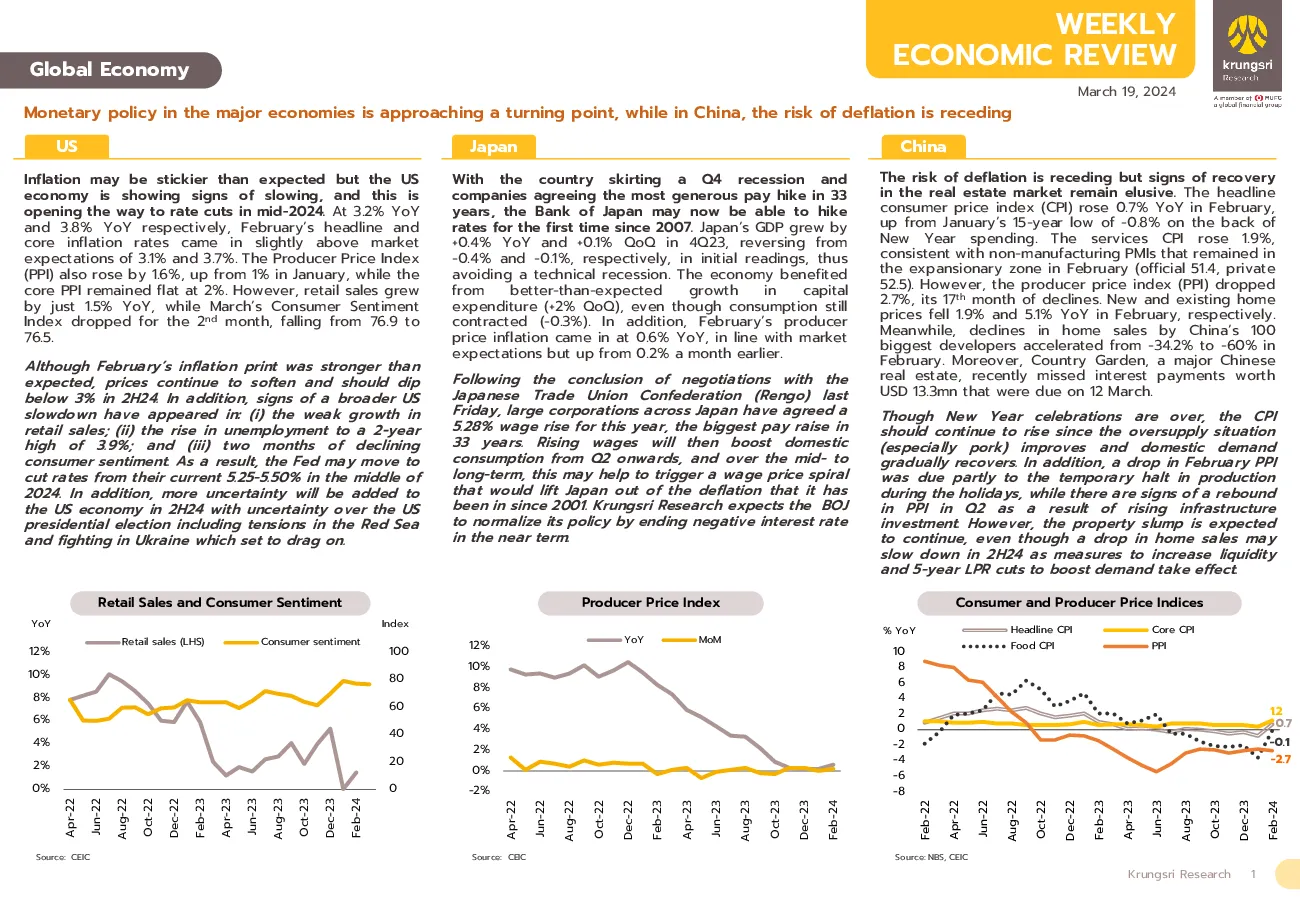
Monetary policy in the major economies is approaching a turning point, while in China, the risk of deflation is receding US China Japan The risk of deflation is receding but signs of recoveryin the real estate market remain elusive.The headlineconsumer price index (CPI) rose 0.7% YoY in February,up from January’s 15-year low of-0.8% on the back ofNewYear spending.The services CPI rose 1.9%,consistent with non-manufacturing PMIs that remained inthe expansionary zone in February (official 51.4, private52.5). However, the producer price index (PPI) dropped2.7%, its 17thmonth of declines. New and existing homeprices fell 1.9% and 5.1% YoY in February, respectively.Meanwhile,declines in home sales by China’s 100biggest developers accelerated from-34.2% to-60% inFebruary. Moreover, Country Garden, a major Chineserealestate,recently missed interest payments worthUSD 13.3mn that were due on 12 March. Inflationmay be stickier than expected but the USeconomyis showing signs of slowing,and this isopening the way to rate cuts in mid-2024.At 3.2% YoYand3.8%YoY respectively,February’s headline andcoreinflation rates came in slightly above marketexpectations of 3.1% and 3.7%. The Producer Price Index(PPI) also rose by 1.6%, up from 1% in January, while thecore PPI remained flat at 2%. However, retail sales grewbyjust 1.5%YoY,while March’s Consumer SentimentIndex dropped for the 2nd month, falling from 76.9 to76.5. WiththecountryskirtingaQ4recessionandcompanies agreeing the most generous pay hike in 33years,the Bank of Japan may now be able to hikerates for the first time since 2007.Japan’s GDP grew by+0.4%YoY and+0.1%QoQ in 4Q23,reversing from-0.4%and-0.1%,respectively,in initial readings,thusavoiding a technical recession. The economy benefitedfrombetter-than-expectedgrowthincapitalexpenditure (+2%QoQ), even though consumption stillcontracted(-0.3%).In addition,February’s producerprice inflation came in at 0.6% YoY, in line with marketexpectations but up from 0.2% a month earlier. Although February’s inflation print was stronger thanexpected,prices continue to soften and should dipbelow 3% in 2H24. In addition, signs of a broader USslowdown have appeared in: (i) the weak growth inretail sales; (ii) the rise in unemployment to a 2-yearhighof 3.9%;and(iii)two months of decliningconsumer sentiment. As a result, the Fed may move tocut rates from their current 5.25-5.50% in the middle of2024. In addition, more uncertainty will be added tothe US economy in 2H24 with uncertainty over the USpresidential election including tensions in the Red Seaand fighting in Ukraine which set to drag on. Followingthe conclusion of negotiations with theJapaneseTrade Union Confederation(Rengo)lastFriday, large corporations across Japan have agreed a5.28% wage rise for this year, the biggest pay raise in33years.Rising wages will then boost domesticconsumption from Q2 onwards, and over the mid-tolong-term, this may help to trigger a wage price spiralthat would lift Japan out of the deflation that it hasbeen in since 2001. Krungsri Research expects theBOJto normalize its policy by ending negative interest ratein the near term. ThoughNew Year celebrations are over,the CPIshould continue to rise since the oversupply situation(especiallypork)improves and domestic demandgradually recovers. In addition, a drop in February PPIwasdue partly to the temporary halt in productionduring the holidays, while there are signs of a reboundinPPI in Q2 as a result of rising infrastructureinvestment. However, the property slump is expectedto continue, even though adrop in home sales mayslow down in 2H24 as measures to increase liquidityand 5-year LPR cuts to boost demand take effect. Debt relief measures effective from 1 April may help toresolve THB 12-18bn in outstanding debts.The Bank ofThailand(BOT)has stated that from 1 April 2024,qualifyinglow-income earners with‘persistent debts’(PDs)will benefit from lower interest rates andacceleratedresolution of these debts.To qualify,debtorsshould have unsecured personal loans,theloans should not be NPLs, and interest payments shouldhaveexceeded repayments of the principal over anextendedperiod.Debts are classified into:(i) generalPDs,for which interest payments have exceededrepayments of the principal for 3 to 5 years; and (ii)severe PDs, that is, debts for which interest paymentshave exceeded repaymentsof the principal for morethan 5 yearsand where the borrower has a monthlyincome of less than THB 20,000 (debts to a financialinstitutionor financial services provider),or less thanTHB 10,000 (debts to non-banks.) Industrialsentimentisweakening,mirroringasofteningof indicators for the Thai manufacturingsector.In February,the Thai Industries SentimentIndex (TISI) print came in at 90.0, down from 90.6 amonth earlier. Declines were driven by worries overthe cost of living and the high level of debt carried byhouseholds,which has then caused consumers tobecome more cautious over their spending and thusundercutdomestic