每周经济评论
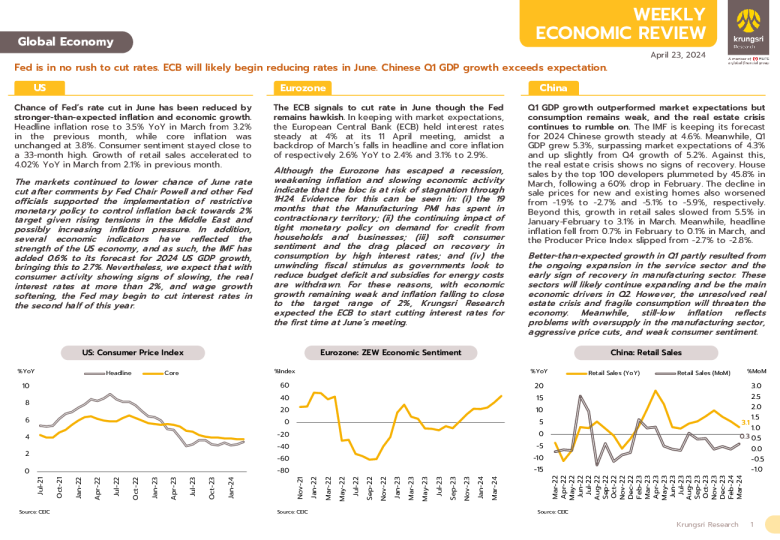
Fed is in no rush to cut rates. ECB will likely begin reducing rates in June. Chinese Q1 GDP growth exceeds expectation. US China Eurozone The ECB signals to cut rate in June though the Fedremains hawkish.In keeping with market expectations,the European Central Bank (ECB) held interest ratessteadyat 4%at its 11 April meeting,amidst abackdrop of March’s falls in headline and core inflationof respectively 2.6% YoY to 2.4% and 3.1% to 2.9%. Chance of Fed’s rate cut in June has been reduced bystronger-than-expected inflation and economic growth.Headline inflation rose to 3.5% YoY in March from 3.2%inthe previous month,while core inflation wasunchanged at 3.8%. Consumer sentiment stayed close toa 33-month high. Growth of retail sales accelerated to4.02% YoY in March from 2.1% in previous month. Q1 GDP growth outperformed market expectations butconsumption remains weak, and the real estate crisiscontinues to rumble on.The IMF is keeping its forecastfor 2024 Chinese growth steady at 4.6%. Meanwhile, Q1GDP grew 5.3%, surpassing market expectations of 4.3%and up slightly from Q4 growth of 5.2%. Against this,the real estate crisis shows no signs of recovery. Housesales by the top 100 developers plummeted by 45.8% inMarch, following a 60% drop in February. The decline insale prices for new and existing homes also worsenedfrom-1.9%to-2.7%and-5.1%to-5.9%,respectively.Beyond this, growth in retail sales slowed from 5.5% inJanuary-February to 3.1% in March. Meanwhile, headlineinflation fell from 0.7% in February to 0.1% in March, andthe Producer Price Index slipped from-2.7% to-2.8%. Althoughthe Eurozone has escaped a recession,weakeninginflation and slowing economic activityindicate that the bloc is at risk of stagnation through1H24.Evidence for this can be seen in:(i)the 19monthsthat the Manufacturing PMI has spent incontractionary territory; (ii) the continuing impact oftightmonetary policy on demand for credit fromhouseholdsand businesses;(iii)soft consumersentimentand the drag placed on recovery inconsumptionby high interest rates;and(iv)theunwindingfiscal stimulus as governments look toreduce budget deficit and subsidies for energy costsarewithdrawn.For these reasons,with economicgrowth remaining weak and inflation falling to closetothe target range of 2%,Krungsri Researchexpected the ECB to start cutting interest rates forthe first time at June’s meeting. The markets continued to lower chance of June ratecut after comments by Fed Chair Powell and other Fedofficialssupported the implementation of restrictivemonetary policy to control inflation back towards 2%targetgiven rising tensions in the Middle East andpossiblyincreasing inflation pressure.In addition,severaleconomicindicatorshavereflectedthestrength of the US economy, and as such, the IMF hasadded 0.6% to its forecast for 2024 US GDP growth,bringing this to 2.7%. Nevertheless, we expect that withconsumer activity showing signs of slowing, the realinterestrates at more than 2%,and wage growthsoftening, the Fed may begin to cut interest rates inthe second half of this year. Better-than-expected growth in Q1 partly resulted fromthe ongoing expansion in the service sector and theearly sign of recovery in manufacturing sector. Thesesectors will likely continue expanding and be the maineconomic drivers in Q2. However, the unresolved realestate crisis and fragile consumption will threaten theeconomy.Meanwhile,still-lowinflationreflectsproblems with oversupply in the manufacturing sector,aggressive price cuts, and weak consumer sentiment. Tourismremains the main driver of the economythrough Q2, helped further by the extension of visa-free travel.The Economics Tourism and Sports Divisionreports that between 1 January and 14 April, 10.72mtouristarrivals were recorded(up 43%from a yearearlier)and in the period,the industry generatedincomeworth THB 518.04bn.The most importantsourcesof arrivals were China(2.03m arrivals),Malaysia (1.39m), Russia (0.70m), South Korea (0.62m),and India (0.55m). Economic impact of Digital Wallet program is estimatedat 0.5-1.1% to GDP. Although sources of funding havenow been identified, hurdles and uncertainties remain.On10 April,the government released information onhowthe THB 500bn required for the Digital Walletscheme is to be funded: (i) THB 175bn will come fromthe FY2024 budget; (ii) THB 152.7bn will come from theFY2025 budget; and (iii) as per article 28 of the StateFiscal and Financial Disciplines Act, THB 172.3bn will befinanced bythe Bank for Agriculture and AgriculturalCooperatives(BAAC)for payments to 17m farmers.Authorities hope to open registration to the scheme forbotheligible people and retailers in Q3 and then tostart their spending in Q4. The tourism sector continues to provide the primaryimpetusfor growth in the economy.Over 1Q24,arrivalsrose from the previous quarter’s 8.10m to9.37m. These were therefore at 87% of the pre-Covid(1Q19) level, and with income from tourism hitting THB454.65bn (88% of the pre-Covid l