AI智能总结
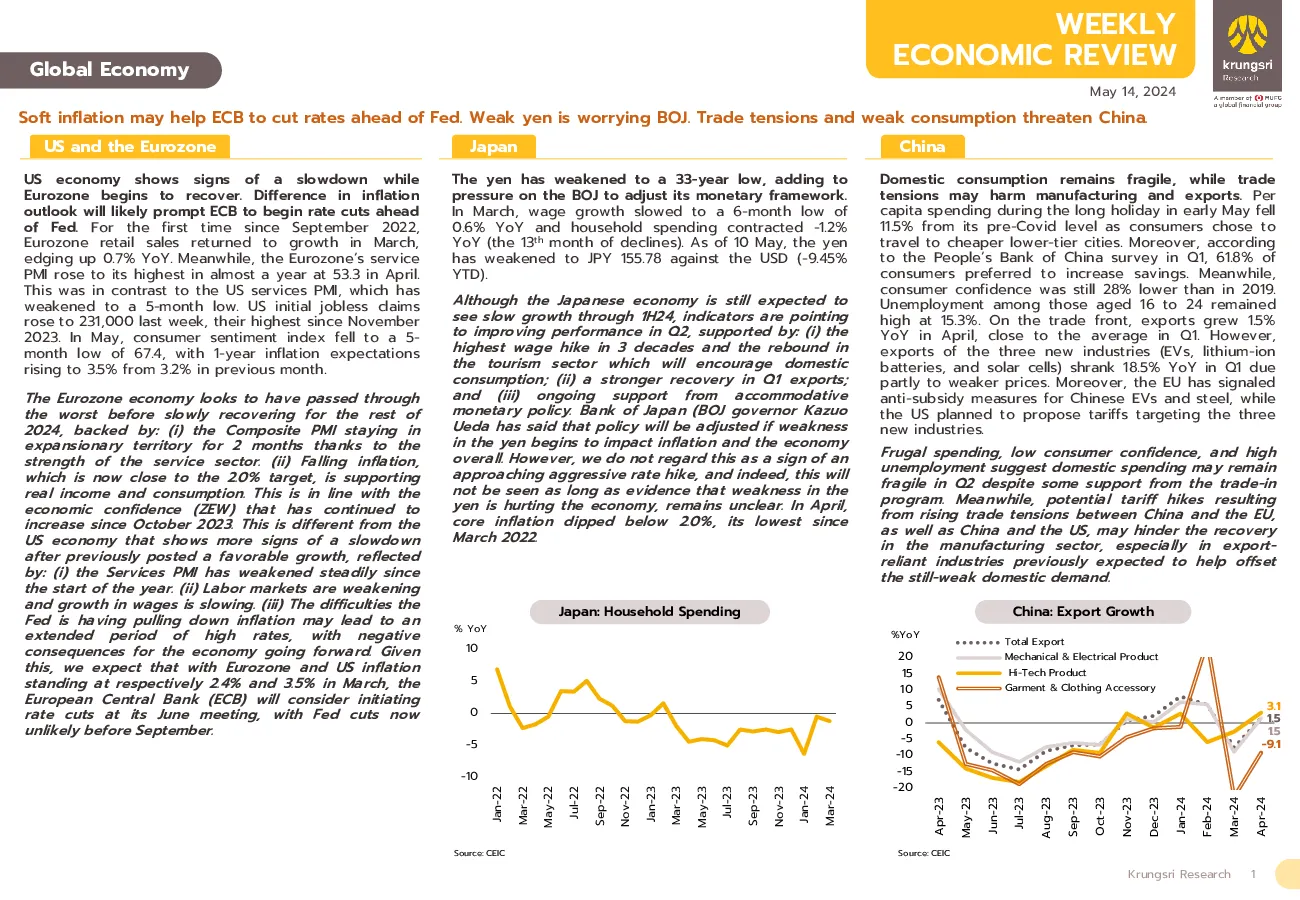
Soft inflation may help ECB to cut rates ahead of Fed. Weak yen is worrying BOJ. Trade tensions and weak consumption threatenChina. US and the Eurozone China Japan USeconomy shows signs of a slowdown whileEurozonebegins to recover.Difference in inflationoutlook will likely prompt ECB to begin rate cuts aheadofFed.For the first time since September 2022,Eurozoneretail sales returned to growth in March,edging up0.7% YoY. Meanwhile, the Eurozone’s servicePMI rose to its highest in almost a year at53.3in April.Thiswas in contrast to the US services PMI, which hasweakenedto a 5-month low.US initial jobless claimsrose to231,000last week, their highest since November2023.In May,consumer sentiment index fell to a 5-monthlow of 67.4,with 1-year inflation expectationsrising to3.5% from3.2% in previous month. The yenhas weakened to a 33-year low,adding topressure on the BOJ to adjust its monetary framework.InMarch,wage growth slowed to a 6-month low of0.6%YoY and household spending contracted-1.2%YoY (the13thmonth of declines). As of10May, the yenhasweakened to JPY 155.78 against the USD(-9.45%YTD). Domesticconsumption remains fragile,while tradetensionsmay harm manufacturing and exports.Percapita spending during the long holiday in early May fell11.5% from its pre-Covid level as consumers chose totravel to cheaper lower-tier cities. Moreover, accordingto the People’s Bank of China survey in Q1,61.8% ofconsumerspreferred to increase savings.Meanwhile,consumer confidence was still28% lower than in 2019.Unemploymentamong those aged 16 to 24 remainedhighat 15.3%.On the trade front,exports grew 1.5%YoYin April,close to the average in Q1.However,exportsof the three new industries(EVs,lithium-ionbatteries, and solar cells) shrank18.5% YoY in Q1 duepartly to weaker prices. Moreover, the EU has signaledanti-subsidy measures for Chinese EVs and steel, whilethe US planned to propose tariffs targeting the threenew industries. Althoughthe Japanese economy is still expected tosee slow growth through1H24, indicators are pointingto improving performance in Q2, supported by: (i) thehighest wage hike in3 decades and the rebound inthetourism sector which will encourage domesticconsumption;(ii)a stronger recovery in Q1 exports;and(iii)ongoingsupportfromaccommodativemonetary policy. Bank of Japan (BOJ governor KazuoUeda has said that policy will be adjusted if weaknessin the yen begins to impact inflation and the economyoverall. However, we do not regard this as a sign of anapproaching aggressive rate hike, and indeed, this willnot be seen as long as evidence that weakness in theyen is hurting the economy, remains unclear. In April,coreinflation dipped below 2.0%,its lowest sinceMarch2022. The Eurozone economy looks to have passed throughtheworst before slowly recovering for the rest of2024,backed by:(i)the Composite PMI staying inexpansionaryterritory for 2 months thanks to thestrengthof the service sector.(ii)Falling inflation,which is now close to the2.0% target, is supportingreal income and consumption. This is in line with theeconomicconfidence(ZEW)that has continued toincrease since October2023. This is different from theUSeconomy that shows more signs of a slowdownafter previously posted a favorable growth, reflectedby: (i) the Services PMI has weakened steadily sincethe start of the year. (ii) Labor markets are weakeningand growth in wages is slowing. (iii) The difficulties theFed is having pulling down inflation may lead to anextendedperiodofhighrates,withnegativeconsequences for the economy going forward. Giventhis, weexpect that with Eurozone and US inflationstanding at respectively2.4% and3.5% in March, theEuropeanCentral Bank(ECB)will consider initiatingratecuts at its June meeting,with Fed cuts nowunlikely before September. Frugal spending, low consumer confidence, and highunemployment suggest domestic spending may remainfragile in Q2despite some support from the trade-inprogram.Meanwhile,potential tariff hikes resultingfrom rising trade tensions between China and the EU,as well as China and the US, may hinder the recoveryinthe manufacturing sector,especially in export-reliantindustries previously expected to help offsetthe still-weak domestic demand. By value, applications for investment support via BOIrose by more than30% in Q1, but other indicatorsshow only weak growth in investment at present.TheBoard ofInvestment(BOI) reported that in the firstquarterof 2024,724 applications for investmentsupportweremade(+94%YoY)withatotalinvestmentvalue of THB 228.21bn(+31%YoY).Thethreemost heavilyrepresentedindustries wereelectronics & electrical appliances, autos & auto parts,and chemicals & petrochemicals. Total foreign directinvestment(FDI)came to THB 169.32bn(+16%YoY)from460 projects(+130%YoY),with the mostimportantsources of this being Singapore,China,Hong Kong, Taiwan, and Australia. The government has decided to extend assistance withthe cost ofenergy, andis in addition preparing to raisethe daily minimum wage to TH