您的浏览器禁用了JavaScript(一种计算机语言,用以实现您与网页的交互),请解除该禁用,或者联系我们。 [泰国大城银行研究中心]:每周经济评论 - 发现报告

每周经济评论

金融 2024-05-28 - 泰国大城银行研究中心 在路上
报告封面

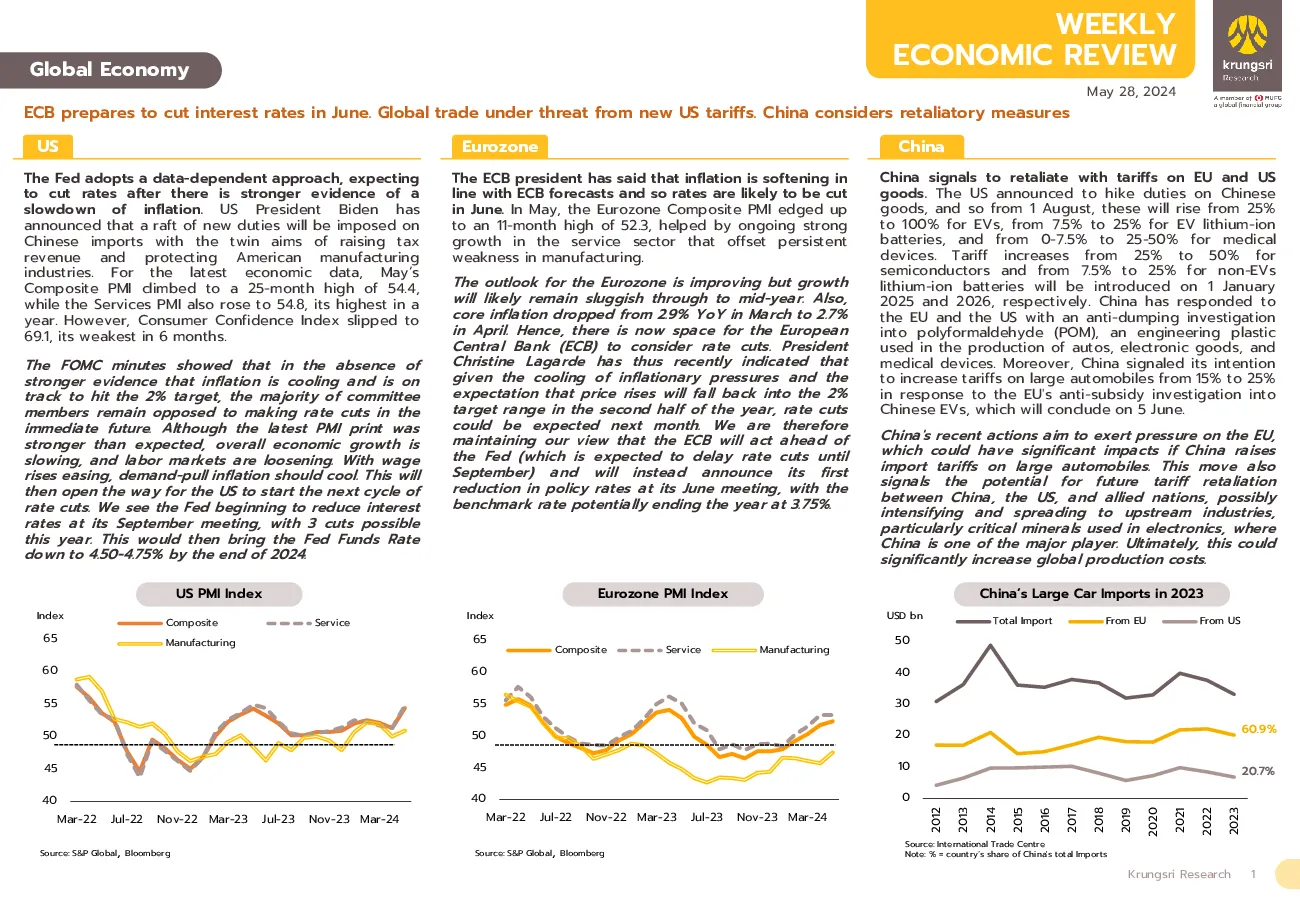
ECB prepares to cut interest rates in June. Global trade under threat from new US tariffs. China considers retaliatory measures US China Eurozone Chinasignals to retaliate with tariffs on EU and USgoods.The US announced to hike duties on Chinesegoods, and so from 1 August, these will rise from 25%to 100% for EVs, from 7.5% to 25% for EV lithium-ionbatteries,and from 0-7.5%to 25-50%for medicaldevices.Tariffincreasesfrom25%to50%forsemiconductorsand from 7.5%to 25%for non-EVslithium-ion batteries will be introduced on 1 January2025 and 2026, respectively. China has responded tothe EU and the US with an anti-dumping investigationintopolyformaldehyde(POM),an engineering plasticused in the production of autos, electronic goods, andmedical devices. Moreover, China signaled its intentionto increase tariffs on large automobiles from 15% to 25%in response to the EU's anti-subsidy investigation intoChinese EVs, which will conclude on 5 June. The Fed adopts a data-dependent approach, expectingtocut rates after there is stronger evidence of aslowdownofinflation.USPresidentBidenhasannounced that a raft of new duties will be imposed onChineseimports with the twin aims of raising taxrevenueandprotectingAmericanmanufacturingindustries.Forthelatesteconomicdata,May’sCompositePMI climbed to a 25-month high of 54.4,while the Services PMI also rose to 54.8, its highest in ayear. However, Consumer Confidence Index slipped to69.1, its weakest in 6 months. The ECB president has said that inflation is softening inline with ECB forecasts and so rates are likely to be cutin June.In May, the Eurozone Composite PMI edged upto an 11-month high of 52.3, helped by ongoing stronggrowthin the service sector that offset persistentweakness in manufacturing. The outlook for the Eurozone is improving but growthwill likely remain sluggish through to mid-year. Also,core inflation dropped from 2.9% YoY in March to 2.7%in April. Hence, there is now space for the EuropeanCentralBank(ECB)to consider rate cuts.PresidentChristineLagarde has thus recently indicated thatgiventhe cooling of inflationary pressures and theexpectation that price rises will fall back into the 2%target range in the second half of the year, rate cutscouldbe expected next month.We are thereforemaintaining our view that the ECB will act ahead oftheFed(which is expected to delay rate cuts untilSeptember)and will instead announce its firstreduction in policy rates at its June meeting, with thebenchmark rate potentially ending the year at 3.75%. TheFOMC minutes showed that in the absence ofstronger evidence that inflation is cooling and is ontrack to hit the 2% target,the majority ofcommitteemembers remain opposed to making rate cuts in theimmediatefuture.Although the latest PMI print wasstrongerthan expected,overall economic growth isslowing, and labor markets are loosening. With wagerises easing, demand-pull inflation should cool. This willthen open the way for the US to start the next cycle ofrate cuts. We see the Fed beginning to reduce interestrates at its September meeting, with 3 cuts possiblethis year. This would then bring the Fed Funds Ratedown to 4.50-4.75% by the end of 2024. China's recent actions aim to exert pressure on the EU,which could havesignificant impacts if China raisesimporttariffs on large automobiles.This move alsosignalsthe potential for future tariff retaliationbetweenChina,the US,and allied nations,possiblyintensifyingand spreading to upstream industries,particularly critical minerals used in electronics, whereChina is one of the major player. Ultimately, this couldsignificantly increase global production costs. Althoughexport value returned to growth in April,continuing structural problems within Thai manufacturingwilldrag on the recovery.The Ministry of Commercereportsthat having contracted 10.9%in March,exportvalue bounced back to growth of 6.8% in April, therebyclimbing to USD 23.3bn. Excluding gold and oil, exportsgrew by 11.4%. The largest gains were reported for rice(+91.5%),computers and computer equipment(+62.0%),machinery and parts (+58.8%), rubber (+36.2%) and autos,autoequipment and auto parts(+20.4%).However,declines were seen in exports of fresh, chilled, frozen anddried fruit (-29.8%), integrated circuit boards (-9.2%), andsugar (-9.1%). Exports to the US, the EU, the ASEAN-5 andthe CLMV nations saw the expansion, while exports toChina and Japan contracted. During the first 4 months ofthis year, export value is up just 1.4%. Foreign investments in Thailand expanded by morethan 40% over 4M24, led by inflows from Japan.TheMinistryof Commerce reports that as per the 1999Foreign Business Act, 253 applications (+17% YoY) forbusiness licenses to operate in Thailand were granted,these having a combined value of THB 54.96bn (+42%).Themost important originating nation by far wasJapan(63 companies with total investments of THB34.06bn), followed by Singapore (42 companies, THB4.50bn), the US (41 companies, THB 1.15bn), China (20companies, T