每周经济评论
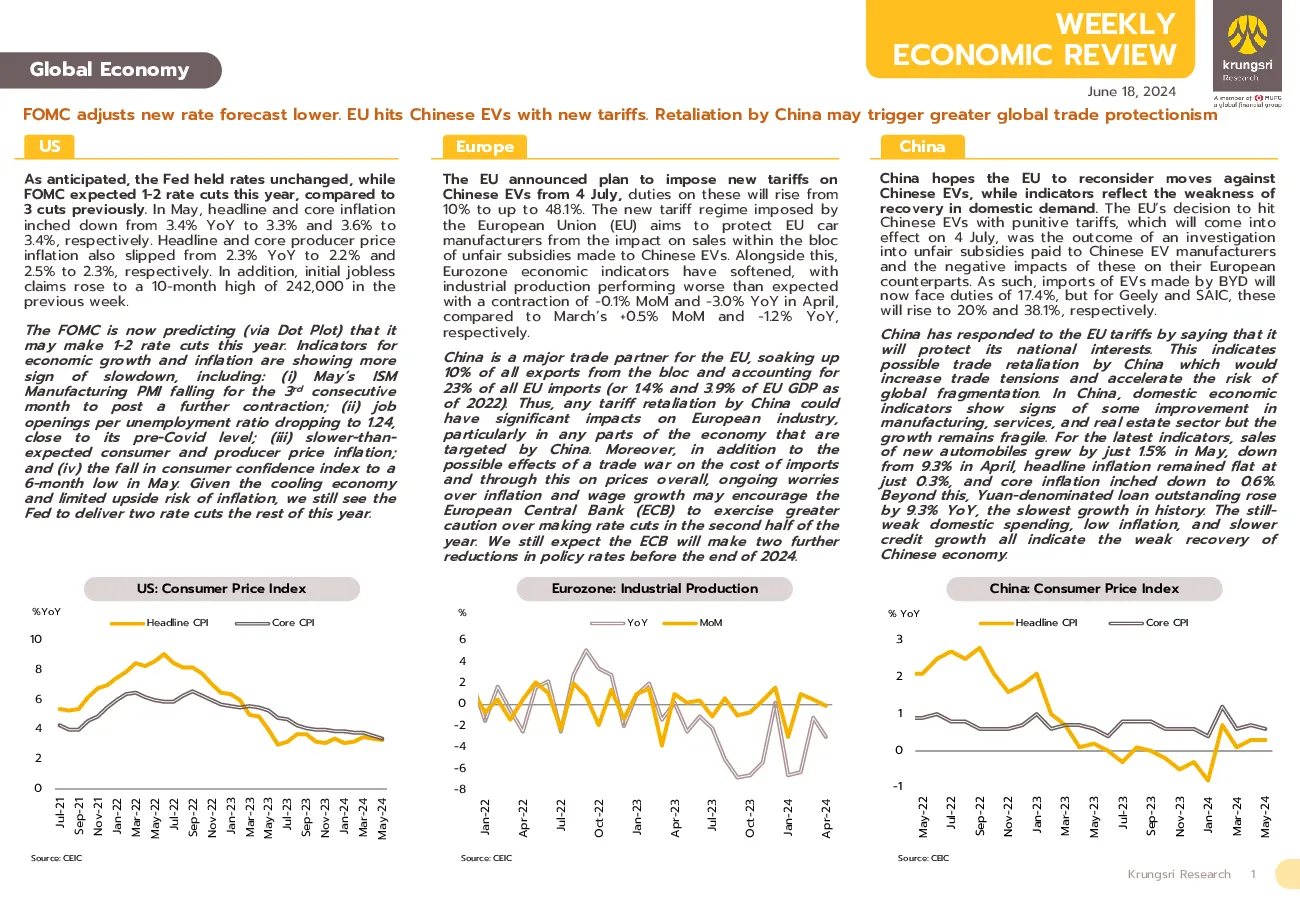
US China Europe TheEU announced plan to impose new tariffs onChinese EVs from4July,duties on these will rise from10% to up to48.1%. The new tariff regime imposed bytheEuropean Union(EU)aims to protect EU carmanufacturers from the impact on sales within the blocof unfair subsidies made to Chinese EVs. Alongside this,Eurozoneeconomic indicators have softened,withindustrial production performing worse than expectedwith a contraction of-0.1% MoM and-3.0% YoY in April,comparedto March’s+0.5%MoM and-1.2%YoY,respectively. As anticipated, the Fed held rates unchanged, whileFOMC expected1-2rate cuts this year, compared to3cuts previously.In May, headline and core inflationinched down from3.4% YoY to 3.3% and 3.6% to3.4%, respectively. Headline and core producer priceinflationalso slipped from 2.3%YoY to 2.2%and2.5% to2.3%, respectively. In addition, initial joblessclaims rose to a10-month high of 242,000 in theprevious week. Chinahopes the EU to reconsider moves againstChinese EVs, while indicators reflect the weakness ofrecovery in domestic demand.The EU’s decision to hitChinese EVs with punitive tariffs, which will come intoeffect on4 July, was the outcome of an investigationinto unfair subsidies paid to Chinese EV manufacturersand the negative impacts of these on their Europeancounterparts. As such, imports of EVs made by BYD willnow face duties of17.4%, but forGeelyand SAIC, thesewill rise to20% and38.1%, respectively. The FOMC is now predicting (viaDot Plot) that itmaymake 1-2 rate cuts this year.Indicators foreconomic growth and inflation are showing moresignofslowdown,including:(i)May’sISMManufacturingPMI falling for the 3rd consecutivemonthto post a further contraction;(ii)jobopenings per unemployment ratio dropping to1.24,closeto its pre-Covid level;(iii)slower-than-expectedconsumer and producer price inflation;and (iv) the fall in consumer confidence index to a6-month low in May.Given the cooling economyand limited upside risk of inflation, we still see theFed to deliver two rate cuts the rest of this year. China has responded to the EU tariffs by saying that itwillprotect its national interests.This indicatespossibletrade retaliation by China which wouldincreasetrade tensions and accelerate the risk ofglobalfragmentation.In China,domestic economicindicatorsshow signs of some improvement inmanufacturing, services, and real estate sector but thegrowth remains fragile. For the latest indicators, salesof new automobiles grew by just1.5% in May, downfrom9.3% in April, headline inflation remained flat atjust0.3%,and core inflation inched down to 0.6%.Beyond this, Yuan-denominated loan outstanding roseby9.3% YoY, the slowest growth in history. The still-weakdomestic spending,low inflation,and slowercreditgrowth all indicate the weak recovery ofChinese economy. China is a major trade partner for the EU, soaking up10% of all exports from the bloc and accounting for23% of all EU imports (or1.4% and3.9% of EU GDP asof2022).Thus,any tariff retaliation by China couldhavesignificantimpactsonEuropeanindustry,particularlyin any parts of the economy that aretargetedby China.Moreover,in addition to thepossible effects of a trade war on the cost of importsandthrough this on prices overall,ongoing worriesover inflation and wage growth may encourage theEuropeanCentral Bank(ECB)to exercise greatercaution over making rate cuts in the second half of theyear.We still expect the ECB will make two furtherreductions in policy rates before the end of2024. MPC may maintain the policy rate at2.50% through2024; political uncertainties weigh on consumer sentiment Private consumption is showing signs of slowing ona fall in consumer sentiment to a7-month low.TheConsumer Confidence Index fell for the3rd month inMay,sliding from 62.1 to 60.5,its weakest sinceNovember2023. Sentiment is being undercut by: (i) asurge in political uncertainty following the decisionby the Constitutional Court to accept a case filed by40senators against the prime minister;(ii)theweaknessof the recovery and the slowness ofdomestic growth; (iii) rising retail fuel prices; and (iv)the possibleimpacts of prolonged conflicts in theMiddle East on the Thai and global economies. The MPC has held the policy rate steady, citing that levelisconsistent with the economy converging to itspotential.At its 12 June meeting,the Monetary PolicyCommittee (MPC) voted6 to 1 to leave the policy rateunchangedat 2.50%on the view that growth willcontinue to be supported through2024 by: (i) domesticdemand that is stronger than anticipated in1Q24; (ii) theongoingrebound in the tourism sector;and(iii)theeffects of increased disbursements of government budgetfrom2Q24 onwards.Nevertheless, structural issues andthe declining competitiveness of Thai industry mean thatgrowthin exports is sluggish.Core inflation remainedcloseto the previous forecast.One MPC member(compared to two in the past two meetings) saw a25-bpcut to bring the rate closer into line with the economy’sweakening growth