每周经济评论
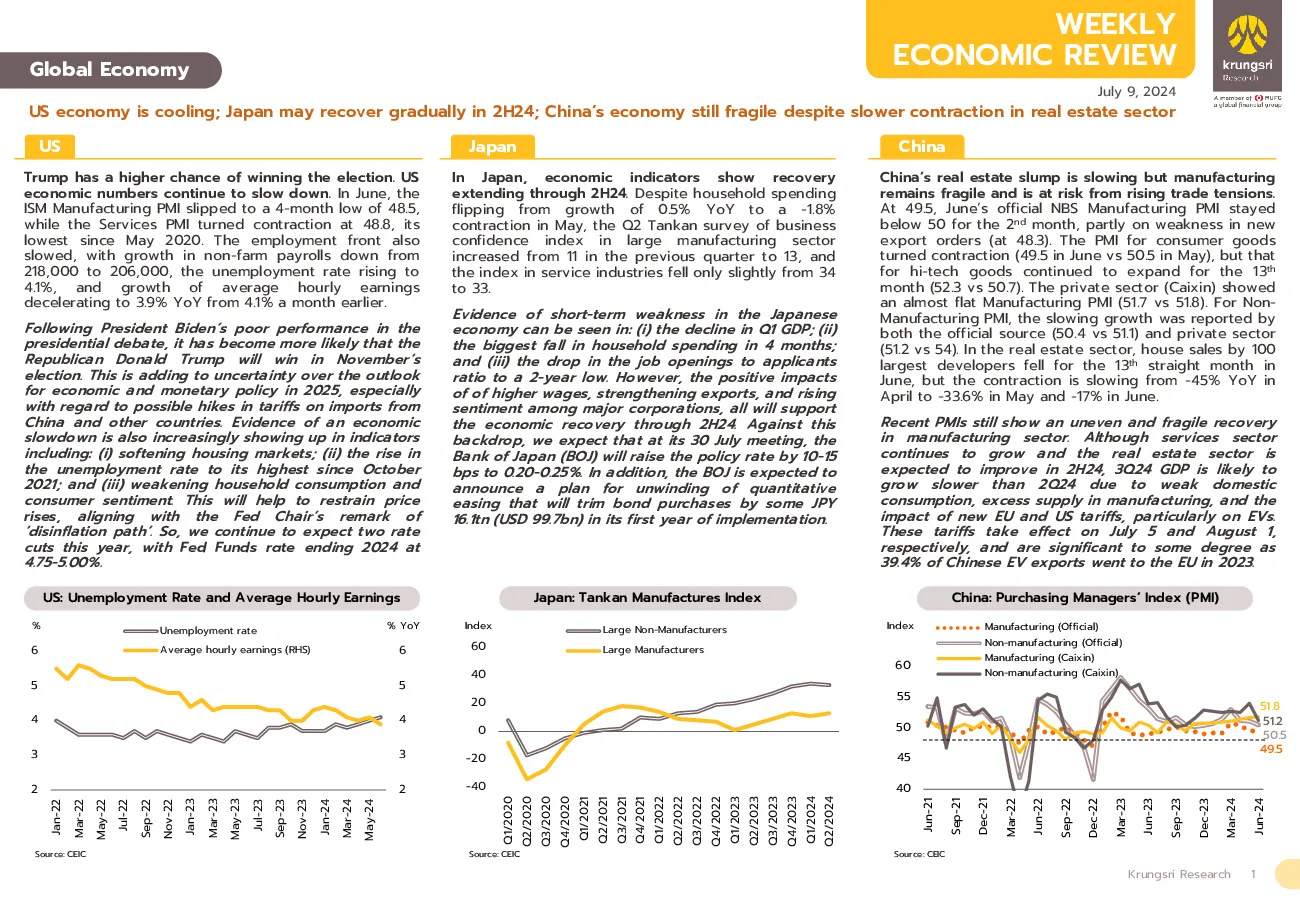
US economy is cooling; Japan may recover gradually in2H24; China’s economy still fragile despite slower contraction in real estate sector US China Japan China’s real estate slump is slowing but manufacturingremains fragile and is at risk from rising trade tensions.At49.5,June’s official NBS Manufacturing PMI stayedbelow50for the2ndmonth, partly on weakness in newexportorders(at 48.3).The PMI for consumer goodsturned contraction (49.5in June vs50.5in May), but thatforhi-tech goods continued to expand for the 13thmonth (52.3vs50.7). The private sector (Caixin) showedan almost flat Manufacturing PMI (51.7vs51.8). For Non-Manufacturing PMI, the slowing growth was reported byboth the official source (50.4vs51.1) and private sector(51.2vs54). In the real estate sector, house sales by100largestdevelopers fell for the 13th straight month inJune, but the contraction is slowing from-45% YoY inApril to-33.6% in May and-17% in June. Trump has a higher chance of winning the election. USeconomic numbers continue to slow down.In June, theISM Manufacturing PMI slipped to a4-month low of48.5,whilethe Services PMI turned contraction at 48.8,itslowestsince May 2020.The employment front alsoslowed,with growth in non-farm payrolls down from218,000to 206,000, the unemployment rate rising to4.1%,andgrowthofaveragehourlyearningsdecelerating to3.9% YoY from4.1% a month earlier. InJapan,economicindicatorsshowrecoveryextending through 2H24.Despite household spendingflippingfrom growth of 0.5%YoY to a-1.8%contraction in May, the Q2 Tankan survey of businessconfidenceindex inlargemanufacturingsectorincreased from 11 in the previous quarter to 13, andthe index in service industries fell only slightly from 34to 33. Evidenceof short-term weakness in the Japaneseeconomy can be seen in: (i) the decline in Q1 GDP; (ii)the biggest fall in household spending in 4 months;and (iii) the drop in the job openings toapplicantsratio to a 2-year low. However, the positive impactsofofhigher wages, strengthening exports, and risingsentiment among major corporations, all will supporttheeconomic recovery through 2H24.Against thisbackdrop, we expect that at its 30 July meeting, theBank of Japan (BOJ) will raise the policy rate by 10-15bps to 0.20-0.25%. In addition, the BOJ is expected toannouncea plan for unwinding of quantitativeeasing that will trimbond purchases by some JPY16.1tn (USD 99.7bn) in its first year of implementation. Following President Biden’s poor performance in thepresidential debate, it has become more likely that theRepublicanDonald Trump will win in November’selection. This is adding to uncertainty over the outlookfor economic and monetary policy in2025, especiallywith regard topossible hikes in tariffs on imports fromChinaand other countries. Evidence of an economicslowdown is also increasingly showing up in indicatorsincluding: (i) softening housing markets; (ii) the rise intheunemployment rate to its highest since October2021; and (iii) weakening household consumption andconsumersentiment.This will help to restrain pricerises,aligning with the Fed Chair’s remark of‘disinflation path’. So, we continue to expect two ratecutsthis year,with Fed Funds rate ending 2024 at4.75-5.00%. Recent PMIs still show an uneven and fragile recoveryinmanufacturing sector.Although services sectorcontinuesto grow and the real estate sector isexpected toimprove in 2H24,3Q24 GDP is likely togrowslower than 2Q24 due to weak domesticconsumption, excess supply in manufacturing, and theimpact of new EU and US tariffs, particularly on EVs.Thesetariffs take effect on July 5 and August 1,respectively,and are significant to some degree as39.4% of Chinese EV exports went to the EU in2023. Despiteeasing headline inflation in June,the MPC isexpected to hold policy rate steady the rest of2024.Headline inflation cooled from1.54% YoY in May to0.62%inJune thanks to the ending of changes to electricityprices and baseline effects in May, and the onset of morefavorable weather that has fed into a drop in prices forfresh food. Core inflation, which excluded raw food andenergy prices, easedslightly from 0.39%to 0.36%.For1H24, headline and core inflation rates have averaged0%and0.41%, respectively. 17.5m foreign arrivals were recorded in 1H24, andwe still expect total2024 arrivals to reach 35.6m.The Economics Tourism and Sports Division reportsthatin June,the country welcomed 2.74m foreigntourists,up 22.3%YoY and an increase on May’s2.63m. This thus brings the1H24total to17.5m, or anincrease of35.5%. Through the period, the 5 mostimportantoriginating nations were China(3.44mtourists), Malaysia (2.44m), India (1.04m), South Korea(0.93m) and Russia (0.92m). Having briefly returned to the target range for the firsttimein 13 months in May,headline inflation droppedback under the target in June. We see inflation graduallyrising through2H24, and this may enter the1-3% targetin4Q24.For the whole of 2024,headline inflation isexpectedto average just 0.7%.Price rises are be