每周经济评论
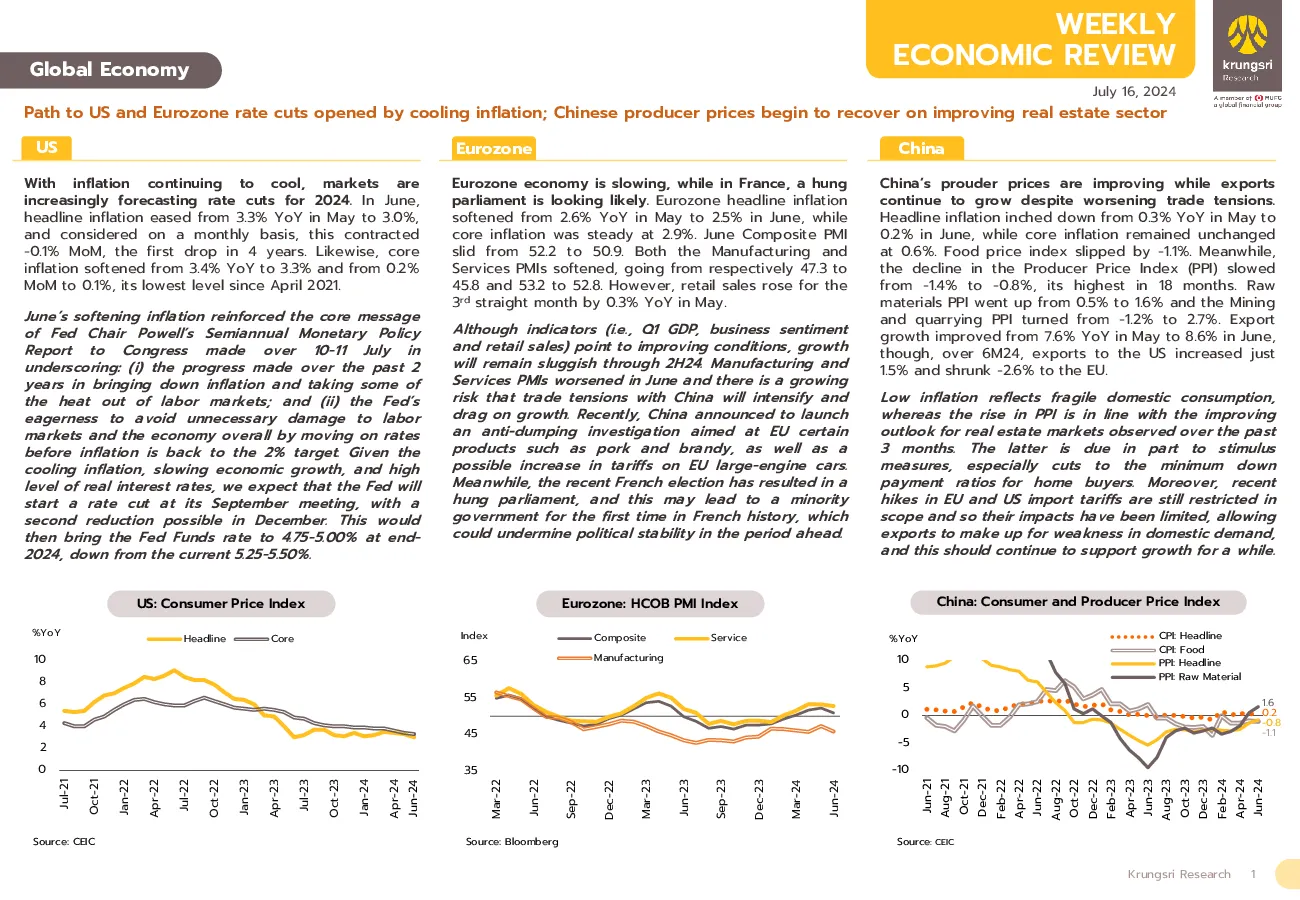
Path to US and Eurozone rate cuts opened by cooling inflation; Chinese producer prices begin to recover on improving real estatesector US Eurozone China China’sprouder prices are improving while exportscontinueto grow despite worsening trade tensions.Headline inflation inched down from 0.3% YoY in May to0.2% in June, while core inflation remained unchangedat 0.6%. Food price index slipped by-1.1%. Meanwhile,thedecline in the Producer Price Index(PPI)slowedfrom-1.4%to-0.8%,its highest in 18 months.Rawmaterials PPI went up from 0.5% to 1.6% and the Miningandquarrying PPI turned from-1.2%to 2.7%.Exportgrowth improved from 7.6% YoY in May to 8.6% in June,though,over 6M24,exports to the US increased just1.5% and shrunk-2.6% to the EU. Eurozone economy is slowing, while in France, a hungparliament is looking likely.Eurozone headline inflationsoftened from 2.6% YoY in May to 2.5% in June, whilecore inflation was steady at 2.9%. June Composite PMIslidfrom 52.2 to 50.9.Both the Manufacturing andServices PMIs softened, going from respectively 47.3 to45.8 and 53.2 to 52.8. However, retail sales rose for the3rdstraight month by 0.3% YoY in May. Withinflationcontinuingtocool,marketsareincreasinglyforecasting rate cuts for 2024.In June,headline inflation eased from 3.3% YoY in May to 3.0%,andconsidered on a monthly basis,this contracted-0.1%MoM,the first drop in 4 years.Likewise,coreinflation softened from 3.4% YoY to 3.3% and from 0.2%MoM to 0.1%, its lowest level since April 2021. June’s softening inflation reinforced the core messageofFed Chair Powell’s Semiannual Monetary PolicyReporttoCongressmadeover10-11Julyinunderscoring: (i) the progress made over the past 2years in bringing down inflation and taking some oftheheat out of labor markets;and(ii)the Fed’seagernessto avoid unnecessary damage to labormarkets and the economy overall by moving on ratesbeforeinflation is back to the 2% target.Given thecooling inflation, slowing economic growth, and highlevel of real interest rates, we expect that the Fed willstarta rate cut at its September meeting,with asecondreduction possible in December.This wouldthen bring the Fed Funds rate to 4.75-5.00% at end-2024, down from the current 5.25-5.50%. Althoughindicators(i.e.,Q1 GDP,business sentimentand retail sales) point to improving conditions, growthwill remain sluggish through 2H24. Manufacturing andServices PMIs worsened in June and there is a growingrisk that trade tensions with Chinawill intensify anddrag on growth. Recently, China announced to launchananti-dumping investigation aimed at EU certainproductssuch as pork and brandy,as well as apossibleincrease in tariffs on EU large-engine cars.Meanwhile, the recent French election has resulted in ahungparliament,and this may lead to a minoritygovernment for the first time in French history, whichcould undermine political stability in the period ahead. Lowinflation reflects fragile domestic consumption,whereas the rise in PPI is in line with the improvingoutlook for real estate markets observed over the past3months.The latter is due in part to stimulusmeasures,especially cuts to the minimum downpaymentratiosfor home buyers.Moreover,recenthikes in EU and US import tariffs are still restricted inscope and so their impacts have been limited, allowingexports to make up for weakness in domestic demand,and this should continue to support growth for a while. There are signs of a slowdown in private consumptionasJuneconsumerconfidencefellforthe4thconsecutivemonth.The Consumer Confidence Index(CCI) dipped from 60.8 in May to a 9-month low of 58.9in June. This was due to rising worries over: (i) increasesin the cost of living that are a result of more expensiveenergy (i.e., electricity and transport fuels), itself partly aconsequenceof the ending of subsidies;(ii)sloweconomicrecovery,which is then impacting incomesandpurchasing power;and(iii)domestic politicaluncertainty. Thegovernment has revised scale and fundingsourcesfor digital wallet policy,planned to to beproposed to cabinet at end-July.At a 10 July meeting,theDigital Wallet Steering Committee agreed areduction to funding for the policy from a total of THB500bn to THB 450bn. This will now be drawn entirelyfrom the fiscal year2024 and 2025 budgets,whichwill contribute respectively (i) THB 165bn (an additionalbudgetof THB 122bn and THB 43bn from budgetmanagement)and(ii)THB 285bn(THB 152bn fromadditionalbudget and THB 132.3bn from budgetmanagement,e.g.,from central government budgetandunspent allocations).In addition,the committeeextendedthe list of goods on which digital walletfunds cannot be spent to include electrical appliances,electronicgoods,and communications devices(e.g.,mobile phones). The fall in the Consumer Confidence Index to its lowestlevel since October 2023 reflects the slowing growth inprivate consumption, despite having jumped 6.9% YoYin Q1. Through the rest of the year, consumption couldbesupported by:(i)the ongoing strength of thetourismsector and gov