每周经济评论
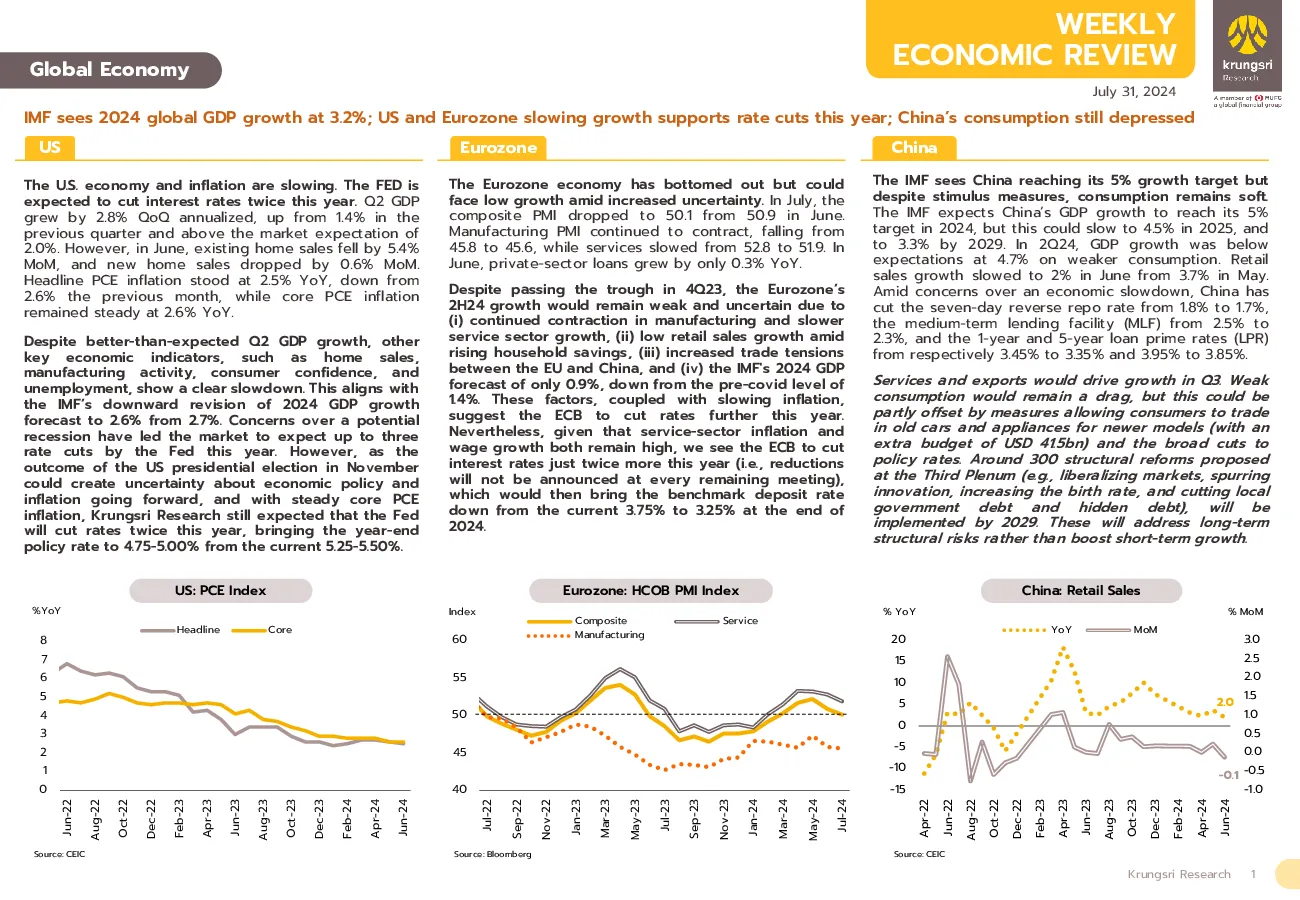
IMF sees2024global GDP growth at3.2%; US and Eurozone slowing growth supports rate cuts this year; China’s consumption still depressed China US Eurozone The IMF sees China reaching its5% growth target butdespite stimulus measures, consumption remains soft.The IMF expects China’s GDP growth to reach its 5%target in2024, but this could slow to4.5% in2025, andto3.3%by 2029.In 2Q24,GDP growth was belowexpectationsat 4.7%on weaker consumption.Retailsales growth slowed to2% in June from 3.7% in May.Amid concerns over an economic slowdown, China hascut the seven-day reverse repo rate from1.8% to1.7%,themedium-term lending facility(MLF)from 2.5%to2.3%, and the1-year and5-year loan prime rates (LPR)from respectively3.45% to3.35% and3.95% to3.85%. The U.S. economy and inflation are slowing. The FED isexpected to cut interest rates twice this year.Q2GDPgrewby 2.8%QoQ annualized,up from 1.4%in theprevious quarter and above the market expectation of2.0%. However, in June, existing home sales fell by5.4%MoM,and new home sales dropped by 0.6%MoM.Headline PCE inflation stood at2.5% YoY, down from2.6%the previous month,while core PCE inflationremained steady at2.6% YoY. TheEurozone economy has bottomed out but couldface low growth amid increased uncertainty.In July, thecompositePMI dropped to 50.1 from 50.9 in June.ManufacturingPMI continued to contract,falling from45.8to45.6, while services slowed from52.8to51.9. InJune, private-sector loans grew by only0.3% YoY. Despitepassing the trough in 4Q23,the Eurozone’s2H24growth would remain weak and uncertain due to(i) continued contraction in manufacturing and slowerservice sector growth, (ii) low retail sales growth amidrising household savings, (iii) increased trade tensionsbetween the EU and China, and (iv) the IMF's2024GDPforecast of only0.9%, down from the pre-covid level of1.4%.These factors,coupled with slowing inflation,suggestthe ECB to cut rates further this year.Nevertheless,given that service-sector inflation andwage growth both remain high, we see the ECB to cutinterest rates just twice more this year (i.e., reductionswillnot be announced at every remaining meeting),whichwould then bring the benchmark deposit ratedown from the current3.75% to 3.25% at the end of2024. Despitebetter-than-expected Q2 GDP growth,otherkeyeconomicindicators,suchashomesales,manufacturingactivity,consumer confidence,andunemployment, show a clear slowdown. This aligns withtheIMF’s downward revision of 2024 GDP growthforecast to2.6% from2.7%. Concerns over a potentialrecession have led the market to expect up to threeratecuts by the Fed this year.However,as theoutcome of the US presidential election in Novembercouldcreate uncertainty about economic policy andinflationgoing forward,and with steady core PCEinflation, Krungsri Research still expected that the Fedwillcut rates twice this year,bringing the year-endpolicy rate to4.75-5.00% from the current5.25-5.50%. Services and exports would drive growth in Q3. Weakconsumption would remain a drag, but this could bepartly offset by measures allowing consumers to tradein old cars and appliances for newer models (with anextrabudget of USD 41.5bn)and the broad cuts topolicy rates. Around300structural reforms proposedat the Third Plenum (e.g., liberalizing markets, spurringinnovation, increasing the birth rate, and cutting localgovernmentdebtandhiddendebt),willbeimplementedby 2029.These will address long-termstructural risks rather than boost short-term growth. Thegovernment has laid out a timeline for theimplementation ofits digital wallet policy,with theexpenditure planned in Q4 of this year.On 24 July,theMinistry of Finance released its timetable forregistrationsfortheTHB10,000digitalwalletpayments.These will happen in three stages:(i)between1August and15September, registrations willopen for those able to use the mobile-phone app.; (ii)from16 September to 15 October,registrations willopen for those without a smartphone; and (iii) from1Octoberonwards,registrationswillopenforparticipating retailers. Further details of stages (ii) and(iii) will be released later. The government now hopestobe able to begin the expenditure under thisprogram during the last quarter of the year. Exportscontracted slightly in June and for the year,growthwill remain soft.The Ministry of Commercereported that in June, export value contracted-0.3% YoYto USD24.8bn, down from May’s 14-month high of USD26.2bn.Excluding oil and gold from the calculations,exportsposted a contraction of-1.6%.Major exportgoods experiencing contractions in the month includedsugar (-51.9%), fresh, chilled, frozen & dried fruits (-37.8%),integratedcircuit(-21.4%)and rubber products(-7.9%).However, export sectors seeing an expansion were rice(+96.6%),rubber(+28.8%),computers&computerequipment(+22.0%),telephones,fax machines,parts&equipment (+20.1%), and automobiles, parts & equipment(+13.5%). Exports to China, Japan, and the ASEAN-5groupall contracted in month, but those to the US, the EU and