每周经济评论
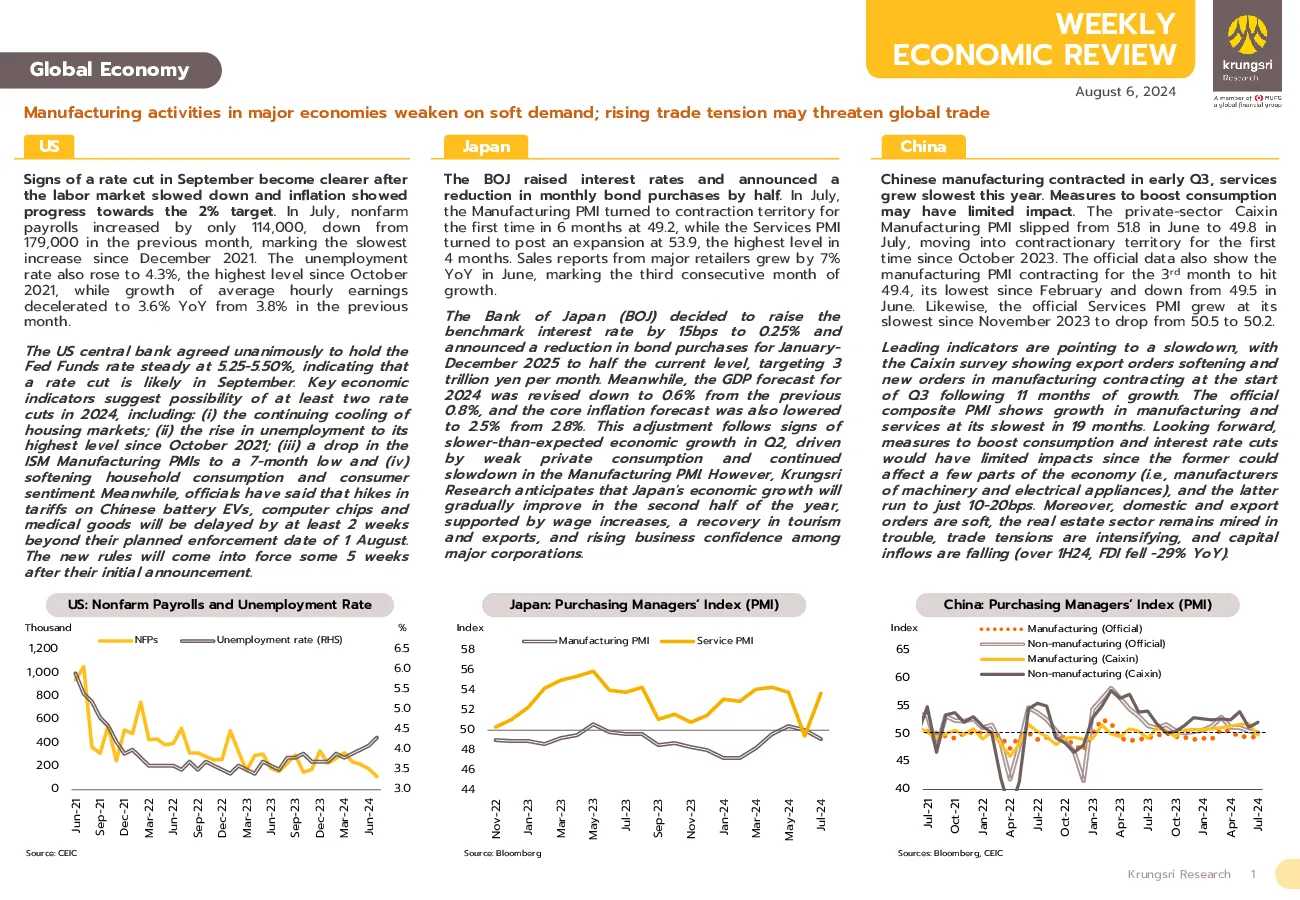
Manufacturing activities in major economies weaken on soft demand; rising trade tension may threaten global trade US China Japan Signs of a rate cut in September become clearer afterthe labor market slowed down and inflation showedprogresstowards the 2%target.In July,nonfarmpayrollsincreased by only 114,000,down from179,000in the previous month, marking the slowestincreasesince December 2021.The unemploymentrate also rose to4.3%, the highest level since October2021,while growth of average hourly earningsdecelerated to3.6% YoY from 3.8% in the previousmonth. Chinese manufacturing contracted in earlyQ3,servicesgrew slowest this year. Measures to boost consumptionmayhave limited impact.The private-sector CaixinManufacturing PMI slipped from 51.8 in June to 49.8 inJuly,moving into contractionary territory for the firsttime since October 2023. The official data also show themanufacturing PMI contracting for the 3rd month to hit49.4, its lowest since February and down from 49.5 inJune.Likewise,the official Services PMI grew at itsslowest since November 2023 to drop from 50.5 to 50.2. TheBOJ raised interest rates and announced areduction in monthly bond purchases by half.In July,the Manufacturing PMI turned to contraction territory forthe first time in6months at49.2, while the Services PMIturned to post an expansion at53.9, the highest level in4months. Sales reports from major retailers grew by7%YoY in June, marking the third consecutive monthofgrowth. TheBank of Japan(BOJ)decided to raise thebenchmarkinterest rate by 15bps to 0.25%andannounced a reduction in bond purchases for January-December2025 to half the current level, targeting 3trillion yen per month. Meanwhile, the GDP forecast for2024was revised down to 0.6%from the previous0.8%, and the core inflation forecast was also loweredto2.5%from 2.8%.This adjustment follows signs ofslower-than-expected economic growth in Q2, drivenbyweakprivateconsumptionandcontinuedslowdown in the Manufacturing PMI. However, KrungsriResearch anticipates that Japan's economic growth willgraduallyimprove in the second half of the year,supported by wage increases, arecovery in tourismandexports,and rising business confidence amongmajor corporations. Leading indicators are pointing to aslowdown, withthe Caixin survey showing export orders softening andnew orders in manufacturing contracting at the startofQ3 following 11 months of growth.The officialcompositePMI shows growth in manufacturing andservices at its slowest in 19 months. Looking forward,measures to boost consumption and interest rate cutswouldhave limited impacts since the former couldaffect a few parts of the economy (i.e., manufacturersof machinery and electrical appliances), and the latterrun to just 10-20bps. Moreover, domestic and exportorders are soft, the real estate sector remains mired introuble,trade tensions are intensifying,and capitalinflows are falling (over 1H24, FDI fell-29% YoY). The US central bank agreed unanimously to hold theFed Funds rate steady at5.25-5.50%, indicating thatarate cut is likely in September.Keyeconomicindicatorssuggest possibility of at least two ratecuts in2024, including: (i) the continuing cooling ofhousing markets; (ii) the rise in unemployment to itshighest level since October2021; (iii) a drop in theISMManufacturing PMIs to a 7-month low and(iv)softeninghousehold consumption and consumersentiment. Meanwhile, officials have said that hikes intariffs on Chinese battery EVs, computer chips andmedical goods will be delayed by at least2weeksbeyond their planned enforcement date of1August.Thenew rules will come into force some 5 weeksafter their initial announcement. Softeningtourism and consumption fed into slowereconomicgrowthinJune,butoverall economycontinued to recover in Q2.The Bank of Thailand (BOT)reports that in June, foreign tourist arrivals and receiptsfromthese dropped by respectively-4.4%and-3.5%MoMsa.Private consumption growth also softened-0.2%on weaker purchases of durable automotivegoods.Exports(ex.gold)also fell-0.7%.However,private investment grew by +0.6%, while government’sbudgetdisbursements for investments and regularspending both improved. Thevalue of applications for investment promotionjumped 35% over 1H24, but other indicators show thatarecovery in overall investment remains weak.TheBoard of Investment (BOI) reports that over 1H24, 1,412applicationsfor BOI incentives were received(+64%YoY)with a value of THB 458.4bn(+35%YoY).Thetargeted industries recoding the most investments wereled by electronics &electrical appliances (THB 139.7bn),automobiles&parts(THB 39.9bn),agriculture&foodprocessing(THB 33.1bn),chemicals&petrochemicals(THB25.3bn)anddigitalindustries(THB25.1bn).Applicationsfor BOI privileges for Foreign DirectInvestment(FDI)came from 889 projects(+83%YoY)valued at THB 325.7bn (+16% YoY). The most importantsources of these funds were led by Singapore, China,Hong Kong, Japan and Taiwan. Relative to Q1, overall economic conditions improved in