每周经济评论
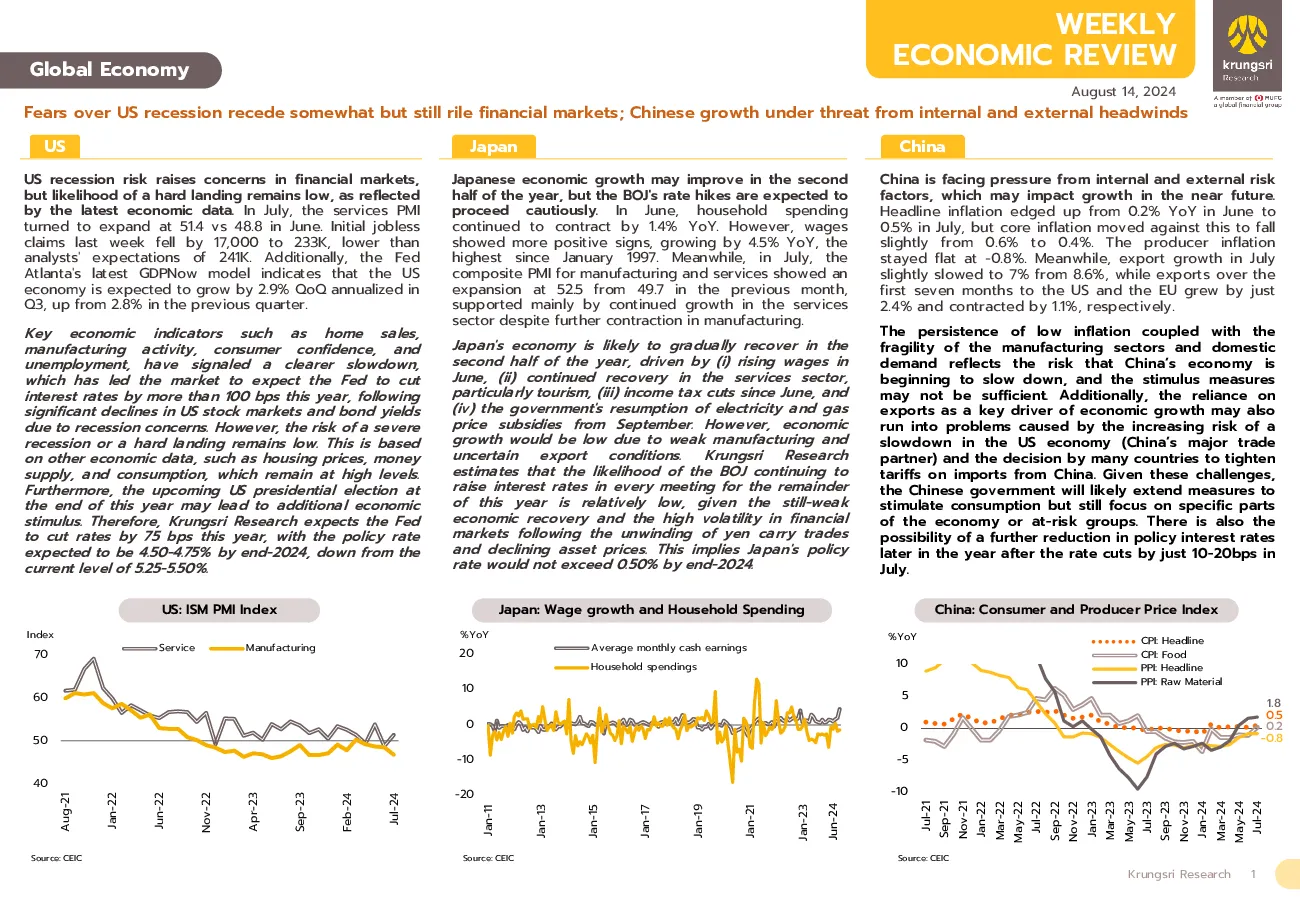
Fears over US recession recede somewhat but still rile financial markets; Chinese growth under threat from internal and externalheadwinds US China Japan US recession risk raises concerns in financial markets,but likelihood of a hard landing remains low, as reflectedby the latest economic data.In July,the services PMIturned to expand at 51.4 vs 48.8 in June. Initial joblessclaimslast week fell by 17,000 to 233K,lower thananalysts'expectations of 241K.Additionally,the FedAtlanta'slatest GDPNow model indicates that the USeconomy is expected to grow by 2.9% QoQ annualized inQ3, up from 2.8% in the previous quarter. Japanese economic growth may improve in the secondhalf of the year, but the BOJ's rate hikes are expected toproceedcautiously.InJune,householdspendingcontinuedto contract by 1.4%YoY.However,wagesshowed more positive signs, growing by 4.5% YoY, thehighestsince January 1997.Meanwhile,in July,thecomposite PMI for manufacturing and services showed anexpansionat 52.5 from 49.7 in the previous month,supported mainly by continued growth in the servicessector despite further contraction in manufacturing. China is facing pressure from internal and external riskfactors, which may impact growthin the near future.Headline inflation edged up from 0.2% YoYin June to0.5% in July, but core inflation moved against this to fallslightlyfrom 0.6%to 0.4%.The producer inflationstayed flat at-0.8%. Meanwhile, export growth in Julyslightly slowed to 7% from 8.6%, while exports over thefirst seven months to the US and the EU grew by just2.4% and contracted by 1.1%, respectively. Thepersistence of low inflation coupled with thefragilityof the manufacturing sectors and domesticdemandreflects the risk that China’s economy isbeginningto slow down,and the stimulus measuresmaynot be sufficient.Additionally,the reliance onexports as akeydriver of economic growth may alsorun into problems caused by the increasing risk of aslowdownin the US economy(China’s major tradepartner) and the decision by many countries to tightentariffs on imports from China. Given these challenges,the Chinese government will likely extend measures tostimulate consumption but still focus on specific partsofthe economy or at-risk groups.There is also thepossibility of a further reduction in policy interest rateslater in the year after the rate cuts by just 10-20bps inJuly. Keyeconomicindicatorssuchashomesales,manufacturingactivity,consumer confidence,andunemployment,have signaled a clearer slowdown,whichhas led the market to expect the Fed to cutinterest rates by more than 100 bps this year, followingsignificant declines in US stock markets and bond yieldsdue to recession concerns. However, the risk of a severerecession or a hard landing remains low. This is basedon other economic data, such as housing prices, moneysupply, and consumption, which remain at high levels.Furthermore, the upcoming US presidential election atthe end of this year may lead to additional economicstimulus. Therefore, Krungsri Research expects the Fedto cut rates by 75 bps this year, with the policy rateexpected to be 4.50-4.75% by end-2024, down from thecurrent level of 5.25-5.50%. Japan's economy is likely to gradually recover in thesecond half of the year, driven by (i) rising wages inJune,(ii)continued recovery in the services sector,particularly tourism, (iii) income tax cuts since June, and(iv) the government's resumption of electricity and gaspricesubsidies from September.However,economicgrowth would be low due to weak manufacturing anduncertainexportconditions.KrungsriResearchestimates that the likelihood of the BOJ continuing toraise interest rates in every meeting for the remainderofthis year is relatively low,given the still-weakeconomic recovery and the high volatility in financialmarketsfollowing the unwinding of yen carry tradesand declining asset prices. This implies Japan's policyrate would not exceed 0.50% by end-2024. Headline inflation edged up to close to the lower bound ofthe target range in July, and so the MPC is likely to leavethepolicy rate unchanged at its 21 August meeting.Headline inflation climbed up from 0.62% YoY in June to0.83%in July on a combination of higher global crudeprices, which then pushed up the domestic cost of gasolineand gasohol, and more expensive food, especially ready-to-eat meals and white and glutinous rice. Core inflation,which excludes raw food and energy prices, also rose from0.36% to 0.52%. For the first 7 months of this year, headlineand core inflation rates have averaged 0.11% and 0.42%,respectively. July’sconsumerconfidencefellforthefifthconsecutivemonth,and with this now at an 11-month low, private consumption may be losing itsgrowth momentum.The Consumer Confidence Index(CCI)fell from 58.9 in June to 57.7 in July due torising consumer worries over: (i) sluggish economicgrowth; (ii) increases in incomes that have not keptpace with the higher cost of living; (iii) the risk ofrisingdomestic political uncertainty;and(iv)th