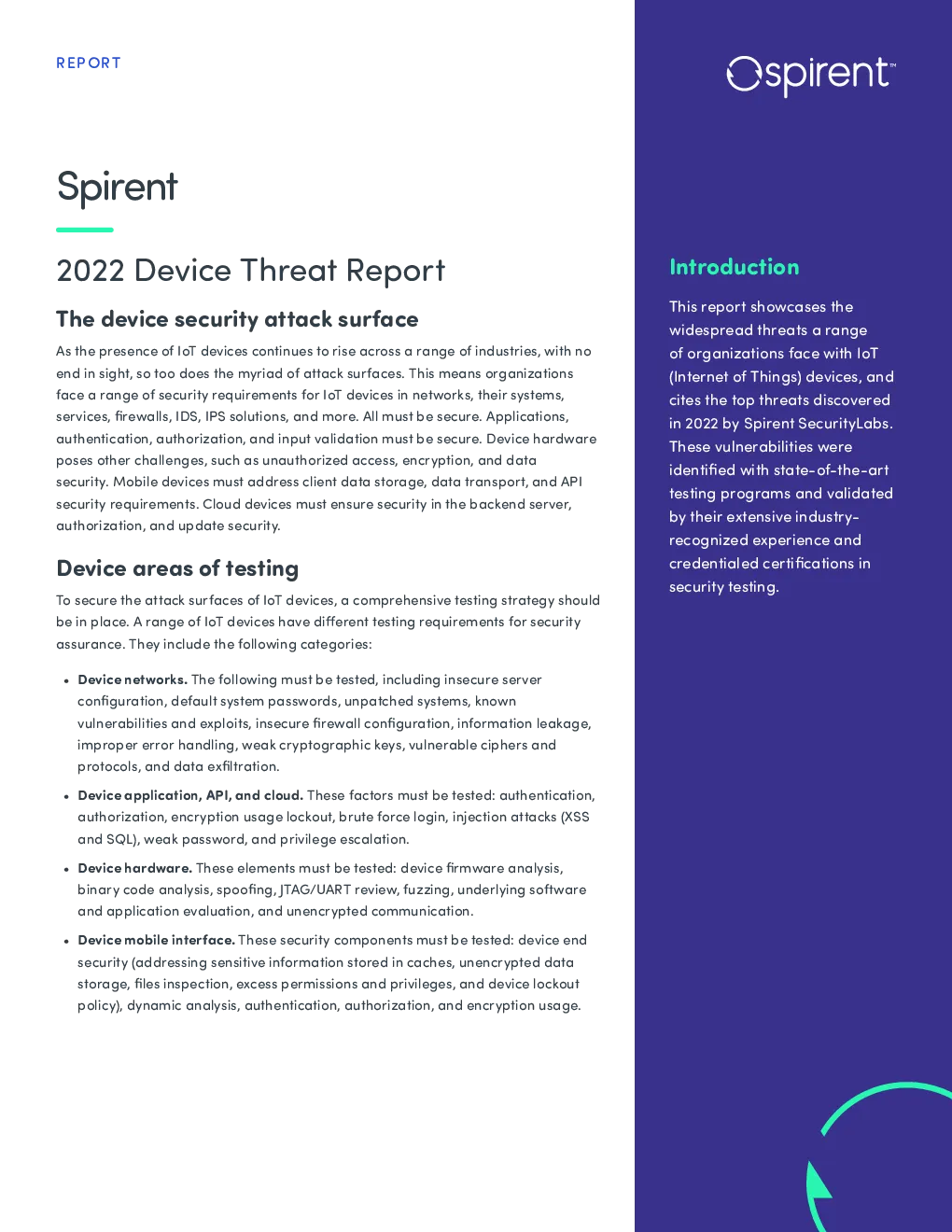
2022 Device Threat Report Summary
1. Threat Landscape and Security Requirements
- IoT Device Growth: The increasing number of IoT devices across industries creates a vast attack surface.
- Security Needs: Organizations must secure networks, systems, services, firewalls, IDS/IPS, and more.
- Device Security Challenges: Applications, authentication, authorization, input validation, hardware security (unauthorized access, encryption, data security), mobile devices (client data storage, data transport, API security), and cloud devices (backend server, authorization, update security).
2. Device Testing Areas
- Device Networks: Insecure server configuration, default passwords, unpatched systems, known vulnerabilities, firewall issues, information leakage, error handling, cryptographic keys, ciphers/protocols, data exfiltration.
- Device Application, API, and Cloud: Authentication, authorization, encryption, lockout, brute force, injection attacks, weak passwords, privilege escalation.
- Device Hardware: Firmware analysis, binary code, spoofing, JTAG/UART, fuzzing, software/app evaluation, unencrypted communication.
- Device Mobile Interface: End security, dynamic analysis, authentication, authorization, encryption.
3. Spirent SecurityLabs Testing Criteria
- Authentication and Authorization: Ensuring secure access controls.
- Firmware Update Mechanisms: Secure update processes.
- Interface Security: JTAG/UART/SPI review, binary code analysis.
- Wireless Communication Security: Wi-Fi, Bluetooth, BLE, Zigbee, LoRaWAN, etc.
- Fuzzing Protocols: Software and hardware level fuzzing.
- Data in Transit Security: Secure data transfer.
- Side-Channel Attacks: NAND glitching, power glitching, memory scrapping, DPA.
4. Penetration Testing
- Real-world Vulnerability Assessment: Tailored to the system under test.
- Industry Standards: NIST, CTIA, OWASP IoT guidelines.
- Testing Methodology: Identifying configuration weaknesses and exploitable vulnerabilities.
5. SecurityLabs Findings - Top Device Vulnerabilities (2022)
- Unencrypted communications
- Hardcoded cryptographic keys
- Reprogrammable components
- Insecure boot process
- Weak and non-standard cryptographic algorithms
- Weak and common credentials
- Unencrypted storage
- Accessible serial console
- Outdated software
- Insecure APIs
- High privileged running services
6. Potential Impact of Vulnerabilities
- Unencrypted communications: MITM attacks, data interception, traffic modification.
- Hardcoded cryptographic keys: System compromise, data access.
- Reprogrammable components: Side-channel analysis, malicious configurations, data exposure.
- Insecure boot process: Firmware and boot process compromise.
- Weak and non-standard cryptographic algorithms: Cryptographic breaches, data modification.
- Weak and common credentials: Brute force attacks, unauthorized access.
- Unencrypted storage: Data interception, identity theft, fraud.
- Accessible serial console: Tapping, interception, replay attacks.
- Outdated software: Security flaws, data breaches, malware.
- Insecure APIs: Manipulation, compromise, damage.
- High-privileged running services: Compromise, catastrophic loss.
7. Conclusions and Takeaways
- Understand vulnerabilities and risks: Unauthorized access, data changes, authentication bypass, privilege escalation, code injection, service crashes, memory leaks, input validation weaknesses, serialization issues, MITM attacks.
- Top vulnerabilities and risk factors: Unencrypted communications, hardcoded keys, reprogrammable components, insecure boot process, weak algorithms, credentials, storage, serial console, outdated software, insecure APIs, high-privileged services.
- Mature security testing strategy: Penetration testing, security from planning phase, alignment with standards.
- Expert testing partner: Understanding technologies, attack methods, established track record, data for reliable baselines, best practices, real-world conditions preparation.