您的浏览器禁用了JavaScript(一种计算机语言,用以实现您与网页的交互),请解除该禁用,或者联系我们。[The Milwaukee Company]:回顾自DeepSeek冲击性消息使市场措手不及以来的赢家与输家 - 发现报告

回顾自DeepSeek冲击性消息使市场措手不及以来的赢家与输家

回顾自DeepSeek冲击性消息使市场措手不及以来的赢家与输家

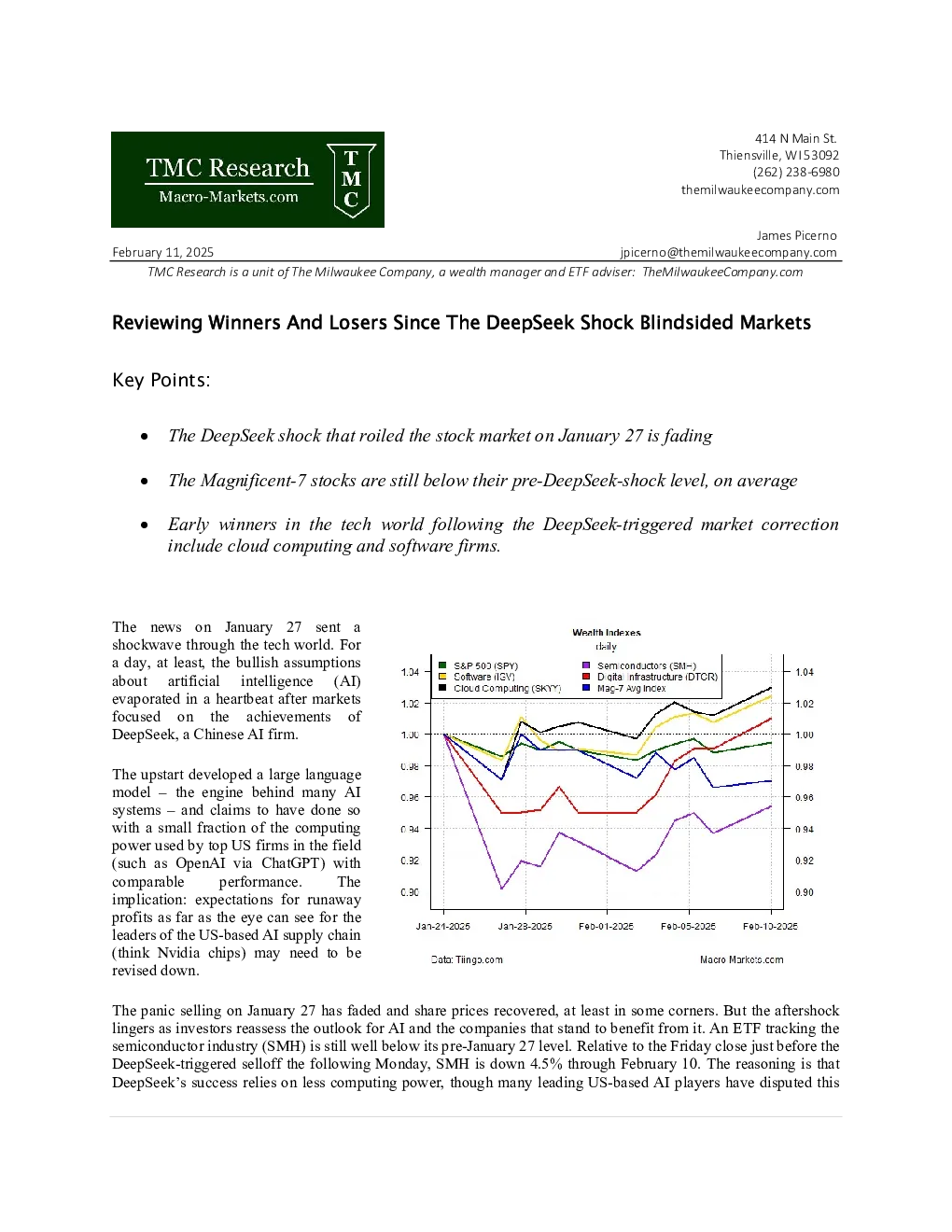
Key Points: The DeepSeek shock that roiled the stock market on January 27 is fadingThe Magnificent-7 stocks are still below their pre-DeepSeek-shock level, on averageEarly winners in the tech world following the DeepSeek-triggered market correctioninclude cloud computing and software firms. Thenews on January 27 sent ashockwave through the tech world. Fora day, at least, the bullish assumptionsaboutartificialintelligence(AI)evaporated in a heartbeat after marketsfocusedontheachievementsofDeepSeek, a Chinese AI firm. The upstart developed a large languagemodel – the engine behind many AIsystems – and claims to have done sowith a small fraction of the computingpower used by top US firms in the field(such as OpenAI via ChatGPT) withcomparableperformance.Theimplication: expectations for runawayprofits as far as the eye can see for theleaders of the US-based AI supply chain(think Nvidia chips) may need to berevised down. The panic selling on January 27 has faded and share prices recovered, at least in some corners. But the aftershocklingers as investors reassess the outlook for AI and the companies that stand to benefit from it. An ETF tracking thesemiconductor industry (SMH) is still well below its pre-January 27 level. Relative to the Friday close just before theDeepSeek-triggered selloff the following Monday, SMH is down 4.5% through February 10. The reasoning is thatDeepSeek’s success relies on less computing power, though many leading US-based AI players have disputed this claim. Nevertheless, it raises the possibility that the most advanced chips manufactured by Nvidia and others may notbe as essential as previously assumed. Big-tech stocks are also nursing losses relative to the trading day before the DeepSeek-shock, based on the averagechange for the so-called Magnificent-7 (Apple, Microsoft, Alphabet, Amazon, Nvidia, Meta and Tesla). Based on themean result for this group, the shares overall are still trading near their collective low on January 27. Yet there are winners, too, perhaps due to the reasoning that DeepSeek’s success may pave the way for wider adoptionof AI at a lower cost, which in turn could boost business for cloud computing and software applications. Investorsseem to agree and have bid up share prices in both industries following the DeepSeek news on January 24. The FirstTrust Cloud Computing ETF (SKYY) is up around 3% relative to its pre-January 27 level. The iShares ExpandedTech-Software Sector ETF (IGV) is a close second and is posting a modest rise over the same period. For comparison,the broad US equities market is nearly flat, based on SPDR S&P 500 ETF (SPY). Meantime, digital infrastructure(DTCR) is rallying lately. It's too soon to know how DeepSeek will change assumptions (and business models) for tech and AI, particularly forthe big-tech stocks that previously were priced for perfection. But investors have become more cautious and the marketis still struggling to sort out what’s changed, and what hasn’t. This much is clear: If DeepSeek’s discovery of a low-cost AI business model proves to be correct (and is replicable),the breakthrough will create winners and losers. Exactly who’s on which list remains a work in progress. Meantime,you can still count on one iron law: everything becomes a commodity… eventually. This Report is provided for informational and educational purposes only and is not intended to be, and should not be construedas, financial or investment advice. The views and opinions expressed in this commentary are solely those of the authors and donot necessarily reflect the official policy or position of The Milwaukee Company. Investors are urged to consult with their own financial advisors before making any investment decisions. The informationcontained in this commentary has been compiled from sources believed to be reliable, but no representation or warranty,express or implied, is made as to its accuracy, completeness, or correctness. Market data and trends are subject to rapid changeand may become unreliable for various reasons, including changes in market conditions or economic circumstances. This Report may also discuss financial models or attempts to model various macroeconomic factors. It is important to recognizethat model risk is inherent in any such analysis. Models rely on assumptions that may not hold under all conditions, and therelationships they attempt to capture can change over time. Furthermore, macroeconomic conditions are constantly evolving,and the unpredictability of shifting models can introduce additional risks or lead to outcomes that differ materially fromexpectations. No guarantee is made that any model, forecast, or projection presented in this Report will prove to be accurate orreliable. Past performance is not indicative of future results. All investments involve risks, including the possible loss of principal. Norepresentation or warranty is made that any return or performance indicated will be achieved. Nothing in thi