您的浏览器禁用了JavaScript(一种计算机语言,用以实现您与网页的交互),请解除该禁用,或者联系我们。[美国农业部(USDA)]:2024年全球咖啡市场和贸易报告(12月版) - 发现报告

2024年全球咖啡市场和贸易报告(12月版)

AI智能总结
查看更多
2024年全球咖啡市场和贸易报告(12月版)

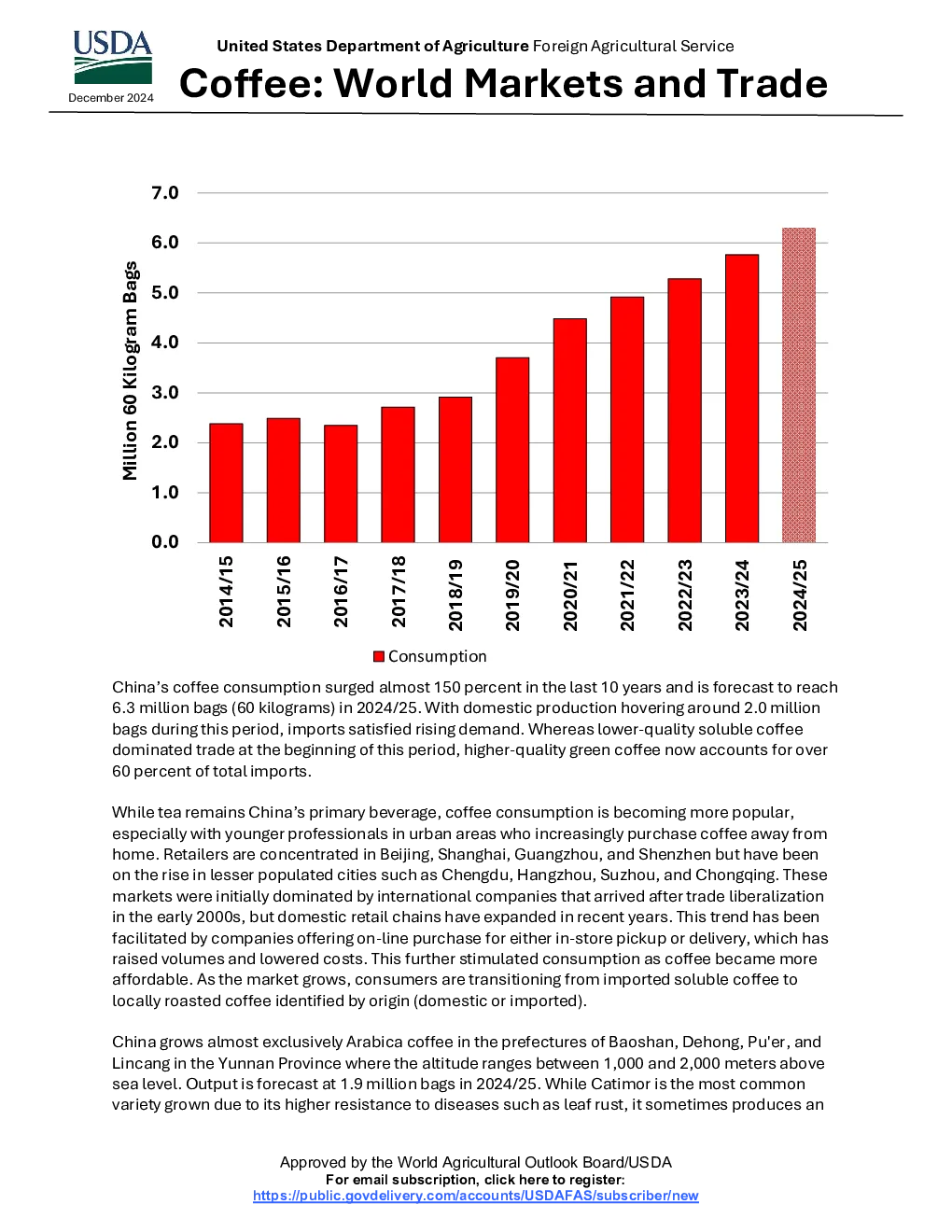
China’s coffee consumption surged almost 150 percent in the last 10 years and is forecast to reach6.3 million bags (60 kilograms) in 2024/25. With domestic production hovering around 2.0 millionbags during this period, imports satisfied rising demand. Whereas lower-quality soluble coffeedominated trade at the beginning of this period, higher-quality green coffee now accounts for over60 percent of total imports. While tea remains China’s primary beverage, coffee consumption is becoming more popular,especially with younger professionals in urban areas who increasingly purchase coffee away fromhome. Retailers are concentrated in Beijing, Shanghai, Guangzhou, and Shenzhen but have beenon the rise in lesser populated cities such as Chengdu, Hangzhou, Suzhou, and Chongqing. Thesemarkets were initially dominated by international companies that arrived after trade liberalizationin the early 2000s, but domestic retail chains have expanded in recent years. This trend has beenfacilitated by companies offering on-line purchase for either in-store pickup or delivery, which hasraised volumes and lowered costs. This further stimulated consumption as coffee became moreaffordable. As the market grows, consumers are transitioning from imported soluble coffee tolocally roasted coffee identified by origin (domestic or imported). China grows almost exclusively Arabica coffee in the prefectures of Baoshan, Dehong, Pu'er, andLincang in the Yunnan Province where the altitude ranges between 1,000 and 2,000 meters abovesea level. Output is forecast at 1.9 million bags in 2024/25. While Catimor is the most commonvariety grown due to its higher resistance to diseases such as leaf rust, it sometimes produces an inferior flavor. In response to demand for higher quality coffee, growers have begun planting otherArabica varieties such as Bourbon and Typica which offer better flavor and more favorably competewith imports. In the last decade, China’s total coffee imports nearly tripled to 5.5 million bags and are forecast toreach 5.6 million in 2024/25. This explosive growth was driven by green coffee jumping from just900,000 bags in 2014/15 to a forecast 3.6 million. Vietnam and Indonesia were initially topsuppliers but have since been overtaken by Brazil and Colombia. Import demand for soluble coffeehas remained relatively flat during this period and is forecast at 1.8 million bags in 2024/25, withtop suppliers including Vietnam and Malaysia. China typically imports less than 400,000 bags ofroasted coffee, primarily from the European Union and United States. Roasted coffee is lessdesirable for imports because it begins to lose flavor and aroma shortly after being roasted unlessshipped quickly in specially designed packaging. China’s consumption growth is expected to continue as this largely tea drinking culture embracesa higher caffeinated beverage and be a major factor in growing global coffee demand. 2024/25 Coffee Overview Worldcoffee production for 2024/25 isforecast 6.9 million bags higher than theprevious year to 174.9 million due primarilyto rebounding output in Vietnam andIndonesia. World exports are forecastmodestly higher as gains in Vietnam andIndonesia more than offset reducedshipments from Brazil. Global consumptionis expected to rise 5.1 million bags to 168.1million, with the largest gains in theEuropean Union, the United States, andChina. Ending stocks are expected to drop1.5 million bags to 20.9 million. Brazilcombined Arabica and Robusta harvest is forecast at 66.4 million bags, up just 100,000 bagsfrom the previous year. Arabica output is forecast 500,000 bags higher to 45.4 million while theRobusta harvest is expected to slip 400,000 bags to 21.0 million. Drought and high temperaturesduring the fruit development and filling period caused Arabica and Robusta yields to fall belowinitial projections. With nearly flat output, coffee bean exports are forecast to drop 2.6 million bagsto 40.5 million due primarily to last year’s inventory drawdown, which lowered total supplies. Vietnamproduction is forecast to recover 2.6 million bags to 30.1 million but remain below the2021/22 record crop. The beginning of the rainy season got off to a dry start and was followed bybelow-average precipitation and temperatures in many of the major growing areas. Whereassimilar conditions lowered yields and output the previous 2 harvests, growers this year respondedto higher coffee prices by picking as much as possible rather than omitting smaller, less profitablecherries. Bean exports are forecast to rebound 1.8 million bags to 24.4 million on higher availablesupplies. ColombiaArabica production is forecast up 100,000 bags to 12.9 million on favorable growingconditions and improving yields. Bean exports, mostly to the United States and European Union,are forecast up 200,000 bags to 10.9 million on slightly higher supplies and sustained demand. Central America and Mexicoproduction is forecast 600,000 bags higher to 17.0 million, withAr