您的浏览器禁用了JavaScript(一种计算机语言,用以实现您与网页的交互),请解除该禁用,或者联系我们。 [世界银行]:Improving Educational Outcomes for Children in Low-Income Countries - 发现报告

Improving Educational Outcomes for Children in Low-Income Countries

信息技术 2025-03-17 世界银行 徐雨泽
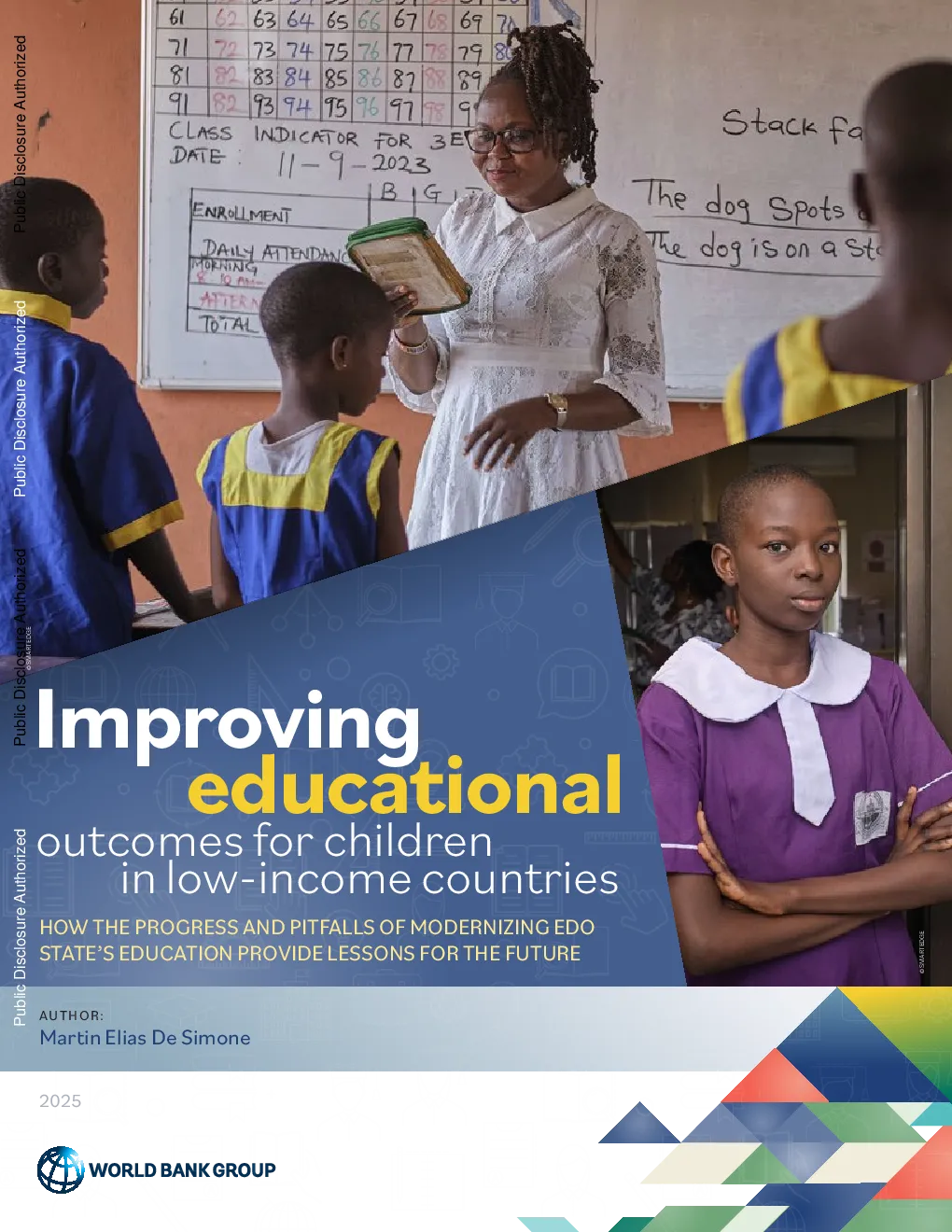
报告封面

in low-income countries HOW THE PROGRESS AND PITFALLS OF MODERNIZING EDOSTATE’S EDUCATION PROVIDE LESSONS FOR THE FUTURE AUTHOR:Martin Elias De SimonePublic Disclosure Authorized 2025 © 2025 International Bank for Reconstruction and Development/The World Bank1818 H Street NWWashington DC 20433Telephone: 202-473-1000Internet:www.worldbank.org This work is a product of the staff of The World Bank with external contributions. The findings, interpretations, andconclusions expressed in this work do not necessarily reflect the views of The World Bank, its Board of ExecutiveDirectors, or the governments they represent. The World Bank does not guarantee the accuracy, completeness, or currency of the data included in this workand does not assume responsibility for any errors, omissions, or discrepancies in the information, or liabilitywith respect to the use of or failure to use the information, methods, processes, or conclusions set forth. Theboundaries, colors, denominations, and other information shown on any map in this work do not imply anyjudgment on the part of The World Bank concerning the legal status of any territory or the endorsement oracceptance of such boundaries. Nothing herein shall constitute or be construed or considered to be a limitation upon or waiver of the privilegesand immunities of The World Bank, all of which are specifically reserved. Contents 5Acknowledgments7Acronyms8Executive Summary12I. IntroductionMethodology13Structureof the report1415II. The context in Edo State18III. Evidence-based interventions:the EdoBEST programThe structuredpedagogy program18EdoBEST@Home:complementing learning in school withlearning at home41The stronger focus on foundational learningin the last fewyears of the program4448IV. Is EdoBEST working?EdoBEST is improvinginputs and outputs48EdoBEST appearsto be improving learning5056V. Political commitment, leadership, and financingInstitutional andpolitical economy challenges58 63VI. A focus on implementation capacityData as akey element63Scalabilityof the program66A public-private partnershipfor implementation68The roleof communities72The deliveryteam74The cost of EdoBESTand its sustainability7679VII. Conclusion and key lessons learned82References Acknowledgments This report was written by Martin De Simone under the guidance of Scherezad Latif, EducationPractice Manager for Western and Central Africa. The team is grateful for the criticalcontributions of the previous Practice Manager, Halil Dundar, whose leadership was instrumentalin the project’s initial stages. The report reflects the efforts and contributions of numerous individualsand organizations. Thomas O’Brien and Juan Manuel Moreno Olmedilla provided invaluable expertfeedback at multiple stages. Many discussions with Luis Benveniste and Jaime Saavedra also helpedshaped multiple sections of the report. This rePraccontributin the proand organfeedbackshaped m The team would like to extend our sincere gratitude to the government authorities of Edo State,Nigeria, as well as federal level authorities. Special thanks go to His Excellency Godwin Obaseki,Executive Governor of Edo State, for his steadfast commitment to educational reform. We sincerelyappreciate the leadership and dedication of Dr. Joan Oviawe, Honorable Commissioner of Education,who envisioned the EdoBEST program, and Mrs. Eyitayo Salami, Chair of the State Universal BasicEducation Board (SUBEB), who continued with its implementation over the last few years. TheSecretary of SUBEB, Imuentinyan Akin-Omoyajowo, has been a key partner. The teamNigeria, aExecutiveappreciatwho enviEducatioSecretary The collaboration with the delivery team of the EdoBESST project has been critical to this report.We particularly recognize Mr. Dele Salami (Project Coordinator) for his exemplary leadership.We also extend our appreciation to all members of the EdoBESST team for their significantcontributions, including Elliot Uhuonoma (Deputy Project Coordinator), Dayo Forsythe (M&EOfficer), Christiana Oshomoh (Project Accountant), James Owolabi (Procurement Officer), HauwaEtsenmuhie (Assistant Procurement Officer), Isoken Osemwimgie (Social Safeguard Officer), QueenAbusonmwan (Grievance Redress Officer), Esther Ogunode (Environmental Safeguard Officer),Friday Asogbaha (Finance Officer), Unyinme Ajah (DLI 3 Focal Person), Boniface Aliu (DLI 4 FocalPerson), Sade Franklin - Osakwe (DLI 5 Focal Person), Peter Obaraye (DLI 6 Focal Person), AsemotaIzoduwa (DLI 7& 8 Focal Person), Samuel Abada (Head, PFMU), Jude Adamu (Accountant, PFMU),Maureen Obarisiagbon (Internal Auditor), Ruth Aliu (Accelerator Program focal point), and BashiruImuekemhe (Assistant Project Accountant). The collaWe particWe alsocontribuOfficer), CEtsenmuhAbusonmFriday AsPerson), SIzoduwa (MaureenImuekem The team is indebted to numerous experts who have provided technical expertise that shaped therecommendations and analysis in this report, many of whom contributed to the Mid-Term Reviewof the Wor