您的浏览器禁用了JavaScript(一种计算机语言,用以实现您与网页的交互),请解除该禁用,或者联系我们。 [ITC]:Transforming Trade, Changing Lives - 发现报告

Transforming Trade, Changing Lives

信息技术 2024-06-27 ITC M.凯
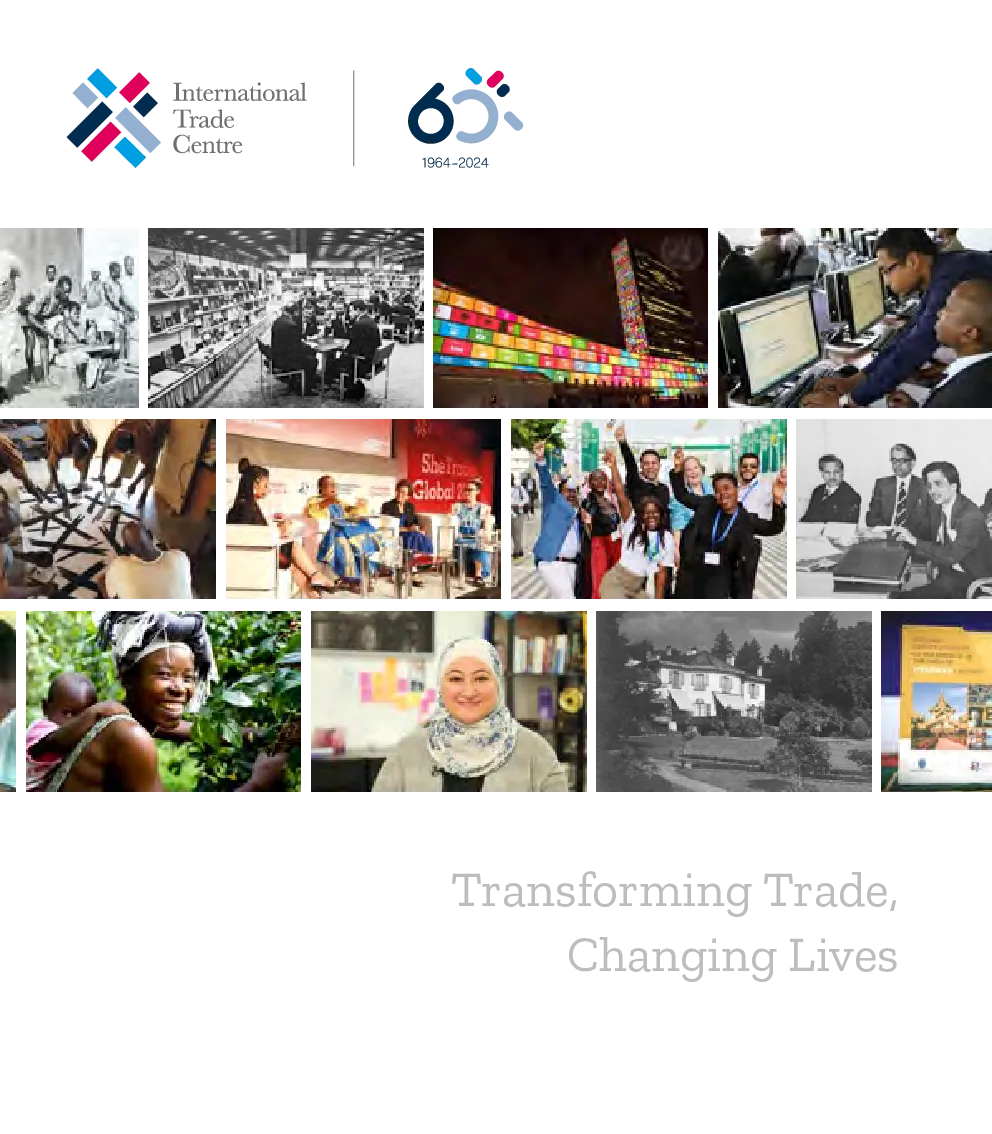
报告封面

Acknowledgements This publication was made possible thanks to the research and writing of Mallika Goel and SofiaBaliño, with research support from Elizabeth Martinez and Evelyn Seltier. Photo research andselection was by Laurena Arribat and design was by Kristina Golubic. Administrative support wasprovided by Faten Ghazal McKarris (all ITC). Transforming Trade,Changing Lives The International TradeCentre at 60 years Talkin’ Bout a Revolution Eighty years ago, the Bretton Woods Conference sought to chart a shared path forinternational economic governance, after two world wars in less than half a century hadlaid bare the need for a new paradigm. The event led to what we now know as the WorldBank Group and the International Monetary Fund, while making clear that an internationalinstitution governing global trade was both wanted and needed. A few years later, inOctober 1947, 23 contracting parties signed the Final Act of the General Agreement onTariffs and Trade (GATT). By 1964, the GATT had expanded to include nearly 60 countries. It was then evident thata rules-based trading system should entail more than just tariff ceilings and tariff cuts, asshown by the Kennedy Round’s expansion to cover topics such as dumping. Nonetheless,while the global rules of trade were emerging, the practice of trade was often hamperedby limited information about trade and market trends: exporters, despite their best efforts,were operating in the dark. That recognition led to the establishment of what is now theInternational Trade Centre in May 1964. Throughout the ITC’s 60-year history, we have sought to respond to the realities that peopleon the ground face in trade, operating on one central premise: to help developing countriesreap trade’s benefits to the fullest, through practical, export-focused interventions. Alongthe way, we crystallized our focus around the drivers of the global economy: micro, small,and medium-sized enterprises (MSMEs), while showing that economic growth must go handin hand with environmental sustainability, social inclusion, and intergenerational equity. But there is more to do. Trade has helped tackle global poverty, and developing economiesare increasingly capturing a greater share of global exports, but this remains a harderproposition for least developed countries, small island developing states, landlockeddeveloping states, small and vulnerable economies, countries in armed conflict or at riskof lapsing or relapsing into conflict, and sub-Saharan Africa. Too many countries stillconcentrate their exports on a handful of commodity sectors, while value addition, economicdiversification, and economic integration remain very challenging to put into practice. Thepast few years, with the unending stream of crises from COVID-19 to conflicts to climatechange-induced disasters, have also shown how quickly decades of hard-won progress canbe undone. These are major challenges, but what ITC has learned over 60 years in operation is that wemust, together, transform trade if we are to change lives for the better. This new publicationprovides a visual journey through that history. It demonstrates that a revolution in how wethink about trade isn’t just on some distant horizon, but is already underway, as shownthrough the lessons that have emerged from ITC’s work putting small businesses first. We’ve learned what makes interventions work: for instance, we know that “helicopter”technical assistance is a recipe for failure. Local institutions, including governments,business support organizations, and the private sector, must be in the drivers’ seat if we areto see change that lasts, and that means that they need the capacity to design and deliverthat change. Development partners and international agencies have an important role toplay, but these efforts must be coordinated and reflect local realities and priorities. We’ve seen why human capital and other forms of soft infrastructure matter, as that iswhere the real growth potential lies. We’ve experienced how partnerships, includingbetween public and private actors, allow for developing the most effective interventions,drawing on our collective strengths. We’ve learned why finance, a major challenge for smallbusinesses, and even more so for those led by women, youth, and vulnerable populations,must become more affordable and easier to access and use. We’ve understood that one ofthe biggest challenges developing countries face involves capacity constraints, and that’swhere we need to channel more of our efforts. The trading system’s postwar paradigm was a start in the right direction, albeit an imperfectone. Now, we need a new paradigm fit for the 21stcentury. It’s not enough to look atenvironmental sustainability, digital connectivity, social inclusion, regional integration, oreconomic growth in their own individual corners: we must work holistically if we are to charta better future for trade-led development. We also cannot risk letting these ideas remainso