市场动态与投资策略分析
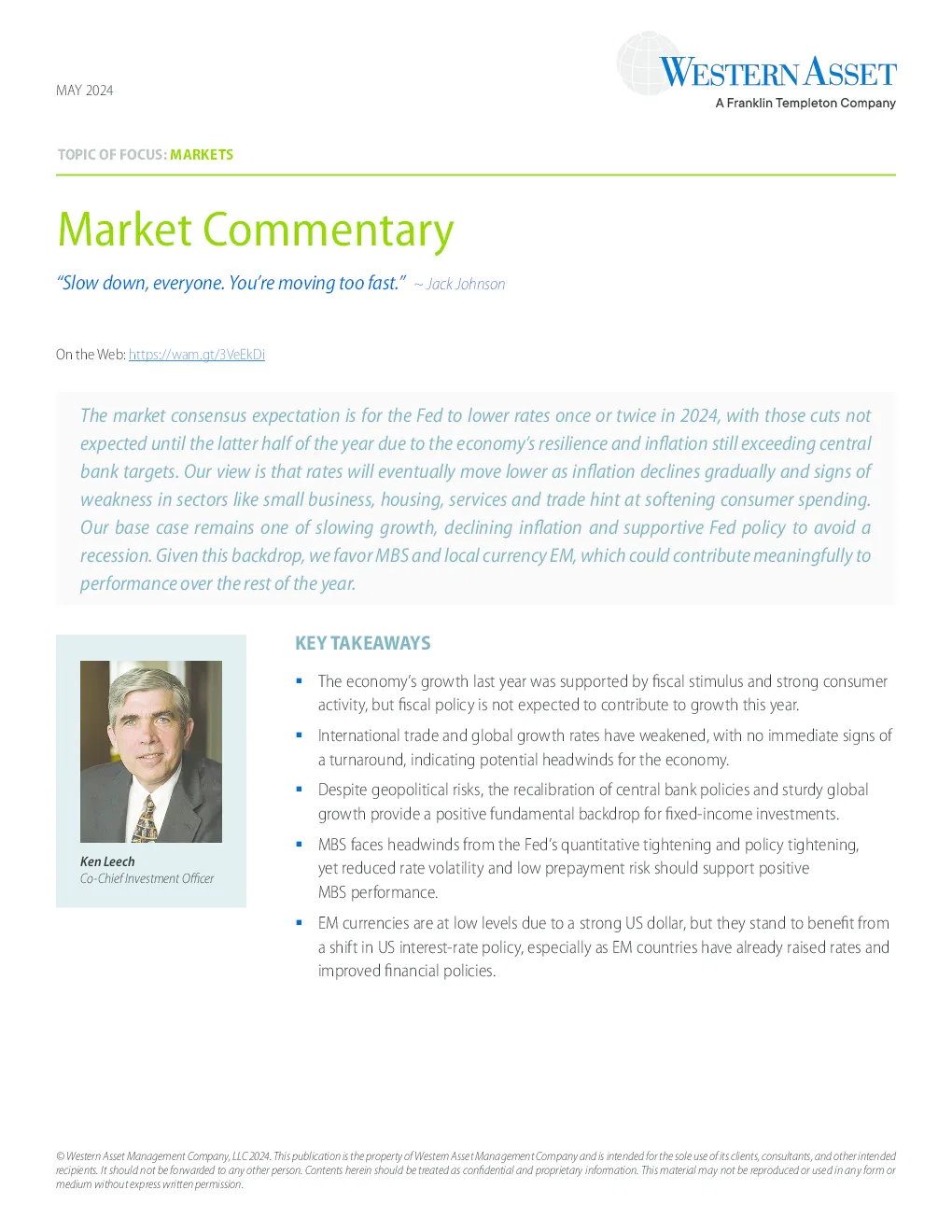
“Slow down, everyone. You’re moving too fast.”~ Jack Johnson On the Web:https://wam.gt/3VeEkDi The market consensus expectation is for the Fed to lower rates once or twice in 2024, with those cuts notexpected until the latter half of the year due to the economy’s resilience and inflation still exceeding centralbank targets. Our view is that rates will eventually move lower as inflation declines gradually and signs ofweakness in sectors like small business, housing, services and trade hint at softening consumer spending.Our base case remains one of slowing growth, declining inflation and supportive Fed policy to avoid arecession. Given this backdrop, we favor MBS and local currency EM, which could contribute meaningfully toperformance over the rest of the year. KEY TAKEAWAYS The economy’s growth last year was supported by fiscal stimulus and strong consumeractivity, but fiscal policy is not expected to contribute to growth this year.International trade and global growth rates have weakened, with no immediate signs ofa turnaround, indicating potential headwinds for the economy.Despite geopolitical risks, the recalibration of central bank policies and sturdy globalgrowth provide a positive fundamental backdrop for fixed-income investments.MBS faces headwinds from the Fed’s quantitative tightening and policy tightening,yet reduced rate volatility and low prepayment risk should support positiveMBS performance.EM currencies are at low levels due to a strong US dollar, but they stand to benefit froma shift in US interest-rate policy, especially as EM countries have already raised rates andimproved financial policies. Ken LeechCo-Chief Investment Officer Market Commentary By Ken Leech, Co-Chief Investment Officer The new market mantra is “higher for longer.” Prevailing market and Federal Reserve (Fed) sentiment is that withthe economy’s resilient growth persisting this year and inflation still above the Fed’s target, the Fed may cut policyrates just once or twice and those cuts are now not expected until well into the second half of the year. Our viewhas been that with the uneven but steady diminution in inflation, the more important takeaway is that rates willultimately move downward even if the timing remains uncertain. Moreover, as the inflation picture clears, the outlookfor spread sector outperformance versus Treasuries remains favorable. Our strong suspicion is that growth is likelyto slow over the balance of the year. In conjunction with falling inflation, this may allow the Fed to cut rates sooner. The inflation picture remains one of a bumpy path toward lower levels. Interestingly, the economy’s trajectory alsosuggests a bumpy path toward lower levels. The US economy grew 3.10% last year. This was helped by additionalfiscal stimulus and a vibrant consumer. This year, that picture is changing. Fiscal policy will no longer be additiveto growth. The current narrative suggests that with unemployment low, and with housing and stock prices high,consumer spending should remain robust. Additionally, the high-tech sector continues to boom and corporateprofits remain healthy. But there are cautionary signs developing on the other side of the ledger. Exhibits 1-4 display some sectors of theeconomy that are sluggish—small business, housing, the service sector and international trade. Small business sentiment continues to decline. The “locked-in” housing market suggests housing starts will remainmodest and will not be a source of growth. After the post-Covid boom in service spending, activity in this sector isslowly waning. International trade has weakened from healthy pre-Covid growth rates. Global growth has alreadydownshifted, suggesting that a turnaround should not be expected. “Our base caseremains oneof below-trendgrowth, fallinginflation andaccommodativeFed policyto forestall arecession.” Furthermore, we continue to look for consumer retrenchment, and recent data as well as anecdotal evidencesuggests this may already be starting. Our base case remains one of below-trend growth, falling inflation and ac-commodative Fed policy to forestall a recession. Today’s favorable backdrop should provide a cushion to a benigndownshift in growth. But lower interest rates are part of that transition as well. Source:Bloomberg,Wells Fargo, US Census Bureau. As of 30 Apr 24. Source:Bloomberg,Institute for Supply Management. As of 30 Apr 24. “Resilient growth,lower inflation andpotential rate cutshave provided apowerful tailwindfor sectorperformancethis year.” On the sector front, the broad-based outperformance is shown in Exhibit 5. Resilient growth, lower inflation andpotential rate cuts have provided a powerful tailwind for sector performance this year. Notably, the only two sectorsto have underperformed have been mortgage-backed securities (MBS) and local currency emerging markets (EM).Both these sectors enjoyed vibrant returns in the fourth quarter of last year as Treasury rates fell. But the softening