您的浏览器禁用了JavaScript(一种计算机语言,用以实现您与网页的交互),请解除该禁用,或者联系我们。[Gartner]:2023年中国数据、分析和人工智能的炒作周期报告 - 发现报告

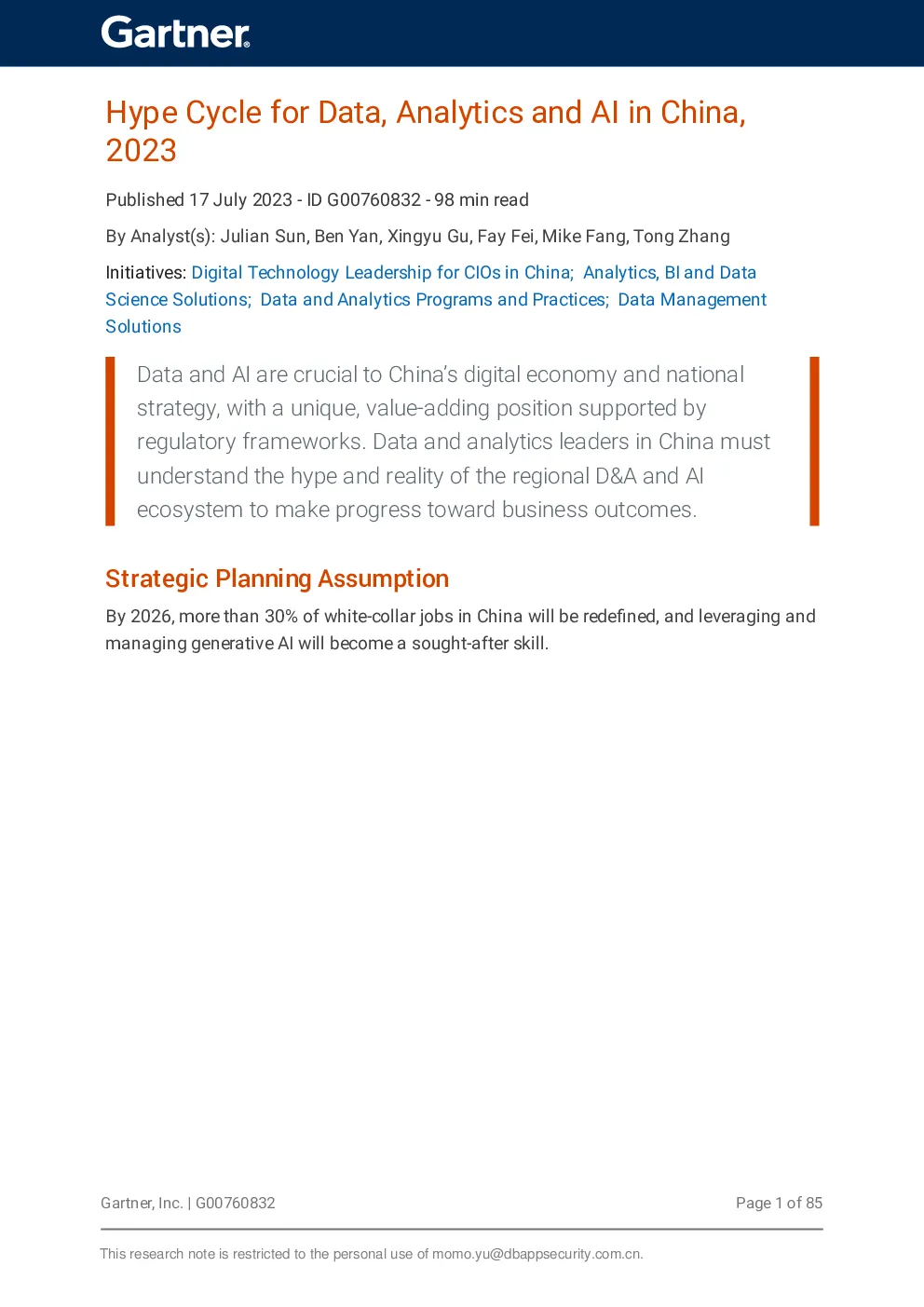
2023年中国数据、分析和人工智能的炒作周期报告

信息技术2024-01-18-Gartner张***
AI智能总结
查看更多
2023年中国数据、分析和人工智能的炒作周期报告

Hype Cycle for Data, Analytics and AI in China,2023 Published 17 July 2023 - ID G00760832 - 98 min read By Analyst(s): Julian Sun, Ben Yan, Xingyu Gu, Fay Fei, Mike Fang, Tong Zhang Initiatives: Digital Technology Leadership for CIOs in China; Analytics, BI and DataScience Solutions; Data and Analytics Programs and Practices; Data ManagementSolutions Data and AI are crucial to China’s digital economy and nationalstrategy, with a unique, value-adding position supported byregulatory frameworks. Data and analytics leaders in China mustunderstand the hype and reality of the regional D&A and AIecosystem to make progress toward business outcomes. Strategic Planning Assumption By 2026, more than 30% of white-collar jobs in China will be redefined, and leveraging andmanaging generative AI will become a sought-after skill. Analysis What You Need to Know Data, analytics and AI in China exhibit many similarities with the global market, but alsopossess unique differentiations in organizational structure, technology focus and valueproposition. In the digital economy era, data, analytics and AI serve as the foundation ofevery organization’s strategy to drive outcome-first investment. Today, data and analytics(D&A) industry best practices tend to align with China’s regulations on data, privacy and AI— even more so than those set in the U.S. or the EU. Despite numerous inflated expectations within this space, there are very few D&A and AIinnovations that have reached a plateau of technology maturity. This Hype Cycle primarilyfocuses on the hype surrounding emerging data, analytics and AI technologies andtechniques that have varying degrees of commoditization. It also addresses theoperationalization of these techniques to create systems that transcend everyday D&Aand AI, as well as the impact of these innovations on people and processes within andbeyond an enterprise context. D&A leaders in China must leverage this research to understand and utilize technologiesthat offer high impact in the present and prepare their strategy for the future. In addition to this Hype Cycle, D&A leaders should consult the following Hype Cycles inadjacent areas: Hype Cycle for ICT in China, 2023■Hype Cycle for Smart City and Sustainability in China, 2023■Hype Cycle for Security in China, 2022■ Together, these four Hype Cycles analyze the elements required for technology CIOs inChina to form a holistic view of the data and analytics ecosystem. The Hype Cycle Data, analytics and AI have consistently been identified as the top investment priorities forChina’s CIOs and are at the forefront of the national strategy supported by the Chinesegovernment. Meanwhile, China’s regulations on data, privacy, and AI are causing concernsamong technology executives across the spectrum. The most crowded part of the Hype Cycle is toward the Peak of Inflated Expectations.Innovations are often hyped as solutions to traditional bottlenecks. The expectation isthat they will demonstrate clear business value by addressing hardware resource scarcity,scalability, sustainable operationalization, security risk mitigation, technology self-sufficiency and multidomain applicability of AI models — all common concerns of CIOs inChina. From the end-user perspective, there is a heightened emphasis on tangible impactrather than abstract strategic concepts. Amid the hype: The concept of data middle office — a highly touted practice among Chineseorganizations — has fallen into the Trough of Disillusionment. Many organizationsand vendors are either shying away from adopting this concept internally orremoving it from their branding altogether.■ Data asset management is a transformative and distinctive practice that anchorsthe digital economy in Chinese organizations, enabling them to effectively articulateand deliver the value of D&A initiatives.■ The Chinese market exhibits a particular enthusiasm for generative AI and largelanguage models (LLMs). However, end users exhibit relatively lower confidence inthe model-centric approach to homegrown LLMs while favoring data-centric orapplication-centric approaches for adopting generative AI. This is particularly due toChina’s lagging ability to produce homegrown AI chips quickly, and Chinesecompanies remain in the early stages of designing AI chips compared with globalvendors such as NVIDIA.■ The innovations featured on the Hype Cycle demonstrate a converged and composabledata, analytics and AI ecosystem in China, categorized into four main areas: Analytics and data scienceincludes augmented data and analytics, citizen datascience, composable D&A, data middle office, federated machine learning,knowledge graphs and self-service analytics.■ Artificial Intelligenceincludes AI engineering, causal AI, decision intelligence,foundational models, generative AI, homegrown AI chips and responsible AI.■ Data managementincludes data classification, data fabric, DBMS self-sufficiency,lakehouse and real-time data management.■ Gar